

 2 hours ago
7
2 hours ago
7
ARTICLE AD BOX
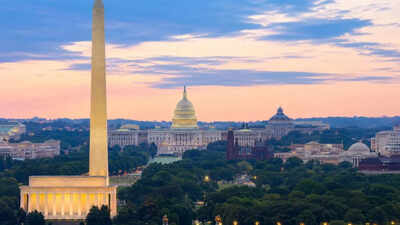
It is easy to treat Washington, D.C., as something fixed on the map, as if it simply appeared already named and arranged around the Potomac. But the label itself, the combination of Washington and Columbia, was not an accident or a single decision made in one sitting.
It came from a sequence of political bargains, personal influence, and a fairly deliberate attempt to anchor a new nation’s capital in symbolism as much as geography.At the time, the United States was still shaping its identity, and naming carried weight in a way that feels almost theatrical now. Places were not just labelled for convenience. They were statements. Washington, D.C., sits in that tradition, carrying two references in a single title, neither of them casual.
One point to a general who became president, George Washington. The other reaches back to a figure Europeans associated with the idea of the “New World”, Christopher Columbus.
How Washington helped choose the capital location
The idea of a federal capital separate from individual states was not universally agreed upon in the early years of the United States. There was suspicion, particularly among smaller states, that a capital located inside one state would tilt the influence in that direction.
So the solution that emerged was awkward but practical: carve out a neutral district.That district would not belong fully to Maryland or Virginia, even though both contributed land. It would be administered by Congress itself. This arrangement was less about elegance and more about preventing political friction from derailing the young republic.When the Residence Act of 1790 was passed, it gave the then-president, George Washington, the authority to select a site along the Potomac River.
The choice was not random. The area was already familiar to Washington, who had spent much of his life in Virginia, and it sat at a kind of geographic midpoint between northern and southern states.What followed was a slow transformation of riverside farmland into a planned seat of government. The land was not empty, nor was it neatly organised. It contained small settlements, estates, and working farms that were gradually absorbed into the design of a capital that did not yet exist in physical form.
The early design of America’s capital city
Once the site was chosen, the task of turning it into a capital fell to planners and surveyors who had to translate political instruction into geometry. Among them was the French-born planner Pierre Charles L’Enfant, whose vision would leave a lasting imprint on the city’s layout.L’Enfant’s design was not subtle. It used broad avenues crossing at angles, open spaces, and focal points intended for future monuments.
The idea was partly aesthetic and partly symbolic. At the time, the site was still referred to in loose terms. “Federal City” was used informally, a placeholder more than a name. Streets were being sketched while the political identity of the place was still under discussion. There was no certainty that the plan would even hold in its original form, given how often early American projects changed direction.What is now known as Washington, D.C. was still just a drawing, with landowners negotiating boundaries and surveyors working around existing roads and waterways.
The shape of the capital existed first as a concept on paper, long before it became something anyone could recognise on the ground.
How Washington shaped the name “Columbia” in the capital
The second half of the name, “Columbia”, is often overlooked, partly because it sounds decorative rather than political. It was drawn from a common 18th-century poetic name for the Americas, derived from Christopher Columbus. In European and early American writing, “Columbia” was used as a symbolic stand-in for the continent itself.At the time, attaching classical or symbolic references to new places was common practice. It gave unfamiliar territories a sense of narrative weight. “Columbia” was meant to evoke discovery, even though that interpretation now sits uneasily with modern understanding of history. So the district became “District of Columbia”, pairing geographic function with symbolic identity. The capital of the United States effectively carries a double identity: one half administrative, the other historical and symbolic, both layered into everyday usage without much reflection on how artificial the combination once was.
From Federal City to Washington, D.C.
Although George Washington did not personally coin the name in a formal sense, his influence is difficult to separate from the outcome. The capital was established during his presidency, and his authority shaped decisions about location and governance.There was also a degree of political sensitivity around his involvement. Washington owned property in the region, particularly in Virginia, which meant planners had to be careful to avoid accusations of personal benefit.
This led to restrictions on federal construction in certain areas, reflecting how even practical decisions were filtered through concerns about fairness and perception.The name “Washington” for the city itself emerged as a way to honour his role in establishing the nation’s framework. It was not unusual at the time for cities to be named after prominent figures, but attaching a sitting president’s name carried a different weight.Still, the full phrase “Washington, District of Columbia” was not something that appeared fully formed. It evolved through official correspondence and administrative usage. Early references sometimes alternated between “Federal City” and “Washington City”, with “District of Columbia” referring to the broader federal territory.
How Washington D.C. got its final name
Before “Washington, D.C.” became standard usage, there was a period where terminology shifted depending on context.
The term “Federal City” was commonly used in early planning discussions, reflecting the idea that this was not simply a city like others, but a seat of national governance.The design work of Pierre Charles L’Enfant contributed to how the space was understood. His plans emphasised ceremonial routes and government buildings placed in relation to one another, reinforcing the idea that the city itself was part of statecraft.
As buildings began to rise and institutions moved in, the need for a consistent name became more practical. Administrative documents gradually settled on combinations of “Washington” and “District of Columbia”, which eventually shortened in common speech to “Washington, D.C.
”.The abbreviation itself feels modern, but it emerged from necessity rather than branding. Officials needed a way to distinguish between the city and the wider federal district, especially as governance structures expanded.
The 1871 reorganisation of Washington D.C.
For much of the early 19th century, the area was not managed as a single unified entity. It consisted of different jurisdictions, including land originally ceded by Maryland and Virginia. This created administrative complexity that persisted for decades.Reportedly, in 1871, Congress passed legislation that reorganised the district into a single municipal government. This did not change the name, but it did alter how the area functioned in practice.
From that point, “District of Columbia” referred more clearly to one consolidated jurisdiction rather than a collection of loosely connected settlements.The name itself, however, remained unchanged, partly because it had already become embedded in legal and political usage. By then, “Washington, D.C.” had entered official documents, maps, and public speech.
How the name settled into everyday use
Over time, the full formal name became less important than its shortened form.
“Washington” was used when referring to the federal government, while “D.C.” distinguished it from other places named Washington across the United States.What began as a layered administrative label gradually turned into something more familiar. The combination of a president’s name and a symbolic reference to the Americas gave the capital a title that feels fixed, even though it was assembled through compromise and evolving usage.Today, the structure of the name still reflects its origins. One part honours a founding political figure, George Washington. The other preserves an older symbolic language tied to Christopher Columbus. Between them sits a district that was once a patchwork of land purchases and planning exercises, gradually becoming the administrative centre of the United States.What remains striking is how unplanned the final name feels when traced back. It does not read like a carefully designed brand. It reads more like a record of decisions made at different moments, each one leaving a small mark on what would eventually become Washington, D.C.








 English (US) ·