

 12 hours ago
5
12 hours ago
5
ARTICLE AD BOX
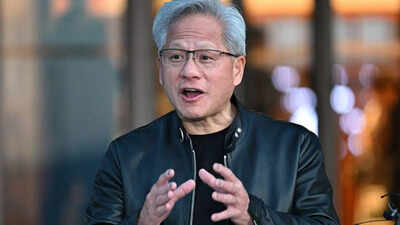
Long before he became the chief executive of Nvidia, the company powering much of today's artificial intelligence boom, Jensen Huang was a nine-year-old boy in rural Kentucky, cleaning toilets at a school his family had never actually meant to send him to.
Huang has spoken about this period many times over the years, and the story has become one of the most retold parts of his biography. His parents, worried about political instability in Southeast Asia at the time, sent Jensen and his older brother to live with an uncle in Tacoma, Washington. The uncle, believing he was placing the boys in a prestigious boarding academy, instead enrolled them at the Oneida Baptist Institute in Kentucky, a religious reform school built for troubled children.
What followed were two hard years that Huang now credits with shaping much of who he became.
Jensen Huang's early life
According to Nvidia's official newsroom biography, Huang was born in Taiwan in 1963. As per Britannica's biography of Huang, when he was around five years old, his family moved to Thailand, where his father worked in the oil refinery business. Britannica also reports that as political instability grew in Southeast Asia during the early 1970s, Huang's parents decided not to settle permanently in Thailand and began looking for a way to get their sons to the United States instead.
According to reports, that plan led Huang's parents to send Jensen and his older brother to stay with an uncle in Tacoma, Washington. The same Britannica biography states that the uncle then enrolled the boys at the Oneida Baptist Institute in rural Kentucky, mistakenly believing it was a prestigious boarding school rather than what it actually was, a religious reform academy for children considered difficult to manage.
Life at the boarding school
As per a December 2025 Benzinga report on Huang's own recollections, he was nine years old when he arrived at Oneida and was the youngest student on campus, and he was assigned to clean the toilets every day while his older brother worked on a nearby tobacco farm as part of his own chores. The same Benzinga report cites a 2022 interview Huang gave to Stratechery, in which he said the school was affordable and that "everybody had chores," adding that at the time it never occurred to him that the work was unusually hard.Life at Oneida was far from gentle. According to Britannica's biography, Huang and his brother faced regular bullying from older students, including ethnic slurs and, at times, threats involving knives. Britannica also notes that Huang has said the environment forced him to grow up quickly and taught him to handle discomfort without complaint, something he has referred to in later interviews as one of the more useful lessons of his early life.
A family reunited in America
According to Britannica, about two years after the brothers arrived at Oneida, their parents finally reached the United States from Thailand, and once they understood the true nature of the school, they removed Jensen and his brother from Oneida. The same Britannica biography states that the family then settled together near Portland, Oregon, where Huang attended Aloha High School and became a competitive table tennis player.Huang went on to earn a bachelor's degree in electrical engineering from Oregon State University in 1984, before completing a master's degree in the same subject at Stanford University in 1992, studying part-time while already working full-time in the semiconductor industry.
Building a career in technology
According to Nvidia's official newsroom biography, before starting Nvidia Huang worked at Advanced Micro Devices and later at LSI Logic.
Britannica's biography adds further detail, stating that Huang spent about a year at AMD as a chip designer before moving to LSI Logic, where he rose through the ranks and eventually became director of one of the company's chip divisions.Nvidia's official biography states that Huang co-founded the company in 1993 along with Chris Malachowsky and Curtis Priem. The three had worked together at Sun Microsystems and LSI Logic, and they worked out their early plans for the company at a Denny's diner in San Jose, starting with about 40,000 dollars between them.The company's early years were far from smooth. According to Britannica, Nvidia came close to running out of money more than once before its graphics chips found a foothold, first in PC gaming and later in far broader fields such as scientific computing and self-driving cars. In more recent years, according to Nvidia's own newsroom statements, those same processors have become central to training and running large artificial intelligence models, a shift that has turned Nvidia into one of the most valuable companies in the world.
Lessons Huang has shared from his childhood
Huang often returns to his time at Oneida when speaking about leadership and resilience, whether at company events, university talks or in interviews with journalists and podcast hosts. As per the Benzinga report on his 2022 Stratechery interview, he has said the experience of doing unglamorous, physical work at a young age stayed with him well beyond childhood.He has also spoken, according to the same Benzinga report, about how being placed in a difficult situation without warning taught him to adapt quickly rather than wait for ideal conditions, a mindset he has said carried directly into how he approached Nvidia's toughest years as a young company.
Nvidia's rise in the age of artificial intelligence
Huang's personal story has drawn fresh attention as Nvidia has become one of the central companies of the AI era. According to Nvidia's own public statements, its chips are now widely used to train and run advanced AI systems, and demand has grown sharply as companies and governments invest heavily in AI infrastructure.Despite the company's scale today, Huang continues to reference his childhood when discussing how Nvidia has handled setbacks, describing the mindset built at Oneida as something that has stayed with him through decades of change in the technology industry, according to the interviews cited by both Britannica and Benzinga.
Why Jensen Huang’s story continues to resonate
Most stories about successful entrepreneurs focus on the big moments: funding rounds, product launches, record breaking valuations. Huang's story stands out because so much of it centres on what happened long before any of that, when he was a nine-year-old cleaning toilets at a school his family never meant to send him to.According to Nvidia's official biography, Britannica's profile of Huang, and the interviews cited by Benzinga, his childhood involved sudden independence, unfair treatment from other children and daily physical labour, none of which he had any say in as a boy.
He has never claimed that this guaranteed his later success, but he has consistently pointed back to it when explaining where his resilience came from.As Nvidia's role in artificial intelligence continues to grow, so has interest in the story behind the man running it. It remains a reminder that some of the most consequential careers begin in circumstances nobody would have chosen, shaped as much by hardship as by ambition.









 English (US) ·