

 1 hour ago
4
1 hour ago
4
ARTICLE AD BOX
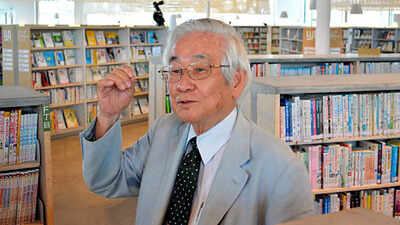
Toshihide Maskawa, 2008 physics laureate. (Getty Images)
You might think a future Nobel laureate would be the kid who always did his homework. Well… not quite. Toshihide Maskawa, 2008 Nobel Prize winner in physics, once shared on X (formerly Twitter) by (The Nobel Prize) that his mother begged his teacher, “Please give my son homework at least occasionally.”
The teacher replied, “Your son has never done his homework despite the fact that I give him homework every day!” Clearly, Maskawa’s school days were full of confusion, comedy, and a little chaos — yet those early struggles didn’t stop him from changing the world of physics.Despite this rough start, Maskawa had a secret weapon: curiosity. While other kids memorized facts from textbooks, he would ask why eclipses don’t happen every month or how three-phase motors actually rotate.
His teachers were baffled, but it was clear that he loved understanding the “why” behind things. Even with poor grades, Maskawa’s curiosity kept him engaged, and that spark would eventually fuel a career that changed the world of physics.The Power of Persistence in LearningHigh school didn’t motivate him much, but a newspaper article about Professor Shoichi Sakata’s particle theory changed everything. Maskawa realized that science wasn’t something finished in Europe in the 19th century — it was happening right in Nagoya, in his own backyard! This revelation lit a fire under him, and he worked tirelessly to prepare for Nagoya University’s entrance exam.
His father, who hoped he would join the family business, allowed him only one chance to succeed — and Maskawa did.University life was a whole new ballgame. He encountered lectures on mathematical analysis, Archimedes’ axioms, and Dedekind’s Cuts — concepts so abstract that they might as well have been magic spells. But instead of giving up, Maskawa dove headfirst. He explored chiral symmetry, current algebra, and even voluntary experiments on neural networks.
He described these early experiments as “etudes for a physicist, just as painters draw variations of changing poses.
” In other words, every failure, every calculation, was practice — and persistence paid off.Turning Curiosity into Nobel-Winning DiscoveriesThe real breakthrough came years later, when Maskawa and his collaborator Makoto Kobayashi tackled CP violation, a complex puzzle in particle physics.
Their work was not straightforward — it involved months of calculations, countless dead ends, and even moments of frustration in the bathtub (yes, literally!). Maskawa once wrote that he almost gave up on the four-quark model, planning to publish a “negative paper,” only to realize that the six-quark model could explain CP violation.
That single insight, born from persistence and curiosity, eventually earned them the 2008 Nobel Prize in Physics.Maskawa’s story shows that early struggles — missed homework, confusion, and even setbacks — don’t define success. They are part of the journey. Curiosity, paired with persistence, can turn a “struggling student” into a Nobel laureate, proving that learning is a marathon, not a sprint.Takeaway for StudentsSo, the next time you’re staring at an impossible homework problem or feeling left behind in class, remember Toshihide Maskawa. Early struggles are not the end of the story — they’re just the prologue. With curiosity, persistence, and a little bit of creative thinking, even the most unexpected setbacks can lead to groundbreaking discoveries. And who knows? Maybe one day, your “failed homework” will be the spark for your own remarkable success story.






 English (US) ·