

 5 days ago
15
5 days ago
15
ARTICLE AD BOX
The investigation found that Sajid Jatt, alias Saifullah Sajid and Habibullah Tabassum, has been hiding in Pakistan, frequently changing his identity, location, and appearance to avoid detection and capture.
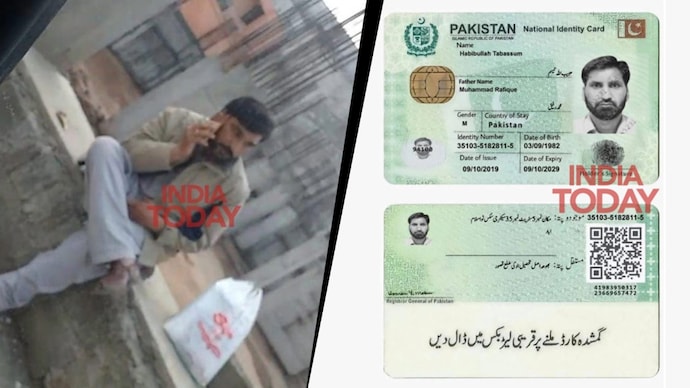
Pahalgam terrorist attack mastermind Sajid Jatt alias Habibullah Tabassum as seen talking over phone (left) from his safehouse in Pakistan's Kasur and his Pakistan identity card (right).
New Delhi,UPDATED: Apr 21, 2026 14:24 IST
A year after the deadly terror attack in Jammu and Kashmir’s Pahalgam, a detailed investigation by India Today TV has uncovered fresh evidence identifying the mastermind behind the assault and tracing his links to Pakistan. The probe reveals that Sajid Jatt, also known as Saifullah Sajid and Habibullah Tabassum, has been hiding in Pakistan while continuously altering his identity, residence, and physical appearance to evade detection.
The attack on April 22, 2025, carried out in the Baisaran Valley of Pahalgam, saw four to five heavily armed terrorists open fire on civilians after allegedly identifying their religion, killing 26 people.
The case has since been investigated by the National Investigation Agency (NIA), which recently filed an extensive charge sheet running into thousands of pages.
In the document, Sajid Jatt is named as the key conspirator and a "most wanted" operative linked to Lashkar-e-Taiba and its proxy outfit, The Resistance Front (TRF), whose operatives carried out the dastardly attack on innocent civilians.
Building on the NIA’s findings, India Today TV’s investigation has established that Sajid Jatt’s real identity is Habibullah Tabassum.
During the investigation, multiple pieces of evidence, including a Pakistani national identity card, photographs of his residence, and visuals showing him speaking on a mobile phone inside a safe house have been accessed.
According to the documents accessed, Tabassum was born on March 23, 1976, and is a resident of Bhoy Asal village in Pattoki tehsil of Kasur district in Pakistan.
The identity card, issued in 2015, lists his father’s name as Mohammad Rafiq.
Investigators note that Kasur has long been associated with individuals linked to Lashkar-e-Taiba, reinforcing suspicions of institutional support networks.
India Today TV also reported obtaining visuals of Tabassum’s house in Kasur, which is located in a narrow residential lane.
The footage is presented as evidence of his Pakistani roots and operational base.
Additional images reportedly show him inside a safe house in Rawalpindi, where he is seen maintaining a low profile, dressed in ordinary clothing and using a basic keypad phone.
Intelligence sources cited in the investigation suggest that Tabassum frequently shifts locations between cities in Pakistan, including Islamabad and Rawalpindi, often using safe houses allegedly linked to the Inter-Services Intelligence (ISI).
He is said to have lived in highly secured areas, including Islamabad’s G-6 sector, and to have been relocated multiple times over the past few years.
The investigation also highlights discrepancies in his identity records. While his earlier identity card lists his birth year as 1976, a later card issued with an Islamabad address reportedly shows a different birth year, suggesting deliberate attempts to obscure his identity.
Officials believe Tabassum has long been active in orchestrating attacks in Kashmir and has maintained direct contact with militants on the ground.
The NIA’s findings indicate he was in communication with the attackers involved in the Pahalgam incident, directing operations remotely.
Known for his ability to change his appearance, Tabassum is described by intelligence agencies as highly elusive. He reportedly uses multiple aliases, including "Salim Langda," a name derived from a limp he developed after being injured in a past encounter with security forces.
Sources further claim that he is currently under threat from unidentified assailants targeting high-value terrorist figures within Pakistan. This has forced him into an even more covert lifestyle, relying on constant movement and disguise.
The investigation also underscores his close coordination with senior Lashkar-e-Taiba operatives and alleged links with Pakistani intelligence officials.
He is believed to have been appointed as a key commander overseeing operations in Kashmir and has been associated with several major attacks in the region over the years.
India Today TV’s report presents its findings as evidence of a direct Pakistani connection to the Pahalgam attack. The combination of identity records, location details, and visual material is cited as proof of cross-border involvement in the planning and execution of the attack.
As the revelations emerge, the case is likely to intensify diplomatic and security concerns, with investigators continuing efforts to track down the mastermind and dismantle the network behind one of the deadliest civilian attacks in recent years.
THE ATTACK, THE RESPONSE, THE ENCOUNTER
Around four to five heavily-armed terrorists stormed Pahalgam's Baisaran Valley on April 22, 2025, killing 26 civilians. Among those dead were 25 tourists and one local pony operator. According to eyewitnesses, the TRF operatives asked the victims' religion before shooting them down.
After days of deliberations, India responded with Operation Sindoor on May 7, obliterating the Pakistani terrorist network and killing over 100 terrorists as it hit terror hideouts in PoK and mainland Pakistan. The strikes were followed by military hostilities over the next three days, before a ceasefire agreement was reached on May 10.
in July 2025, Indian forces eliminated all the terrorists involved in the April 22 attack, in an encounter carried out under Operation Mahadev. The operation was led by a joint team of the Army and J&K Police. Around 17 grenades, one M4 carbine and two AK-47 rifles were recovered from the hideout of the terrorists.
- Ends
Published On:
Apr 21, 2026 14:24 IST





 English (US) ·