

 1 hour ago
4
1 hour ago
4
ARTICLE AD BOX

Family history of heart disease in India is a growing concern, with cardiovascular issues causing nearly 24% of deaths and affecting younger individuals. Experts urge early screening in the 20s and proactive lifestyle changes, including diet, exercise, and stress management, to break the generational cycle and prevent silent damage before symptoms appear.
Heart disease rarely arrives without warning. In many families, it leaves a trail. A father who had a bypass at 52. An aunt who struggled with high blood pressure. A grandparent lost too soon.
When patterns repeat across generations, they tell a story.In India, that story is growing louder. According to a study published in the American Heart Association, cardiovascular diseases account for nearly 24 percent of all deaths in the country. The report shows that heart disease is affecting Indians at younger ages compared to many Western countries.Dr Ashish Agarwal, Director & Unit Head (Unit-1)- Cardiology , Aakash healthcare, told TOI Health, “Family history of heart disease means preventing the disease as early as possible, not after symptoms appear.
Risk of heart disease begins silently, usually decades earlier than symptoms appear; therefore, screening should begin in your 20s or 10 years before the youngest person in your family was diagnosed with a heart-disease, as soon as possible. Regular monitoring (e.g., blood pressure, cholesterol, blood sugar, and lifestyle) is part of an effective prevention strategy.
”When heart disease runs in the family, the question is not whether to act.
It is how early.
Why family history changes the clock
Family history is not just a detail on a medical form. It reflects shared genes, shared food habits, and shared lifestyles.Research supported by the National Institutes of Health explains that having a first-degree relative with early heart disease significantly increases personal risk.If a father or brother had heart disease before 55, or a mother or sister before 65, doctors consider that “premature” heart disease. That detail matters.
It suggests a stronger genetic role. But genes are not destiny. They load the gun. Lifestyle pulls the trigger.Dr Ashish Agarwal said, "Knowing about family history of heart disease/training can significantly reduce the risk of developing heart diseases, but you also need to adopt healthy lifestyle changes and/or to manage your weight properly, stay active, eat a proper diet, manage stress, and not smoke."

For individuals with a strong family history, doctors advise starting regular screening by the late 20s or early 30s.
India's Heart Health Crisis: Cardiologists Discusses Common Ailments And Why The Youth is Falling Victim
How early is “early enough”?
Waiting for symptoms is a mistake. Heart disease develops silently over years.For individuals with a strong family history, doctors advise starting regular screening by the late 20s or early 30s. That includes:
- Blood pressure checks at least once a year
- Lipid profile tests to measure cholesterol
- Blood sugar testing, especially if overweight
- Waist circumference tracking
The World Health Organization notes that raised blood pressure and high cholesterol are among the leading risk factors globally. Acting early means building awareness before damage begins.Dr Ashish stressed that, "Another reason for the need for preventive care is that if you do not take action to improve your health through preventive care, then you will not be able to track the warning signs of heart disease (e.g.,
high cholesterol or beginning vascular changes) until long after significant damage to your heart has occurred."
The silent signals many ignore
Heart risk does not always show up as chest pain.Persistent fatigue. Breathlessness during mild activity. Snoring with daytime sleepiness. Sudden weight gain around the abdomen. These changes are often brushed aside as “stress” or “age.”But in families with heart history, these small signs deserve attention.Routine health check-ups should not wait for a crisis. A simple ECG, echocardiogram, or stress test may be recommended if symptoms appear. Early detection reduces complications. That is not fear-based advice. It is preventive logic.
As the ancient Greek physician Hippocrates said, “Walking is man’s best medicine.” The line still holds true.
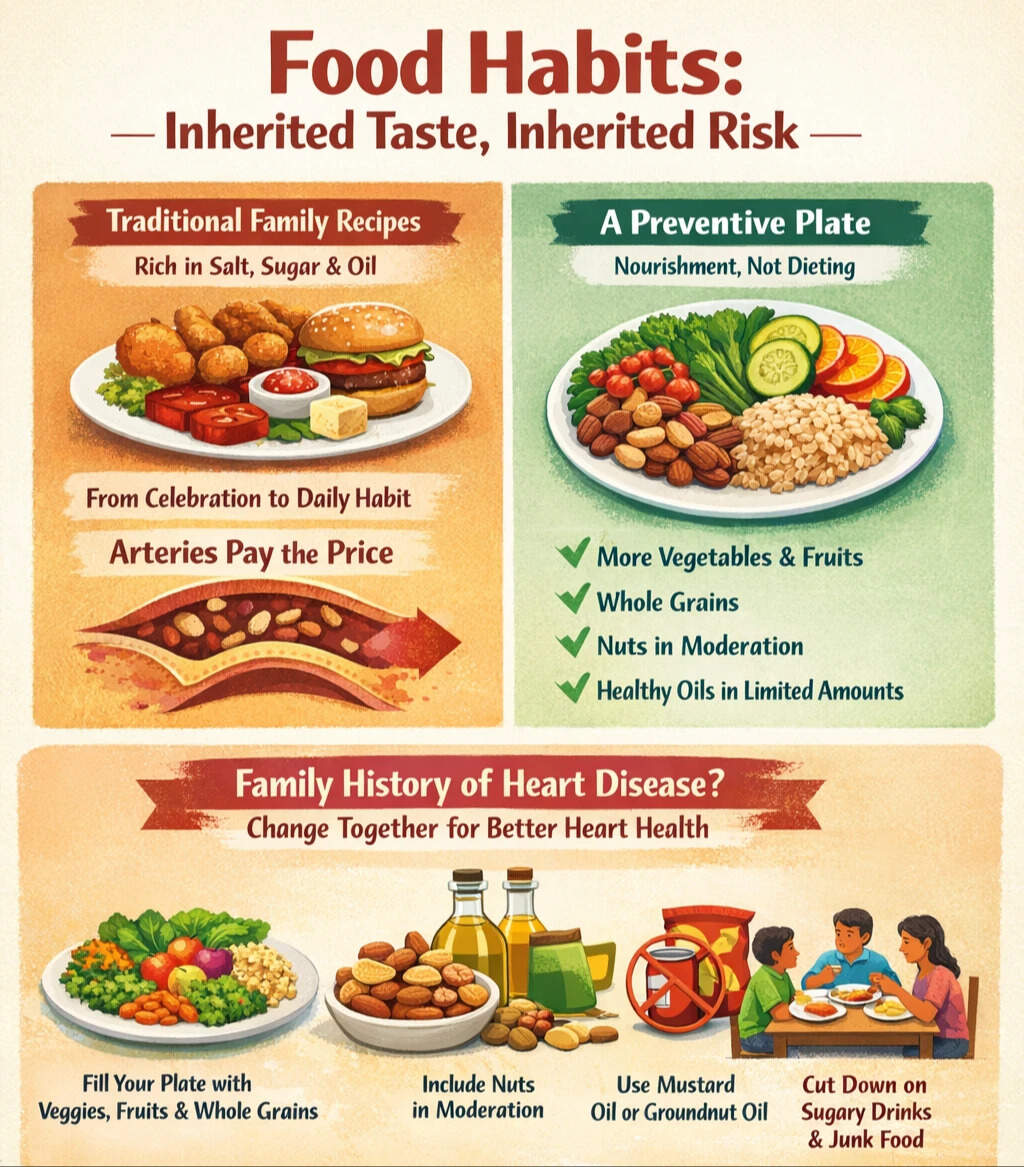
Food habits: Inherited taste, inherited risk
Many families pass down recipes rich in salt, sugar, and oil. Celebration foods become daily meals. Over time, arteries pay the price.A preventive plate looks different:
- More vegetables and seasonal fruits
- Whole grains instead of refined flour
- Nuts in moderate portions
- Mustard oil or groundnut oil in limited amounts
- Reduced packaged snacks and sugary drinks
The focus should not be on dieting. It should be nourishment.
A family history of heart disease is improved when the entire household changes eating habits together. Heart health improves when food is simple and consistent.
Movement as medicine, not punishment
Exercise is not about sculpted bodies. It is about strong vessels.The WHO recommends at least 150 minutes of moderate-intensity physical activity per week for adults. That equals about 30 minutes on most days. Walking briskly, cycling, swimming, or even dancing at home counts.For someone with a family history, consistency matters more than intensity.Strength training twice a week also helps manage insulin resistance and cholesterol levels. Small daily effort creates long-term protection.
Stress, sleep, and the invisible load
Many Indian households carry silent stress. Financial pressure. Work deadlines. Caregiving duties. Chronic stress raises blood pressure and fuels inflammation. Poor sleep worsens insulin resistance.Seven to eight hours of sleep each night is not indulgence. It is repair time. Managing stress through breathing exercises, prayer, meditation, or journaling lowers heart strain over time.Emotional patterns also pass through families. Breaking cycles of anger, silence, or neglect can protect the heart as much as diet can.
Medical partnership, not fear
Some people avoid doctors because of anxiety. Others rely only on home remedies.Dr Ashish explained further, "Many young people believe that because they feel fine, they do not need to have screenings done, but health promotion through preventive care is most effective before any damage has occurred.
Evidence of heart disease in your family is not just a genetic determinism; it could be seen as possibility, therefore through follow-up monitoring with lifestyle changes as necessary, you can disrupt the pattern of heart disease in your family.
"The right approach lies in balance. Regular consultations with a physician help track numbers. If cholesterol or blood pressure remains high despite lifestyle changes, medication may be necessary.
That is not weakness. It is prevention.Statins, antihypertensives, and blood sugar medicines have strong evidence when prescribed correctly. Ignoring rising numbers does not make them disappear. The goal is control, not panic.A family history of heart disease is not a curse. It is early information. And early information gives power.The most loving act may be to break the chain for the next generation. Children who grow up watching healthy food choices and active routines carry those lessons forward.A heart attack feels sudden. In reality, it builds silently over decades. Acting in the 30s can prevent regret in the 50s.The heart remembers how it was treated.Medical experts consulted This article includes expert inputs shared with TOI Health by: Dr Ashish Agarwal, Director & Unit Head (Unit-1)- Cardiology , Aakash healthcareInputs were used to explain how a family history of heart disease increases personal risk, when individuals should begin early screening, and why timely lifestyle changes and medical consultation are essential for prevention.









 English (US) ·