

 52 minutes ago
5
52 minutes ago
5
ARTICLE AD BOX
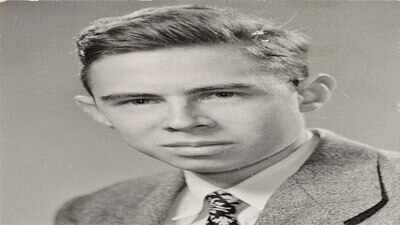
Frank Rosenblatt, the American psychologist and computer scientist who introduced the Perceptron in 1958, laying the foundation for modern artificial neural networks. Image Credits: Wikimedia Commons
The use of artificial intelligence has radically transformed the way the computer understands reality. It has given rise to such phenomena as facial recognition, analysis of images in medicine, driverless cars, and visual search.
However, although very complicated, all these innovations have originated from something much simpler.Namely, in 1958, an American psychologist and computer scientist, Frank Rosenblatt, introduced his invention named the Perceptron at the Cornell Aeronautical Laboratory in Buffalo, New York. The development was funded by the United States Navy. It was an important step forward, as it showed that the computer is not only able to follow pre-programmed instructions but can also learn from experience and improve.
The Perceptron itself was capable of doing only simple things. Still, it was the foundation for machine learning, which eventually gave rise to artificial neural networks and computer vision.The machine that learned from examplesBefore the emergence of the Perceptron, computers functioned mostly based on explicit programming. It required setting up firm rules for each task that limited opportunities for adaptation to new data from the machine side.
This time, the scientist suggested something totally new. Inspired by neurons' work, he developed a model that could alter its own settings based on example-based learning. In its first public demonstration in 1958, the Perceptron used an IBM 704 computer and punch cards to identify the difference between cards marked on the left side and those marked on the right.
While the task may seem rather easy now, it was one of the first demonstrations of machine self-adjustment to new data through training rather than only predefined programming.People's interest in the invention was caused by its implication that it might be possible someday for machines to recognise patterns and objects and make decisions independently. Rosenblatt defined the Perceptron as a system capable of perceiving and recognising its surrounding environment due to its learning capacity. While the goals were beyond what the technology of the time could achieve, this invention fundamentally changed how people viewed artificial intelligence research.
It is often seen as a key step toward machine capabilities based on data analysis rather than just programmed algorithms.A study on Perceptron Theory Can Predict the Accuracy of Neural Networks identifies the Perceptron as the ancestor of modern artificial neural networks, explaining that its learning process relied on adjusting numerical weights based on labelled examples. The study argues that this principle remains central to contemporary machine learning, where neural networks continuously refine internal parameters during training to improve prediction accuracy.
While today's AI models contain millions or even billions of parameters, they still follow the same fundamental concept first demonstrated by Rosenblatt's machine in 1958.From a simple classifier to modern computer visionAlthough the original Perceptron introduced several groundbreaking concepts, it suffered from several significant limitations. Firstly, it was not capable of dealing with more complicated classifications. These drawbacks came to wide attention in the late 1960s; therefore, people doubted whether neural networks would ever meet the expectations they raised.
Nevertheless, the core idea of the Perceptron never died; on the contrary, it inspired many scientists, who invented multi-layer neural networks that could get around the disadvantages of the initial Perceptron.One contribution of the Perceptron was showing that visual recognition could be achieved by learning from examples. Instead of programming computers to identify every possible feature manually, researchers increasingly focused on training systems using large collections of labelled images.
This approach helped shape modern computer vision, enabling AI to recognise faces, classify medical scans, detect objects in autonomous vehicles, and interpret satellite imagery.
Although today's convolutional neural networks are vastly more sophisticated than Rosenblatt's original design, they inherit the same underlying philosophy: machines improve by learning patterns from data.A brief review on Deep Learning for Computer Vision describes the Perceptron as one of the major historical milestones that paved the way for deep learning and image recognition.
The review notes that while the Perceptron itself could not perform modern visual tasks, it established the conceptual framework that later researchers expanded into advanced neural-network architectures. In hindsight, Rosenblatt's invention did not solve computer vision; it helped make the field possible by demonstrating that machines could learn to classify patterns through experience rather than explicit programming.
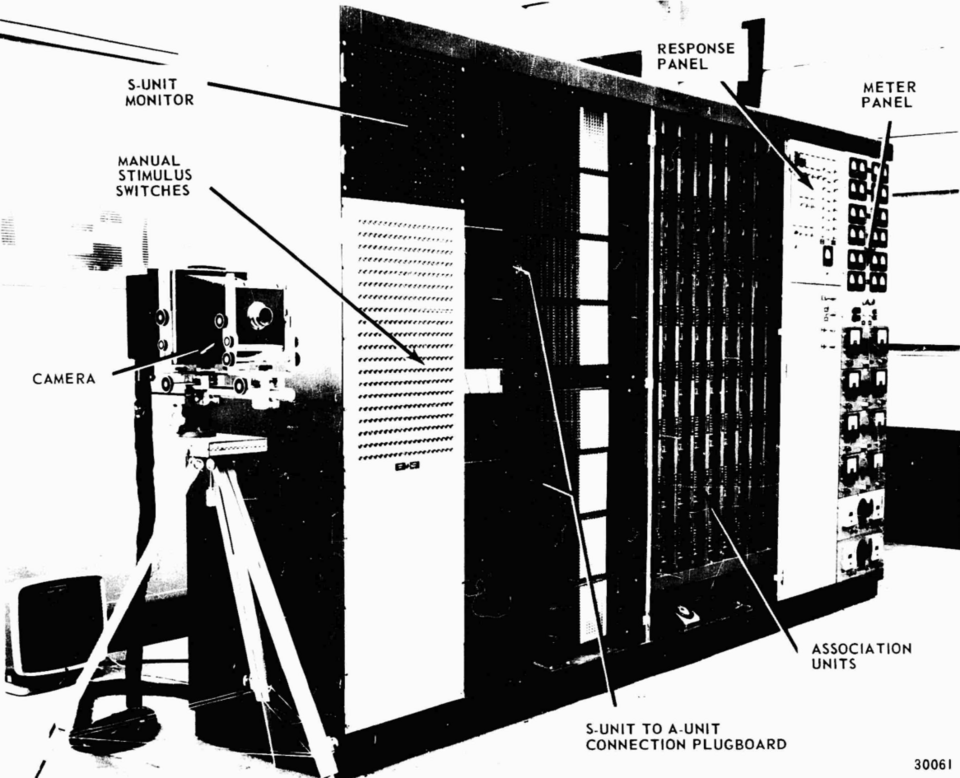
The Mark I Perceptron, one of the earliest machine-learning systems, demonstrated how computers could learn to recognise patterns from examples instead of relying solely on programmed rules. Image Credits: Wikimedia Commons
A legacy that continues to shape artificial intelligenceWhat made the Perceptron really special nowadays was not its technical peculiarities, but the idea behind it. It moved artificial intelligence away from strict programming and towards flexible learning based on collected information. The methodology applied in the Perceptron is applicable in several fields of artificial intelligence, including natural language processing, recommendation systems, robotics, and computer vision.The development of the Perceptron is considered one of the most important events in the history of artificial intelligence. The reason is that it presented a completely novel concept of building an intelligent machine by training the machine rather than programming it from the very beginning.









 English (US) ·