

 6 days ago
6
6 days ago
6
ARTICLE AD BOX
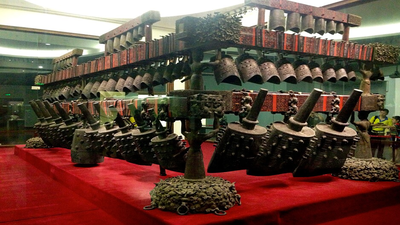
Bianzhong of Marquis Yi of Zeng in Hubei Provincial Museum. Image Credit: Wikimedia Commons
In the process of dredging, the workers stumbled upon a burial site of Marquis Yi of Zeng, which consisted of numerous items. The centerpiece was a set of 65 bronze chime bells.This is not just another archaeological discovery, but one of the greatest finds.
The ancient instruments are well preserved and bear inscriptions related to music theory. More than 40 years later, researchers can still use the find to reconstruct ancient sounds.A happy discovery in mudAs it is stated in a summary of an excavation report by Harvard University, the burial pits had about ten metric tons of bronze items. The scale of the find makes it one of the most significant archaeological discoveries in China.According to the same summary by Harvard, the key object among all the artifacts is the precisely tuned set of 65 bells which weigh 2,500 kg.
Because the bells were found in their original arrangement, scientists gained a rare opportunity to study how an ancient court ensemble was constructed and tuned.Decoding ancient music theoryWhat makes these instruments unusual is the writing on them. The gold-inlaid inscriptions are the oldest known texts on music theory in China. These inscriptions are extremely valuable for researchers because they provide historians an opportunity to compare the ancient Chinese concepts of music with the ancient Greek ones.
As noted by the Smithsonian Museum Conservation Institute, the inscriptions helped reshape the history of acoustics. The inscriptions were not merely decorative; they provided a clear link between the bells’ construction and their musical use.Five octaves of musical geniusThe music range offered by the Marquis Yi bells surprised the modern experts. According to a teaching aid from the Smithsonian National Museum of Asian Art, the bells could reach a music scale of five complete octaves because of their impressive size and needed more than one musician to play.The Smithsonian source notes that these bells could not be played like ordinary handbells. These ancient instruments reflect a highly complex musical system. Because they are so well preserved, the Marquis Yi bells are a key reference for evaluating replicas.

The Bianzhong of Marquis Yi of Zeng or Zenghouyi Bells, is the name given to an ancient musical instrument made of bells unearthed in 1978 in the Tomb of Marquis Yi of Zeng in Leigudun Community. Image Credit: Wikipedia
Science behind the double tonesResearchers found that the bronze bells could produce two distinct tones. According to a PubMed indexed study, the bells could produce two distinct tones depending on where they were struck.
The double-tone effect is associated with the bells’ oval shape and short tone decay.This design made the bells difficult to reproduce from appearance alone. To reproduce the double tones, a replica would need an interior identical to the original bells.Restoring a lost traditionCreating reproductions of these instruments proved challenging because the production technique had been lost. This type of bell was not preserved through continuous practice over time.
That means no surviving workshops can teach contemporary craftsmen how to make such bells.Researchers had to reconstruct the bells’ production process from surviving examples. Today, institutions such as Harvard’s CAMLab hold regular conferences on these chime bells as part of ritual and music scholarship. The 1978 discovery not only gave museums remarkable specimens for display, but also provided an invaluable source of information about ancient sounds.









 English (US) ·