

 1 week ago
6
1 week ago
6
ARTICLE AD BOX
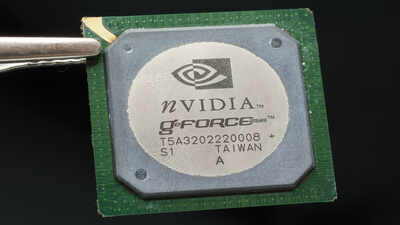
The NVIDIA GeForce 256, launched in 1999, is widely regarded as one of the first graphics processing units (GPUs). Designed to accelerate 3D graphics, its parallel computing architecture later became the foundation for scientific computing and modern AI workloads. Image Credits: Wikimedia Commons
In 1999, NVIDIA introduced the GeForce 256, at a time when computer graphics were becoming more advanced. Game developers, multimedia professionals, and 3D software increasingly demanded hardware that could process images faster and more accurately.
While consumers saw it as just another graphics card for improving gameplay, it mattered far beyond entertainment because it introduced an architecture that processed graphics calculations in parallel. While it was never intended to be used in artificial intelligence or scientific computing, the core concepts of this chip would lay the groundwork for what we have today in modern AI, supercomputing, and scientific research.
Nearly 20 years after its launch, the chip was regarded as an important milestone in GPU history and an early building block of modern computing.The graphics card that changed computer architectureBefore the GeForce 256, most graphics cards mainly displayed images produced by the computer's central processing unit (CPU). The increasing complexity of gaming graphics in the late 1990s made it difficult for CPUs to multitask between their normal functions and graphics computations.
NVIDIA responded with hardware that could perform many graphics computations simultaneously rather than one after another.
This increased efficiency and reduced load on the CPU.The GeForce 256 was part of a technological revolution in which graphics cards evolved into processors designed to perform specific functions. Unlike earlier graphics cards, which processed instructions consecutively, the graphics processor could process thousands of similar instructions concurrently.
This feature was especially useful for rendering the millions of pixels required in a three-dimensional environment.Research published in the IEEE explains that graphics processing units evolved because rendering visual scenes involves performing numerous identical calculations simultaneously. This demand encouraged the development of highly parallel architectures that later proved valuable beyond graphics.
Although the GeForce 256 itself was intended for visual computing, it demonstrated the effectiveness of parallel hardware at a time when most computing still relied heavily on sequential CPU performance.
The architecture introduced during this period became the basis for future generations of GPUs capable of performing increasingly complex computational tasks.Opening new doors for scientific computingAs GPU technology matured, researchers began exploring whether graphics processors could accelerate computations unrelated to graphics.
Initially, adapting gaming hardware for scientific applications was difficult because early GPUs were not designed for general-purpose programming. However, continued improvements in hardware and software gradually transformed GPUs into powerful computational accelerators.A study published by the Institute of Mathematical Statistics highlights that graphics processors quickly attracted researchers because of their exceptional computational throughput and growing programmability.
Their ability to process thousands of operations simultaneously made them particularly useful for computational biology, chemistry, engineering simulations, medical imaging, and large-scale statistical analysis. Consumer demand for realistic graphics unintentionally accelerated the development of affordable hardware capable of solving scientific problems that previously required expensive supercomputers.This is where the GeForce 256 becomes an important part of that historical development. Although it did not immediately change scientific computing, it showed that graphics processors could be used beyond their original purpose. It contributed to the emergence of parallel-computing design principles and encouraged vendors and programmers to consider broader uses. With the introduction of new GPU generations featuring programmable architectures and computing platforms, researchers started using graphics processors for computations on huge data sets.

NVIDIA's headquarters in Santa Clara, California. The company that introduced the GeForce 256 has since become a global leader in GPU technology, with its processors powering artificial intelligence, high-performance computing, and data centres worldwide. Image Credits: Wikimedia Commons
From graphics processing to artificial intelligenceThe GeForce 256's legacy includes its role in paving the way for artificial intelligence. Current systems require billions of computations to be done at the same time to train models for deep learning. It turned out that the parallelism and high-throughput processing that made the GeForce 256 effective for graphics were also well suited to machine learning.Studies on AI hardware note that GPUs are efficient at large matrix operations and often outperform CPUs on those tasks.
Major achievements in computer vision and neural network training were made only after GPU technology evolved into a general-purpose computing device. The GeForce 256 may not have been an AI chip, but it is an early example of the path leading there.Today, GPUs power applications such as self-driving cars, medical diagnostics, language models, and generative artificial intelligence. In conclusion, the GeForce 256 should be recognised not just as a popular product but as a turning point in computing history.
It symbolises a turning point when graphics processors began evolving into specialised computing engines capable of solving challenges far beyond rendering digital worlds.
Its release in 1999 demonstrated how innovations driven by gaming could reshape the future of computing, ultimately laying the hardware foundation for scientific research and artificial intelligence that continues to transform society today.








 English (US) ·