

 1 week ago
7
1 week ago
7
ARTICLE AD BOX
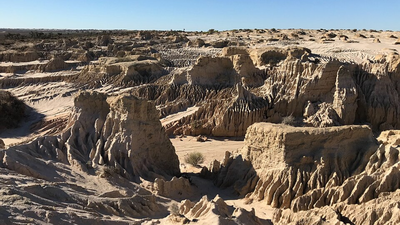
Landscape of Lake Mungo in New South Wales, where shifting sands preserved ancient human footprints. Image Credits- Wikimedia Commons
For thousands of years, the footprints lay hidden beneath the sands of an ancient lakebed in Australia's arid interior. They were the impressions of bare feet left by people crossing the muddy edge of a lake that has long since disappeared.These footprints discovered by archaeologists at Lake Mungo in 2003 are very rare indeed. Footprints record actual movement, unlike most artefacts. They allow us to see how our ancient ancestors walked, travelled, and adapted to a landscape that was ever-changing.This discovery provided another piece to the puzzle of Lake Mungo, which is one of the most significant archaeological sites in Australia. Previous excavation work at the site had uncovered the earliest evidence of human remains in Australia, thereby placing the Willandra Lakes area into historical perspective.A landscape that preserved Australia's ancient pastLake Mungo is an archaeological treasure trove that is well-known even before the footprint story attracted attention worldwide. According to research published by the Nature journal, the region is noted as one of the best places to preserve evidence of prehistoric human activity in the interior of Australia.Today, Lake Mungo lies in an arid landscape, but thousands of years ago its freshwater shores attracted human settlement.
The lake offered water, while the surrounding lunettes and shoreline deposits served as natural pathways across the landscape. Earlier research had already established Lake Mungo as one of Australia's most important archaeological sites, making it an ideal place to uncover further evidence of early human life.
The footprints were therefore not a chance find, but another discovery from a landscape known for preserving traces of Australia's ancient past.What the footprints actually recordWhile bones and stone tools record long-term activity, footprints capture a brief moment in time. Footprints are not just a record of the presence of ancient people in a region, but also tell us about how they interacted with the environment. According to research published by the Scientific Reports journal, \, fossilised footprints can give us information about locomotion and group behaviours which would otherwise be impossible to gain from other types of archaeological artefacts.The impressions preserved at Lake Mungo record details such as stride length, foot placement and direction of travel, allowing researchers to reconstruct how these individuals moved across the landscape. The mud was soft enough to register every step, before drying and hardening into a natural record that survived for thousands of years. Together, the tracks provide a rare behavioural snapshot of everyday life in prehistoric Australia.
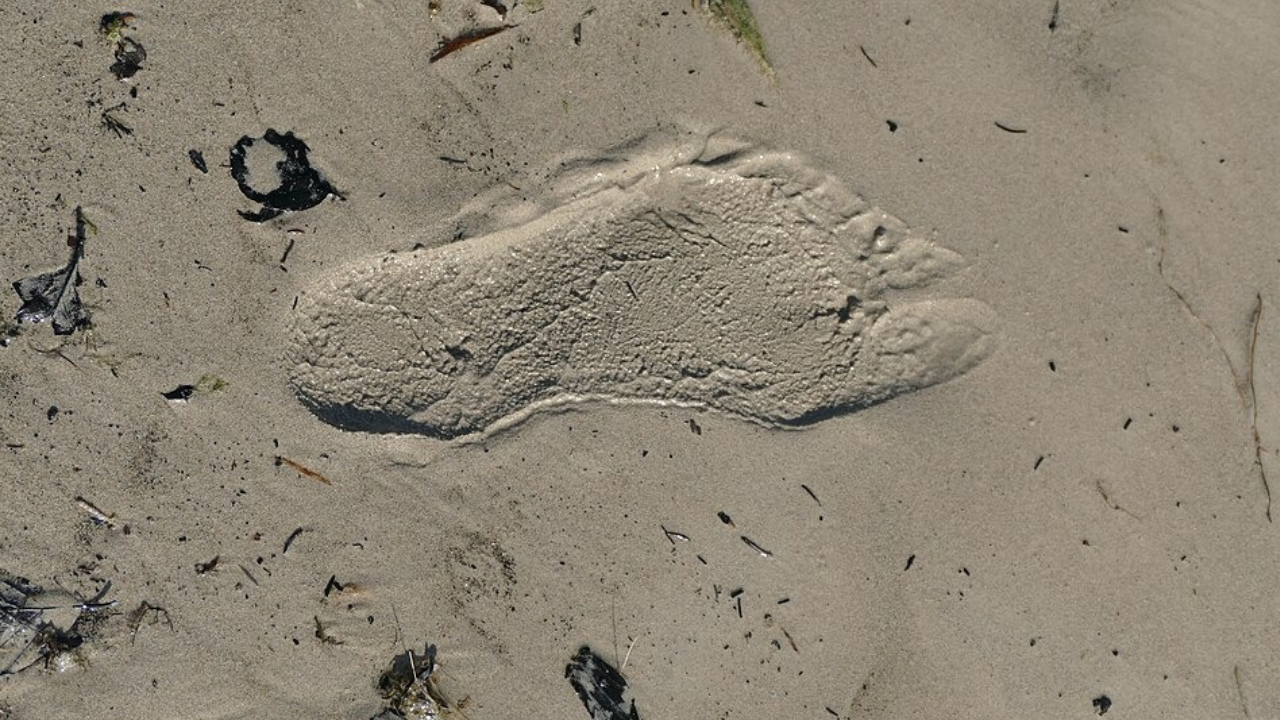
A depiction of a human footprint pressed into wet sand, illustrating how ancient footprints at Lake Mungo were formed and preserved before hardening over thousands of years. Image Credits- Wikimedia Commons
How speed and gait became visible One reason why the footprints of Lake Mungo caught people’s attention is that the space and shape of the footprints can tell about speed. In the study of footprints, researchers use the comparison of step length, imprint depth, and foot position to reconstruct movement patterns. This does not mean we know the exact time of day. It means researchers can reconstruct a range of movement from the physical evidence.
This was the case at Lake Mungo, too, where the trackways were analysed using this method.Why the discovery still mattersThe footprints document movement and much more. They also show how people adapted to the landscape. It means that the people who left the tracks were living with uncertainty in a drying inland world. The footprints do not tell us their names or their plans. But they do show that people crossed the lake edge in a setting where water was not always available, and the ground itself could shift from soft to hard.
In that sense, the find helps humanise the broader archaeological record.Another significant reason the Lake Mungo footprints remain important is that they link three fields at once: archaeology, geology and human movement studies. The evidence is strongest when sediment, dating and context are analysed together.









 English (US) ·