

 3 days ago
7
3 days ago
7
ARTICLE AD BOX
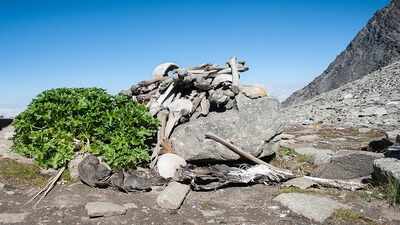
Human Skeletons of Roopkund Lake.Image Credits: Wikimedia Commons
For decades, Roopkund Lake in Uttarakhand has been known as the "Skeleton Lake." Scattered across its icy shores are hundreds of human bones, giving rise to stories of pilgrims caught in a deadly hailstorm, lost armies and forgotten expeditions.
It was one of archaeology's most enduring mysteries, seemingly pointing to a single catastrophic event.But in 2019, scientists looked beyond the legends and into the DNA preserved inside the bones. What they discovered changed the prevailing interpretation.A lake that kept its secretThe skeletal remains at Roopkund, located in the Himalayan region, have been puzzling archaeologists and visitors for many years now.
Previous theories about their origins assumed that all the skeletons came from one fatal event; however, the landscape of the site left plenty of room for speculation. The bones were scattered randomly and lacked the characteristics of a regular grave site, leaving plenty of space for conjecture.
Roopkund became an unusual case of archaeological inquiry because its physical layout was clear, even as its human history remained unknown. According to a study published in the Nature Communications journal, the researchers decided to go straight to the source and use the samples from the bones in order to unravel the mystery behind the bones.
What the team found challenged the most common version of the story. The DNA recovered from the skeletal remains revealed that the bones did not belong to just one population, but to multiple genetically distinct groups of people. That finding matters because a single tragic event would likely have produced more uniform remains. The evidence suggests that the site may have been revisited, reused, or received remains from more than one episode.
In that sense, Roopkund is less like a frozen moment and more like a long-running record of movement through a difficult mountain zone.DNA split the bones into three groups
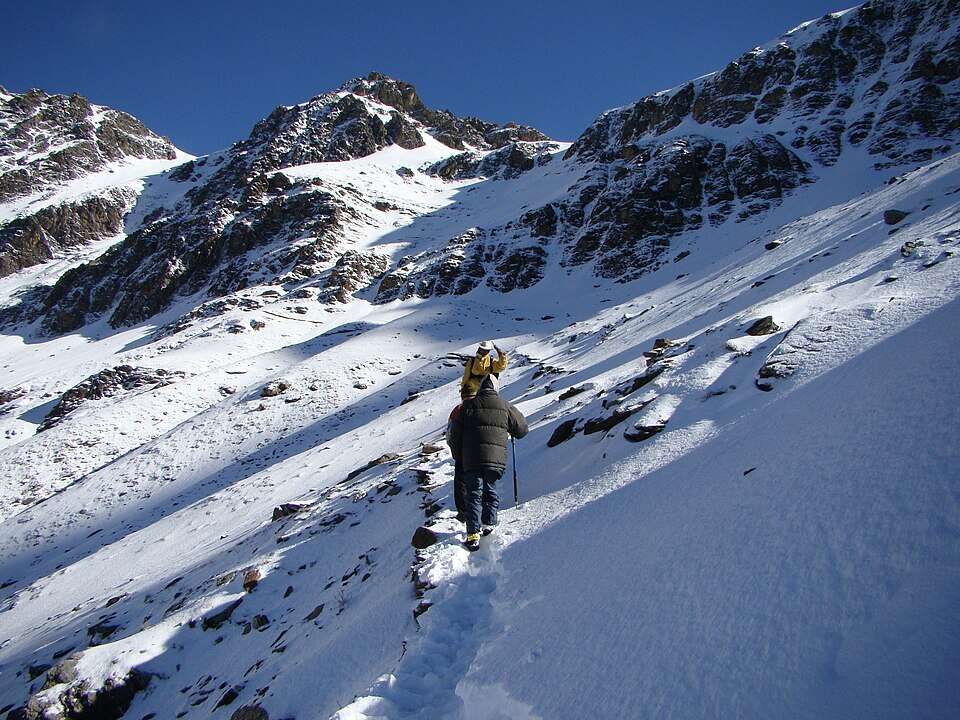
The challenging terrain leading to Roopkund Lake in Uttarakhand.Image Credits- Wikimedia Commons
This key finding was based on genome-wide ancient DNA extracted from 38 people. They were then grouped according to three distinct genetic clusters. One set showed ancestral origins similar to those of contemporary South Asians. Another group exhibited ancestral origins similar to those found in eastern Mediterranean communities.
Lastly, one individual was found to have ancestry similar to that of contemporary Southeast Asians.
This was surprising since the locations are not neighbouring regions.The paper classifies the remains and places them in the wider archaeological context of a high-altitude Himalayan site with scattered skeletons. It is pointed out by the authors that the genetic sequence is incompatible with a mass death due to a catastrophe.
This is an essential part of the story. The key question is not whether people died at Roopkund, but why people with different ancestry profiles ended up there.The dates did not line upHowever, radiocarbon dating was an important addition. According to the Max Planck Institute of Geoanthropology, the South Asians date back to approximately 800 CE, while the non-South Asians date back to approximately 1800 CE. This nearly thousand-year gap is significant. It suggests that the skeletons did not come together in one time period, despite their current location in the same lake environment.
The dating and the DNA evidence confirmed each other's findings, indicating that Roopkund is not one burial scene but a recurring deposit formed due to multiple events over many centuries.In this context, Roopkund becomes a revealing archaeological case study. If the remains had all dated to the same period, the ancestry groups could have been interpreted as part of a single event. What Roopkund changed in archaeologyRoopkund became an important case study for biomolecular archaeology because of its disturbed nature. Conventional archaeology could help explain the setting, but it could not explain the identity of those individuals and the origin of their bones. Through the use of genetic analysis, it was demonstrated that even under such complex circumstances, it is possible to retrieve information on population structure, dating, and diet from ancient DNA.
This makes Roopkund a useful case study for biomolecular archaeology.







 English (US) ·