

 4 days ago
6
4 days ago
6
ARTICLE AD BOX
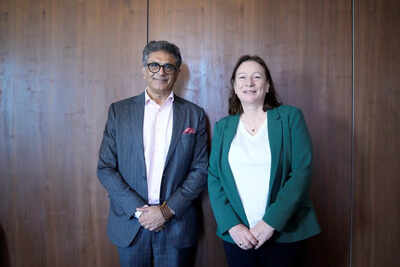
India’s political stability, economic growth prospects and large pool of educated talent could continue to attract strong global investment inflows despite rising geopolitical and economic uncertainty, according to senior leaders at Baker Tilly International, one of the world’s leading audit and advisory networks.In a conversation with Times Internet, Francesca Lagerberg, CEO of Baker Tilly International, and Ajay Sethi, Managing Partner at Baker Tilly ASA India, said India remains well positioned to attract global capital as investors increasingly seek stable and trusted markets in a volatile world.“If India continues to position itself as a trusted and stable place to do business, it will become even more successful,” Lagerberg said.
“India has a growing economy, political stability and a talented, well-educated population. People are always looking for good places to do business.”However, they cautioned that improving the on-ground investor experience will be critical. While policy intent at the leadership level is strong, bureaucratic processes and procedural hurdles at the grassroots level can sometimes slow down investments.Q. What is your assessment of the current global environment, especially considering geopolitical tensions and shifts that are taking place?Francesca: I think no one foresaw exactly what was going to happen or when it was going to happen.
I know there has been conflict there for decades. But the speed with which things have changed and the volatility that exists today are quite striking. Someone was asking us what is going to happen in a year’s time. I am not quite sure what is going to happen in ten days’ time. It is very hard to tell.It is an incredibly volatile world at the moment. There are some really good things, but there are also some very challenging developments.
We pretty much service businesses everywhere in the world. We are present in 140 territories, have a combined revenue of about $6.8 billion, and around 50,000 people working across the organisation.So, we are dealing with businesses and people across the world. That sense of volatility is driving almost every conversation we have. What is going to happen next? What will happen in the medium term? What about the longer term? Whenever things shift quickly, whether it is technology or geopolitical conflicts, they have massive ramifications.
They impact how businesses operate and they affect supply chains. Sometimes you simply do not know what the answer will be.A lot of our time is spent helping our clients navigate changing geopolitical and local issues.Q. Dubai has been a major hub for business and investments. Do you think such hubs could lose their attractiveness, and could companies move towards locations like India or Singapore? Or will this phase pass?Francesca:It is very hard to be absolutely certain. The attraction of a stable environment is huge.
If you look at somewhere like India, it has great stability compared to many other places.But if you go back just a couple of years to the time of COVID, many people believed that the geopolitical situation meant we would never return to certain parts of the world or operate in a global way again. That did not happen. So, it is difficult to make sweeping predictions about these developments.However, governments that provide stability, consistency of rules and strong talent pools are always going to succeed in the current environment.Q. India seems to meet many of these criteria. Do you believe India could emerge as a stable destination for investments, especially given its large consumer base and strong economic growth?Francesca:I think India is very well positioned. You have a growing economy, political stability and a talented, well-educated population. People are always looking for good places to do business.It does not necessarily matter what issue is causing the global challenge.
Places that provide stability and opportunity will continue to attract businesses. India is very nicely positioned in relation to that environment.It is not about benefiting at the expense of other countries. It is about providing an attractive environment that encourages businesses to invest and operate there.Q. What sectors are companies particularly keen to invest in when it comes to India?Ajay: From the India side, we have been advising foreign companies for the last 35 years.
Among the biggest investors today are Japan, the United States, France and earlier Germany was also a major investor. I believe the automotive sector will remain strong for some time, especially with electric vehicles picking up significantly. Semiconductors will be the next big thing, and in many ways they already are.India initially moved into assembly and testing in the semiconductor sector, and now there are signals that the country wants to move into fabrication as well.
The Micron unit is an indication of that. Another important development is the announcement of Semicon 2 that India wants to move into the design space. Centres have already been set up in Bengaluru and Pune.This has attracted interest across the entire supply chain. Companies involved in ultra-pure water, industrial gases and specialised logistics for semiconductor components are all exploring opportunities.
Transporting semiconductor chips requires highly specialised logistics. Even a small shake can disrupt production.Renewable energy will also continue to remain attractive. Consumer goods will continue to attract investment, although much of that may shift towards manufacturing in India or expansion by Indian manufacturers.There are also strong Indian examples emerging in sectors like solar panel manufacturing.
The success of several IPOs shows how domestic companies are scaling up. The combination of Indian manufacturing and global technology partnerships will play out significantly over the next five to ten years.Q. Which countries do you expect to invest more in India going forward?Ajay: Japan will remain a major investor across multiple sectors. France is showing increasing interest, particularly in aerospace and defence, and is also moving into semiconductors.
Korea is coming back strongly into the market. Germany has again shown renewed interest.The United Kingdom is often underestimated in manufacturing, but it has a strong BFSI sector and deep expertise in financial services. It also has a highly developed IT ecosystem that India has not fully tapped into yet. I am seeing increasing interest in fintech collaborations between India and the UK.The potential India-EU free trade agreement could also generate significant interest and movement of investments.Q. Do you have any estimates of the scale of investments that might come into India?Ajay: Unfortunately, we have not conducted a study ourselves. The only benchmark available would be government data, which indicates that around 81 billion dollars came into India in 2024–25.Q. Are there any concerns or areas India needs to address to attract more investments? For instance, ease of doing business or infrastructure?Ajay: Whenever such concerns are raised, the government does make efforts to address them.
I do not see the government avoiding reforms in the regulatory environment, labour laws or other areas.However, one concern I would highlight is the difference between policy intent at the leadership level and the experience investors sometimes have at the grassroots level. Policies may be good, but local officials can sometimes focus too much on minor procedural issues rather than the substance of the law.If there is more education at the grassroots level about how to handle foreign investors, that could significantly improve investor experiences.Francesca:Another major factor is certainty. The more certainty a country provides, the more attractive it becomes for businesses. This is easy to say but difficult to deliver.In recent years, many political systems around the world have experienced significant shifts. New governments often introduce changes because that is what their manifestos promise. But frequent changes can make it difficult for businesses to plan long-term investments.Businesses prefer stable rules and predictability. There is nothing worse than making a major investment decision today and discovering in two years that regulatory changes have made that decision unviable.Q. How important is trust when it comes to positioning India as an investment destination, especially compared to countries like China?Francesca:Trust is a very important part of the overall equation. Investors want to operate in countries where governance is strong and decision-making is stable.In a world where trust has eroded in many areas, it is becoming even more important for business relationships. Investments are rarely short-term. Most companies are looking at medium to long-term commitments.If India continues to position itself as a trusted and stable place to do business, it will become even more successful.Despite the chaos we see globally, India remains relatively well positioned. In a chaotic world, businesses look for safe havens where they can invest with confidence and operate in a stable environment.If India continues to build on that positioning, it will remain in a very good place for attracting global investments.







 English (US) ·