

 1 hour ago
4
1 hour ago
4
ARTICLE AD BOX
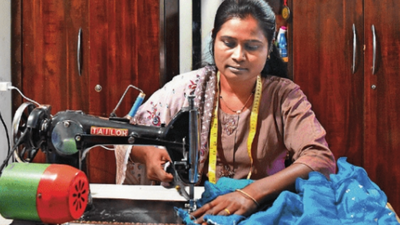
Jyoti Ausarmal has taken up residence in Beed for her son and daughter’s education. She is a beautician and sews clothes from home. She has also enrolled for a course in designing
Their victories may seem negligible by most urban standards:Getting ancestral land transferred in their names after years of resistance, fighting the family and moving to towns so their daughters can study, forming a group to supply labour and getting organised, becoming a point of contact to help other women get documents, returning to classrooms themselves to finish high school and even pursue degrees.In Maharashtra’s drought- and migration-prone districts, where the wives of men lost to agrarian suicide often inherit only debt, neglect, and an inescapable social script of staying dependent, some women are fighting with everything they have and more, forcing change.TOI spoke to such women, widowed in different years, in Beed which accounted for nearly 149 eligible farmer suicides in these 10 months, the highest in Marathwada.
Even for these small victories, women had to fight not just their families, but the entrenched patriarchy of the entire village as they saw women owning their life as the ultimate act of rebellion.‘Education feeds you, customs don’t’The front balcony in Jyoti Ausarmal’s (35) 1BHK first-floor house overlooks a small garden with a chiku-laden tree, but she says she has no time to sip tea and enjoy the view.Despite wanting to be in the police force, she was married immediately after school and widowed in 2018 after her marginal-farmer husband died of suicide due to loans and failed crops.
Jyoti suddenly found herself responsible for three children, in-laws, zero household income, and a family and village against letting her step outside to talk or work.With nothing to eat and her children’s education suffering, she went to her mother’s house for 15 days and never stopped rebuilding her life.She learnt sewing, and skills to work as a beautician, and started working from her mother’s house. She is now working toward her master’s degree.“When I sent my daughter to study in a free residential hostel in Pune, the village opposed but I stood my ground. What I couldn’t do, my children must,” Jyoti said. Her other two school-going children live with her.Her days begin at dawn, with cooking, housework, taking care of children, sewing, salon work, and studying, and end past midnight.“People back in the village badmouth me for staying in the city,” she said, adding that her children won't have an early marriage.Still not welcome in her husband’s village, she said, “My kids' destiny must not depend on any person.”‘If the system won’t help us, we’ll learn’Her younger son was just 12 days old when Vaishali Fuljhalke (35) lost her husband to suicide due to years of crop losses, medical expenses of her elder son who had heart issues, and mounting loans.With nowhere to go and no land in her name, she worked for four years on her in-laws’ fields without any income.When extreme poverty and lack of money for her son’s treatment forced her to ask for her share of her husband’s land, she was kicked out.“When they refused to let me claim even what belonged to my sons, I had no option but to protest and claim the land as my own,” Vaishali said.She faced backlash with villagers criticizing her for “demanding too much.”With help from organisations working for women farmers, she visited local govt offices to learn how to claim her husband’s land and the schemes she was eligible for.She says govt offices don’t treat poor women well, with most not ready to help or explain things, dismissing them as illiterate, insulting them for wasting their time.“I had endured worse so their tart words were nothing. I repeated the questions till they responded and learnt things on my own while working in the 3/4th acre of my husband’s land, which is still not in my name but at least I keep the earnings,” Vaishali said, sitting on the cowdung-plastered floor, under the asbestos-sheet shade in front of her mother’s house, where she now lives.Today, she cultivates cotton, potato and peanuts on the farm.Vaishali also ensured women like her are not helpless by turning her experience with bureaucracy into a resource for them.“We are taught not to ask questions. Our own shortcomings make us vulnerable and we avoid things for fear of being called out for our ignorance. But we need to ask, till we understand, whether it is a family matter or govt matter. Our voice matters.”Vaishali has also formed a group of 10 women workers.“Villages punish women. At least govt officials can be empathetic,” she added.‘I live for my daughter’Manisha Bhadgile (32) was underage when she married, migrated for sugar cane cutting, and spent years as a daily worker before her husband’s suicide.With no support from her in-laws and shunned by her parents, she had nowhere to go. She and her two kids were driven out by her in-laws, only to be taken in after villagers interceded.“I slept on an empty stomach,” she said.The turning point came when she connected with a self-help group under MAVIM, which sent her elder boy and younger girl to a hostel to study.But when her elder son quit the hostel, she enrolled her daughter in a village school, but the school was only till Std VIII.“I wanted my daughter to study but years of controlling behaviour by my in-laws and constant scrutiny in the village meant moving out for her education was impossible.
Fighting every norm that she was made to live by, she shifted to a single room on rent in Beed so her daughter could study without interference. Her son, influenced by relatives, moved back to the village and now blames her for living alone. ‘I miss him,’ she says, ‘but there’re drunk men in the village, including my relatives.
It was not safe for us.’”A life in Beed with no support wasn’t easy. Landlords refused to rent to a single woman, families hesitated to employ her, and her caste added another layer of discrimination.From working as a domestic help in one house, her hard work became her calling card, and now she works in multiple houses earning a low but steady income. Her 10x10 one-room home with the asbestos roof and a shared toilet is small, but nobody throws her out.Her working hours end at 1 pm, a self-imposed rule as her daughter returns from school then. Even with these restrictions, she manages food, rent, school fees and small savings.“Everything I do is for my daughter so she doesn’t repeat my life,” she says.






 English (US) ·