

 1 hour ago
8
1 hour ago
8
ARTICLE AD BOX
Even in the least flashy goal of his World Cup hat-trick, Lionel Messi’s genius was quietly at work. All one needed to do was look closely. At first glance, his second goal comes across as a plain vanilla poacher’s strike — an easy tap-in from a few metres with the goalkeeper out of position. It is only on a second look, ideally in slow motion, that the layer of intrigue is unearthed in this seemingly open-and-shut goal.
On the frame of the goalkeeper sprawled on the ground, after his futile full-length desperate dive to his right, helplessly watching the ball pass him by on his left, was the smooth cursive Messi signature.
The Argentine great could have easily scored by going to the right of the goalkeeper – clearly the best option, as he only had to swing his right foot and hook the ball. He could have even tried the fancier, and often-used, alternative of chipping the ball over the goalie. But Messi, as usual, took the less travelled path — pushing the ball to the goalie’s left, catching him on the wrong foot. It was truly an unimaginable option that only occurs to the outliers, despite the urgency of hectic goal-mouth action.
Argentina 🇦🇷 vs Algeria 🇩🇿 World Cup Goals
Messi first Hat- trick at World Cup #football #fyp #viral #worldcup #messi pic.twitter.com/1M8EUIUsbU
— Global Football Update (@GlobalFoot110) June 19, 2026
Mortals beat the goalkeepers, Messi annihilates them. Maradona, and Pele before him, too would do the same — prefer to dribble past the goalkeeper, rather than merely kicking the ball past them. Again, it is about putting the signature.
Masters of the game are known to do things differently. They read the thoughts of their opponents, expose their limitations, make them look awkward and inadequate. Without intending it, they also end up belittling them — just like the Algerian goalkeeper at this World Cup or Pakistan’s Moin Khan one late April afternoon at Multan in 2004. In the latter case, it was Sachin Tendulkar, the leg-spinner, who had embarrassed the wicketkeeper.
It was the last ball of the day, and the wicket of the last specialist batsman, a habitual late-order thorn in the flesh for bowlers, would have been priceless for India. Moin seemed ready to defend the ball and take the battle to the next day of the tight Test. With a slip in place, Tendulkar pitched the ball on off-middle. It was the ideal line for the ball to spin towards slip, induce an edge by beating the forward defensive shot. The line was good even for a straight ball that could fetch an LBW.
But then, these are the kind of last-ball plans that germinate in the minds of common cricketers. Tendulkar would bowl a googly from the spot that would have been perfect for a leg-break. Like the Messi goal — this one too didn’t take the expected left turn but the unexpected right. The ball would sneak between Moin’s legs and hit the top of leg-stump. Moin walked away sheepishly. He played just one more Test after that.
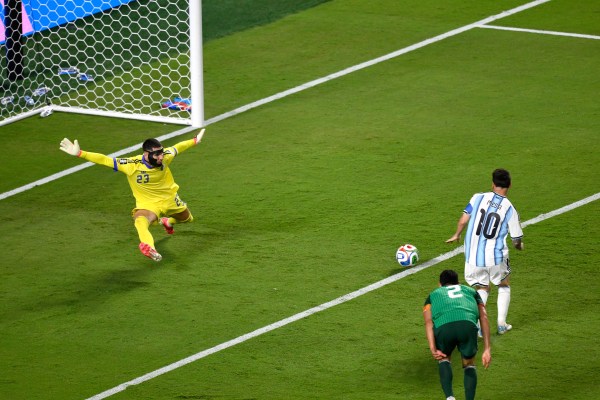 It is only on a second look, ideally in slow motion, that the layer of intrigue is unearthed in Messi’s seemingly open-and-shut goal. (AP Photo)
Victims of greatness
If fate somehow brings them together, the Algerian goalkeeper and the Pakistan wicketkeeper can exchange notes and share the common pain of being the victim of greatness. Messi and Tendulkar also could talk about the joy they get in pulling off such delightful cons.
Check the two YouTube videos and you can see GOATs showing child-like glee in their moments of triumph, beaming and hugging teammates like teens in school playgrounds. Also note that there is no hint of insult towards the vanquished and not a single muscle can be seen flexing superiority. It’s simply pure happiness of a carefully planned idea working out, the result of a lifetime of rigorous pursuit.
There is a handy experiment to understand how geniuses think. The next time, while watching Messi, when the ball is at his feet, try guessing the path he and the ball will take. Most of the time, you would get it woefully wrong. It is expected since even the top pros entrusted with the job of marking him have regularly been foxed. When you expect it to be a square pass to a teammate free on the wings, it would be a through ball to a striker who has just launched his forward run.
Having lived all his life in a crowded midfield and the heavily manned D-area, Messi knows how to find his way through the maze. From his tiki-taka days at Barcelona, he is aware of the angles and routes that not many are familiar with. Born in Maradona’s country, he has the skills to use every centimetre of both his feet to send the ball in unexpected directions. Messi has a mind that throws up options that even beat the AI-powered computers of sports analysts.
In an incredibly insightful interaction on his 50th birthday, Tendulkar had given an idea about how sporting geniuses think.
Mind games
It was from a Test at Adelaide in the 1999 India-Australia tour. The bowling unit had a plan in place against Tendulkar — they would bowl away from him, tempt him to reach for the ball and edge behind the wicket. (Glenn) McGrath bowled four to five maiden overs to him. Tendulkar kept leaving the ball. For those beyond the boundary rope, the Aussies were winning and Tendulkar had been forced into a shell.
At this point in the narration, a smile emerged on Tendulkar’s face. “That evening, for the rest of the world, it seemed like I had lost the battle but the Australian team knew I had won the battle. And I knew I had won the battle,” he said.
Years later, Tendulkar’s dear friend Shane Warne would talk to him about that day. “The guys who mattered knew exactly what happened. Warne told me later about that meeting. They said, ‘We are in trouble, he is playing a different game’.”
Next morning, Tendulkar would start by hitting a couple of boundaries to balls that had landed on the same spot that he had been leaving the previous day. “It was a message that I decided when to play and when to leave the ball.”
Wiser after those words, we would ask a follow-up question. How do you get into a bowler’s head? He said that since he bowled a lot, he understood the game better. But it was an incomplete answer. Tendulkar would go on to add: “Certain things can’t be taught.” They just need to be closely observed, appreciated and enjoyed.
Just like Messi’s least-applauded second goal of his hat-trick.






 English (US) ·