

 4 days ago
15
4 days ago
15
ARTICLE AD BOX
My LPG supplier sent me a terse message amid the war in the Middle East. But the message from fellow Indians that I got on a short driving trip was one of resilience and hope.
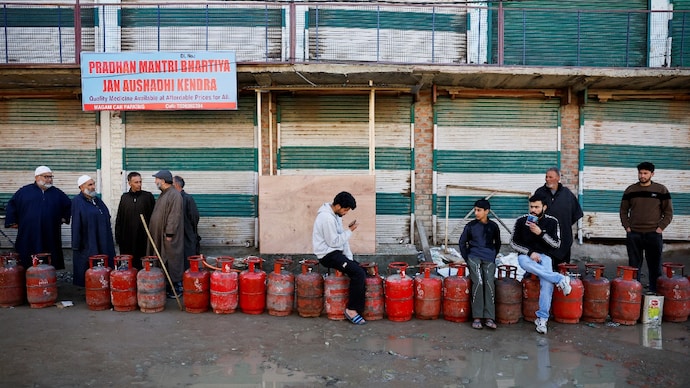
People wait in a queue with their empty LPG cylinders outside a gas agency amid supply disruptions following the US-Israeli conflict with Iran, in Magam town, J&K. (Image: Reuters)
New Delhi/Orchha/Gwalior/Greater Noida,UPDATED: Mar 30, 2026 11:58 IST
"Pls avoid repeated calls and have patience," is what Indane, my LPG supplier, told me tersely through an SMS on March 21. I actually had been calling up the automated number once every day to check if Indane would allow me to book a refill. The SMS hit home. I bought an induction cooktop and struck the gas-guzzling aloo parantha, rajma and bhuna mutton off the menu.
I always took care to order a refill when one of my two LPG cylinders ran out. But like the Iranians negotiating in Geneva, I was caught off guard this time. The Strait of Hormuz turned into a minefield and oil and gas plants across the Middle East were up in flames. It was only after the government increased the booking wait-time that I realised that my kitchen was running on the last of the two cylinders. That's what made me call Indane and try my luck.
My last LPG cylinder was delivered on February 21, and I needed to wait for 30 days before I was able to book a refill.
But this story isn't just about me or my LPG refill. It's more to do with what I saw, heard and realised while driving from Delhi to Orchha in Madhya Pradesh. A driving trip planned months in advance which I cut by half, with the war in the Middle East being one of the reasons.
By this time, the US-Israel-Iran war had entered its fourth week, and I saw enough people scurrying for LPG cylinders. The scarcity of LPG refills was hitting almost everyone. That's because other than gas and oil, India runs on corruption. And it is the system that promotes and facilitates it.
From small eateries to mid-sized hotels, most run on the 14.2-kg LPG cylinders meant for domestic use but procured by them on the black market. At the current rate, a 14.2-kg cylinder costs Rs 913 in Delhi while the 19-kg commercial cylinder costs around Rs 1,885.
Because of the ease-of-doing business that LPG delivery guys provide, these roadside stalls and eateries prefer to pay Rs 200 more than the legal price and buy them on the black market. If it weren't for the war, a 14.2-kg LPG cylinder would have cost around Rs 1,100 on the black market in Delhi. But the squeeze at Hormuz was felt in the squeeze in LPG supplies in India.
In Delhi, the cost of a 14.2-kg cylinder jumped to Rs 3,500 on the black market. In Agra, I was told, it was around Rs 2,500. In rural Sitamarhi of Bihar, an acquaintance paid Rs 1,600 for a cylinder because he urgently needed it for the halwai for his son's engagement ceremony.
With people in long queues for LPG cylinders, eateries shutting down, a sense of uncertainty hanging in the air, and officials giving daily briefings, the ghosts of the pandemic had suddenly returned. Lav Agarwal, the government official who gave the daily Covid count, was back on national TV. This time briefing Indians about the fuel situation in the country.
"This crisis will be a major test for our country," Prime Minister Narendra Modi said in Parliament on March 24. He said the country should be "prepared and united, just as it had stood together during the Covid-19 pandemic".
During my drive, which began on March 25, just a day after the PM's speech, I was constantly told of an impending "energy lockdown" by locals, until the government was forced to dispel the fears. Countries were already facing an energy crunch and had started rationing fuel and reducing workdays.
Petrol was generally available on the highway from Delhi to Gwalior to Orchha and the return via Agra. I saw some pumps out of action and was told supplies were taking longer than usual to reach pumps. A fuel tanker driver confirmed that.
After walking through the Gwalior Fort complex under an unsparing summer sun, I bought a bottle of Sting and realised how India is dependent on foreign countries for not just its energy needs, but also its energy drinks — from Sting to Red Bull to Monster. I wouldn't mind a Lahori Zeera with some caffeine in it.
In Gwalior, I was told that induction cookers and electric ovens were being used more regularly to conserve LPG in mid-tier hotels. Starred hotels, an industry veteran told me, were waiting and watching the situation evolve. The top-starred ones generally have fuel back-up of a few weeks with them, he said.
In Orchha, I saw a sous chef getting a chulha (clay oven) built. The resort had already converted two of its tandoors, earlier used for a variety of breads, with grills on top for items that take longer to cook. He said coal and firewood were in abundant supply.
Coal, painted dirty fuel by the white west after it used it to steamroller its industrial expansion, seems to be now a life-saving alternative for India. Ujjwala can take a breather till the war clouds clear. Survival takes precedence over trying to achieve targets set by first-world countries after themselves doing most of the damage.
But the disruption in supplies isn't limited just to oil and gas. Petroleum byproducts provide vital raw materials and chemicals for plastics, FMCG, textiles, automotive, infrastructure and even the agriculture sector. Exports from India could take a big hit. The war in the Middle East adds to the pressure from the four-year-old Ukraine-Russia war.
The latest war could hit India's growth prospects and households if industries need to make workforce adjustments. That is the disruption experts and policymakers are worried about. PM Modi has asked state governments to take care of the poor and the migrant workers because they are impacted the most during such hard times.
In India, where there is a lack of social security net, people are each others' insurance. During the peak of Covid, when the official machinery was overwhelmed, India saw people helping out each other with daily essentials, by running community kitchens, and arranging hospital beds and oxygen cylinders.
The night before I was to drive back to Delhi, a relative messaged me, enquiring if we had enough LPG back-up. I told her about the induction cooker and the no-rajma-bhuna-mutton menu along with the ROFL emoji.
I couldn't help but compare the two messages.
"Dear Customer, if you are an active Indane customer, your booking reference no will be sent to you shortly. Pls avoid repeated calls and have patience.
INDANE."
The caps lock was bang on, just like the ominous messages from President Donald Trump. Thanks for your attention, thus far.
Driving back to Delhi, I took a break near Greater Noida. While waiting for my coffee and chole bhature at a cafe that had opened just four months ago, I started chatting with the young manager, an IHM-Shimla graduate. "You have just started this outlet, do you fear a Covid-like disruption in business?"
"We have seen it all, haven't we? At least this isn't going to kill people directly like the Covid virus did. We will help each other and survive," said Tushar. I didn't ask him for his second name.
I was reminded of my report for The Times of India on how apparel exporters took to making PPE suits, distilleries and cosmetics manufacturers produced sanitisers and a paper company made cardboard beds for quarantine centres. Hospitals got more beds and on-site oxygen plants. Covid changed India.
What could be the silver lining of this disruption? A better PNG network with more renewables in the energy mix or something that we can't even begin to imagine right now? It'll be clear once the storm has blown over.
So, after buying an induction cooker, rationing my last LPG cylinder, eliminating fuel-consuming foods from the menu and realising that this too shall pass, I have taken a decision. Dear Indane, I am not going to book my next LPG refill in the next one week, giving you a full fortnight of my patience. Because patience will be key in the long haul we are in.
- Ends
Published By:
Anand Singh
Published On:
Mar 30, 2026 11:58 IST
Tune In




 English (US) ·