

 14 hours ago
5
14 hours ago
5
ARTICLE AD BOX
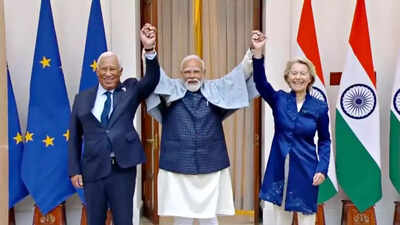
NEW DELHI: India and the European Union have concluded what EU chief described as the “mother of all deals”, finalising a comprehensive Free Trade Agreement that is expected to significantly boost India’s manufacturing and services sectors, deepen market access and strengthen investor confidence.The India-EU Free Trade Agreement, cleared by the Union Cabinet after negotiations concluded on January 23, is among the largest bilateral trade deals globally in terms of economic size, regulatory scope and population covered. A commerce ministry official said the pact stands out as the EU is a customs union, giving India preferential access to all 27 member states under a single framework.The agreement covers a combined market of nearly 1.9 billion people and links two economic blocs that together account for around 25 per cent of global GDP, 30 per cent of the world’s population and about 11 to 12 per cent of global trade.
Out of total global trade estimated at USD 33 trillion, India and the EU together account for nearly USD 11 trillion.Calling the deal historic, the official said, “So it’s a huge deal in that sense,” noting that while the China-ASEAN pact is large, ASEAN is not a customs union like the EU.Addressing a joint press conference with European Commission President Ursula von der Leyen and European Council President Antonio Costa after the 16th India-EU Summit, PM Modi linked the agreement to wider geopolitical and institutional reforms.
“Today, there are major turmoils in the global order. In such a situation, the partnership between India and the European Union will strengthen stability in the international system,” the Prime Minister said.He added that India and the EU had discussed key global and regional issues, including Ukraine, West Asia and the Indo-Pacific, while stressing the need for reforms in global institutions.“Respect for multilateralism and international norms is our shared priority.
We also agree that to address today’s challenges, global institutions need reform,” PM Modi said.Outcome 1: Towards 2030 Joint India-EU Comprehensive Strategic AgendaWhat it means:This agenda provides an overarching framework for the India-EU Strategic Partnership for the next five years. It aims to align cooperation across trade, investment, supply chains, digital connectivity and green transition.Expected impact:The roadmap is expected to deliver stronger trade and investment ties, resilient supply chains, faster green transition, improved physical and digital connectivity, deeper collaboration in digital, AI and emerging technologies, enhanced security cooperation, and greater skills exchange and mobility.Outcome 2: Conclusion of India-EU Free Trade Agreement negotiationsWhat it means:The conclusion of FTA negotiations marks the economic centrepiece of the partnership, aimed at enhancing bilateral trade, investment and regulatory cooperation.Expected impact:The agreement is expected to improve market access for Indian goods and services, support sustainable and inclusive growth, strengthen diversified supply chains, encourage innovation and technology transfer, and create new employment opportunities, particularly for the youth.Outcome 3: Security and Defence PartnershipWhat it means:India and the EU agreed to deepen cooperation across defence industry collaboration, maritime security, cyber and hybrid threats, space and counter-terrorism.Expected impact:The partnership will open opportunities for Indian defence firms under EU defence initiatives, strengthen national security, promote advanced defence technologies, support Make in India in defence manufacturing, and generate new defence-sector jobs.Outcome 4: Comprehensive Framework on Cooperation on MobilityWhat it means:This is the first mobility-related agreement signed at the EU level with India, aimed at facilitating structured movement of skilled professionals.Expected impact:The framework will streamline safe mobility for skilled workers, create job opportunities for Indian youth, improve access to European education and research, ease movement for seasonal workers, and strengthen people-to-people ties.Outcome 5: Disaster risk management and emergency response cooperationWhat it means:An arrangement between India’s NDMA and the EU’s DG-ECHO focuses on cooperation in disaster preparedness and emergency response.Expected impact:The partnership will enhance coordination during natural disasters, strengthen preparedness mechanisms, and help save lives and protect property during emergencies.Outcome 6: Cooperation between RBI and European Securities and Markets AuthorityWhat it means:The arrangement enables recognition of Indian clearing houses by ESMA, facilitating closer coordination between European banks and Indian clearing entities.Expected impact:This will support smoother capital flows, improve financial market integration, and establish a structured dialogue on financial services regulation.Outcome 7: Arrangement on advanced electronic signatures and sealsWhat it means:The agreement establishes a framework for interoperability of electronic signatures and seals between India and the EU.Expected impact:It is expected to improve efficiency in cross-border trade, boost business confidence, and provide momentum to the digital economy.Outcome 8: Renewal of India-EU scientific and technological cooperation agreementWhat it means:The agreement on scientific and technological cooperation has been renewed for the 2025–2030 period.Expected impact:The renewal will expand research collaboration, promote innovation and technology development, and provide Indian researchers and institutions greater access to Europe’s R&D ecosystem and global exposure.Outcome 9: Constitution of a Green Hydrogen Task ForceWhat it means:The task force aims to deepen cooperation in green hydrogen production and technology development.Expected impact:It will create opportunities for Indian industries, support green energy production, encourage innovation and knowledge sharing, generate green jobs, drive industrial decarbonisation and strengthen climate action.Outcome 10: Launch of negotiations on India-EU Security of Information AgreementWhat it means:The proposed agreement will facilitate the exchange of classified information between India and the EU.Expected impact:It will enhance information sharing, strengthen national security, and pave the way for deeper cooperation in security and defence initiatives.Outcome 11: Exploratory talks on India’s association with Horizon EuropeWhat it means:India and the EU will begin exploratory talks on India joining the Horizon Europe programme.Expected impact:This will enable structured scientific cooperation, open access to large-scale research funding, promote high-tech partnerships, and provide innovation opportunities for MSMEs.Outcome 12: Joint implementation of projects under India-EU Trilateral PartnershipWhat it means:The two sides will jointly implement four projects covering clean energy, digital innovation, early warning systems, agriculture and women empowerment.Expected impact:Projects will be rolled out in Africa, Small Island Developing States in the Indo-Pacific and the Caribbean, supporting sustainable development and climate resilience.Outcome 13: EU pilot Legal Gateway Office in IndiaWhat it means:The EU will set up a pilot Legal Gateway Office in India to support skill mobility, initially focusing on the ICT sector.Expected impact:The office will serve as a one-stop hub for EU job opportunities, improve awareness of visa and mobility procedures, strengthen India’s skilling ecosystem and complement the Skill India Mission through direct engagement with EU companies.





 English (US) ·