

 4 days ago
5
4 days ago
5
ARTICLE AD BOX
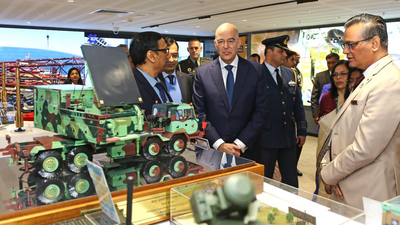
NEW DELHI: Greek defence minister Nikos Dendias on Monday visited the Defence Public Sector Undertakings (DPSU) Bhawan in New Delhi, where he was given an overview of India’s range of indigenous defence equipment.
This also included the Akash air defence system, one of the cornerstones of India’s homegrown military technology.India and Greece on Monday signed a joint declaration of intent to strengthen defence industrial cooperation, setting the stage for a five-year roadmap to boost technology exchange and joint production. The agreement followed talks between Defence Minister Rajnath Singh and his Greek counterpart Nikolaos-Georgios Dendias in New Delhi, aimed at expanding bilateral defence and strategic engagement.
Mr. Nikolaos-Georgios S. Dendias, Minister of National Defence of the Hellenic Republic, participated in an industry interaction at DPSU Bhawan on 09 February 2026.
🔸 During his visit, the engagement featured interactions with… pic.twitter.com/BdbxYwk5Mt
— Defence Production India (@DefProdnIndia) February 9, 2026
During the visit, Dendias interacted with senior officials from India’s defence sector and reviewed the capabilities of several indigenous platforms. A special focus was placed on the
Akash surface-to-air missile
system, which has become a key symbol of India’s growing self-reliance in advanced defence manufacturing.Developed by the Defence Research and Development Organisation (DRDO), Akash is a medium-range, surface-to-air missile designed to neutralise aerial threats such as fighter jets, drones, and cruise missiles.
— DRDO (@DRDO_India) July 17, 2025
Currently operational with both the Indian Army and the Indian Air Force, it plays a vital role in India’s layered air defence network by offering area air defence for critical infrastructure and forward troop formations.The standard Akash system can engage multiple targets simultaneously within a range of about 25 kilometres and at altitudes up to 18 kilometres. It uses the Rajendra fire control radar for tracking and guiding missiles against hostile targets, and is mounted on mobile platforms for rapid deployment and relocation. The missile can intercept targets moving at speeds of up to Mach 2.5.
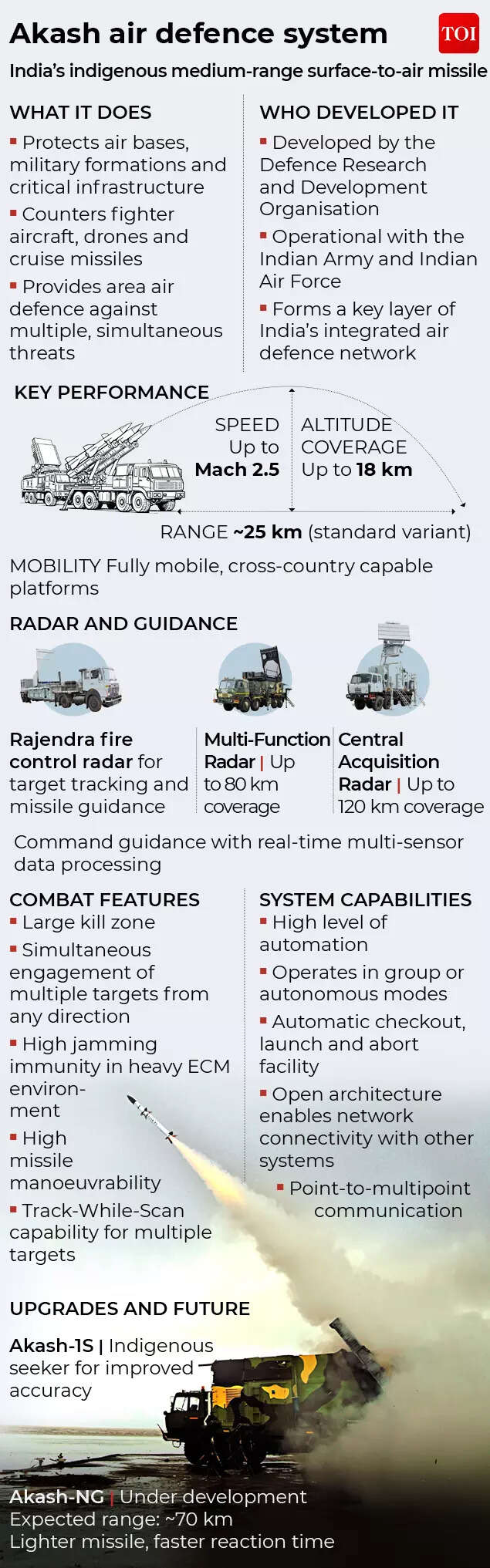
Advanced versions of the system — including Akash-1S with an indigenous seeker for improved accuracy and the under-development Akash-NG (Next Generation) with an extended interception range of around 70 kilometres — further highlight India’s push for technological upgrades and export competitiveness.
— DRDO (@DRDO_India) December 23, 2025
The system’s operational features include automatic launch and abort capability, high missile manoeuvrability, jamming resistance, and an open-architecture design that allows integration with other digital networks. Equipped with both multi-function and central acquisition radars, Akash can track multiple targets and provide real-time 3D measurements of range, azimuth, and elevation.Akash has also emerged as a promising success in India’s defence export efforts, with Armenia having inducted the system into its service. Its growing global interest underscores India’s expanding role as a reliable defence partner and exporter of advanced military technology.









 English (US) ·