

 1 hour ago
7
1 hour ago
7
ARTICLE AD BOX
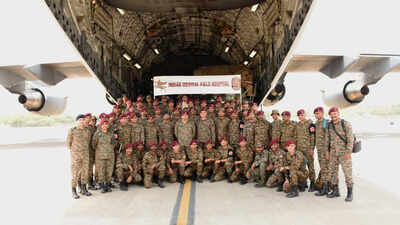
Soldiers of the 60 Para Field Ambulance, the same unit that earned high praise during the Korean War. (Image credit: Indian Army)
The Korean War which began on June 25th 1950 and lasted till 27 July 1953 was a devastating conflict that erupted when North Korea, backed by China and the Soviet Union, invaded South Korea, which was supported by the United Nations under US leadership.
Korea had been divided at the 38th parallel after Japan’s defeat in 1945, with rival governments emerging in 1948, with Kim Il Sung in Pyongyang and Syngman Rhee in Seoul. On 25 June 1950, North Korean forces captured Seoul, prompting the UN Security Council to mobilize troops from 21 nations, with the US providing the majority.By August, South Korea and its allies were confined to the Pusan Perimeter, but a daring UN landing at Inchon in September reversed the tide, leading to the recapture of Seoul and an advance into North Korea.
China’s intervention in October pushed UN forces back, resulting in a bloody stalemate. Armistice talks began in 1951 but dragged on until 27 July 1953, when the Korean Armistice Agreement established the demilitarized zone.
The war caused immense casualties—around one million military deaths and up to three million civilian deaths—while atrocities and heavy bombing devastated North Korea. No peace treaty was signed, leaving the peninsula divided in a “frozen conflict.”
India’s role in the Korean War was defined by principled neutrality, humanitarian commitment and pioneering peacekeeping. This at a time when the UN itself was an active combatant in the conflict. While refusing to send combat troops, India dispatched the 60th Para Field Ambulance in December 1950—its first UN mission and the largest medical contingent among the contributing nations. Known as “The Maroon Angels,” the unit under Lt Col AG Rangaraj operated close to the frontlines, treating over 222,000 patients, including UN soldiers, civilians, and even enemy personnel.
Their four-year tour until 1954 earned gallantry awards, including two Maha Vir Chakras, and established India’s reputation as an impartial humanitarian service. Lt Col AG Rangaraj is also India's first paratrooper as per an Indian Express report.This credibility positioned India uniquely during the prisoner-of-war stalemate. The 1953 Armistice created the Neutral Nations Repatriation Commission, with India at its helm.
To execute its mandate, India deployed Custodian Force India, commanded by Major General (later Lieutenant General) SPP Thorat and overseen by Lt Gen KS Thimayya, who would later become the army chief. Tasked with custody of over 20,000 prisoners of war, the CFI faced hostility from South Korea’s Syngman Rhee.On the ground, Indian leadership displayed remarkable restraint. In one crisis, Thorat personally defused a riot by Chinese prisoners of war. Such professionalism earned praise from global leaders, including President Eisenhower, as reported by the New York Times on June 13, 1953. India’s Korean mission was its first large-scale overseas peacekeeping effort, cementing a doctrine of active neutrality and laying the foundation for its enduring leadership in UN peacekeeping operations.



 English (US) ·