

 1 day ago
6
1 day ago
6
ARTICLE AD BOX
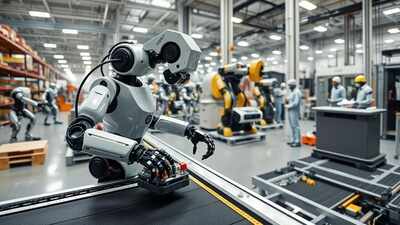
It has long been common to see LinkedIn posts from US-based Indian engineers lamenting the lack of opportunities to work on hardware back home, arguing that most roles remain confined to software.
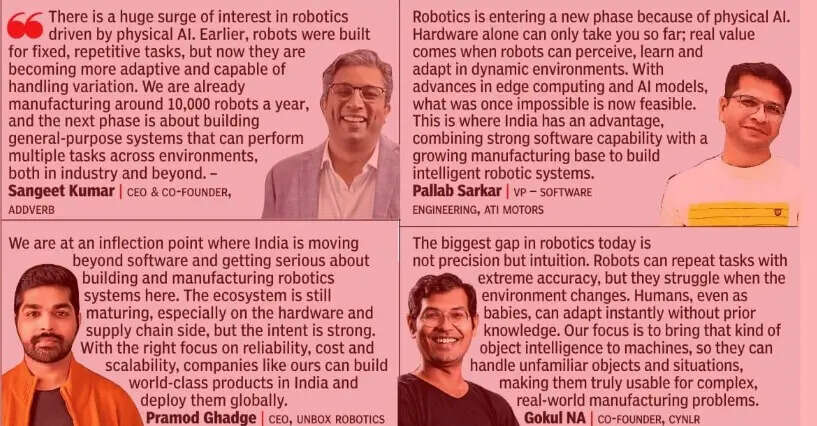
That perception, however, is beginning to shift, thanks in part to a new wave of robotics startups.From warehouse automation to adaptive factory systems and cutting-edge machine vision, firms such as Addverb, Unbox Robotics, Ati Motors and CynLr are collectively shaping what could become one of the country’s most consequential deep-tech ecosystems.“Indians are getting serious about robotics and even getting manufacturing done here, rather than just focusing on software,” Pramod Ghadge, CEO of Unbox Robotics, said.
His company builds swarm-based robotic systems that automate sorting and order consolidation in warehouses – a critical bottleneck in e-commerce logistics. The idea emerged from his time at Flipkart, where he saw first-hand how rigid and capital-intensive existing automation systems were.
Experts speak
Unbox’s approach is to deploy fleets of small, coordinated robots that can scale within the same warehouse footprint. “You can start with a 20-robot system today and then add more robots in the same layout as volumes grow,” Pramod explained.
The company has already deployed hundreds of robots across India and Europe, with most of its revenue coming from overseas – a reflection of where demand currently lies.That global demand is a recurring theme across the ecosystem. Indian robotics firms are often building for the world first. Pramod pointed out that while there is demand in India, automation typically makes economic sense only at scale, and in Europe, even mid-sized companies can justify such investments.If Unbox represents flexibility in logistics, Ati Motors is focused on industrial environments where conditions are dynamic and unpredictable. Its autonomous mobile robots (AMRs) are designed to handle material movement in factories – tasks that are “dirty, dull and dangerous”, as Pallab Sarkar, its VP of software engineering, put it.Ati’s differentiation lies in what it calls a “physical AI” layer. “You can innovate to a certain level with hardware, but when you try to perceive, learn and adapt based on the environment, intelligence comes into the picture,” Pallab said.
This intelligence allows robots to navigate changing factory layouts, avoid obstacles and optimise routes in real time – capabilities that are increasingly essential as manufacturing shifts towards more flexible, software-defined operations.The rise of such capabilities is tied to broader technological shifts. Edge computing has become powerful enough to run sophisticated models on-device, while advances in AI have made real-time perception feasible.
“What was not possible 20 years back can now be done in a palm-sized computer,” Pallab noted.Inflection point in roboticsThis convergence of AI and robotics is what many in the industry describe as a turning point. Sangeet Kumar, CEO & co-founder of Addverb, said there is a huge amount of interest in robotics today because of the rapidly evolving capabilities from fixed, pre-programmed machines to systems that can handle variability and learn from their environments.
“Earlier, robots were designed to perform one specific task repeatedly.
Now, with advances in AI, they can handle variation – different shapes, sizes and conditions – without needing everything to be perfectly structured,” he said.Addverb’s scale reflects how quickly the market is evolving. The company currently manufactures around 10,000 robots annually across different form factors, even as it has built capacity to produce up to 100,000 units a year.
Sangeet said the ambition is to move towards more general-purpose systems. “A generalist robot should be able to perform multiple activities – whether it is moving goods, assembling components or handling new, unfamiliar tasks,” he said.The challenges remain formidable. Building robots is not just about writing code; it is about integrating sensors, actuators, power systems and compute into reliable machines that can operate in the real world.CynLr is tackling one of the most fundamental challenges in robotics: perception and manipulation. Cofounder Gokul NA describes the problem in almost philosophical terms. Robots today can repeat tasks with extreme precision, but struggle when anything changes in their environment. Humans, by contrast, adapt instinctively. “Robots lack the intuition of even a human baby,” he said.CynLr’s approach is to build what it calls an “object intelligence” stack – a system that allows machines to understand and interact with objects in a more human-like way.
Instead of relying purely on pretrained data, its robots learn on the fly, using sensory inputs to figure out how to grasp and manipulate unfamiliar objects. “A baby need not know that it’s a pen, it will simply go and grab it,” Gokul explained.This focus on intelligence rather than brute-force data reflects a broader divergence in how companies are approaching the problem. While some rely heavily on simulation and large datasets, others are experimenting with more adaptive, realtime learning models.
The field, as Gokul put it, is still too early for any single approach to dominate.Issues in manufacturing & researchThere’s also the question of manufacturing these robots. Most companies still depend on imported components for critical parts such as sensors and specialised electronics. Ati Motors sources key navigation components like LiDAR from abroad, even as the electric vehicle ecosystem has improved local availability of motors and related hardware.Unbox Robotics said only a small number of parts are directly imported, but indirect dependencies – through global suppliers operating in India – remain significant. At the same time, companies are increasingly localising production. “We are today able to do mechanical parts, batteries, PCB assembly,” Pramod said.This gradual localisation is one of the clearest signs of the ecosystem maturing. But highquality vendors are limited, and companies often have to manage manufacturing processes closely rather than relying on a mature supply chain. Research is another area where India is still building depth. Pallab said research-led innovation needs stronger collaboration between industry and academia.









 English (US) ·