

 1 hour ago
3
1 hour ago
3
ARTICLE AD BOX
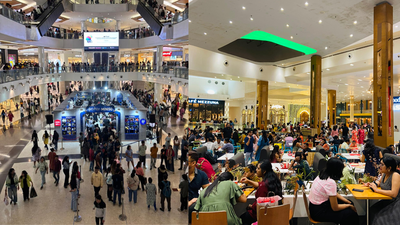
Global capital is flocking to India's thriving mall sector, attracting over $3.5 billion in the next three years, a stark contrast to Western markets facing closures
KOLKATA: As malls in Western economies braced for an existential crisis, global capital pivoted towards India’s mall sector, where consumption growth and institutional confidence counter broader retail headwinds.The US witnessed a net closure of nearly 1,200 mall stores since 2020, with rising vacancies forcing almost 40% of empty malls to undergo rezoning or repurposing. In contrast, ANAROCK Research & Advisory forecasts that India’s malls will attract over USD 3.5 Bn of capital inflows over the next three years.Anuj Kejriwal, CEO – Retail Leasing and Industrial & Logistics, Anarock Group, said, “Latest data shows that in next 3 years, Indian malls are set to see over $3.5 billion of capital inflows.
Meanwhile, 88+ foreign brands have entered the Indian retail market and are seeking to expand aggressively. Several more global brands are in the pipeline, seeking space in the severely restricted Grade-A assets currently available.
”As a counterpoint to Western markets, India’s massive unmet demand from a young consumer base and limited organised retail competition, backed by supportive FDI policies, attracted foreign brands and investors.
India’s per capita organised retail stock remains low, with Tier 1 cities operating at just 4-6 sq ft per person, Tier 2 and 3 cities at 2-3 sq ft, and Grade A mall space at barely 0.6 sq ft per person. By comparison, the US averages around 23 sq ft and China exceeds 6 sq ft“This gap, combined with India’s per-capita income nearly doubling in the last decade, has created a demand–supply mismatch virtually unheard of in global retail,” says Kejriwal.
“Grade-A malls are running near-full occupancy, reporting 95–100% leased space with long waitlists for key zones. Rental growth has consistently surpassed pre-pandemic levels, and developers now find leasing cycles outpacing construction cycles – a rarity anywhere in the world.
”India’s consumption economy is on track to reach USD 6 Tn by 2030, underpinned by a young population, rising incomes and rapid urban expansion.
Major malls routinely record daily footfalls exceeding 20,000 on weekdays and 40,000 at weekends, with F&B and entertainment accounting for 30–35% of visits.Sharpened investor appetite has intensified competition for quality retail assets. Of over 600 operational malls, fewer than 100 meet institutional benchmarks. “With its 19 malls’ portfolio housing 1,000+ brands and generating INR 1,600 Cr in annual NOI, Blackstone’s Nexus Select Trust REIT listing in 2023 kick-started retail-led REITs in India,” adds Kejriwal.
“It established the sector’s credentials as a transparent, scalable, and professionally managed asset class.
By 2030, at least two more retail REITs are expected to enter the Indian market.”Indian malls have also benefitted from e-commerce growth rather than succumbed to it. At around 8% penetration, online retail remains well below levels seen in China and the US. Many brands now adopt a ‘phygital’ model, using offline stores for experience and trust-building while online platforms drive scale.Grade-A malls in India typically deliver 14–18% IRRs, nearly twice the yields in many Western markets, supported by rental escalation cycles, consumption-linked revenue-sharing and consistently low vacancies. This value proposition underpins long-term investor interest.“This renders India unique among the world’s leading retail markets,” Kejriwal sums up. “In the US and Europe, malls are contending with oversupply, declining footfalls, online cannibalization – and the looming spectre of repurposing into other formats. In contrast, the Indian retail market has limited quality supply, rising incomes, heavy footfalls, and rapid brand expansion. In the first half of 2025, retail leasing in India rose almost 70% Y-o-Y, and new mall supply grew by over 160%.
”









 English (US) ·