

 1 hour ago
5
1 hour ago
5
ARTICLE AD BOX
Last Updated:March 23, 2026, 08:55 IST
The proposed National Aero Engine Test Complex will be a comprehensive facility where entire engines & their individual components can be tested in simulated real-world conditions


A project like this can accelerate indigenous engine development, shorten testing cycles, and improve reliability. (AI-Generated Image)
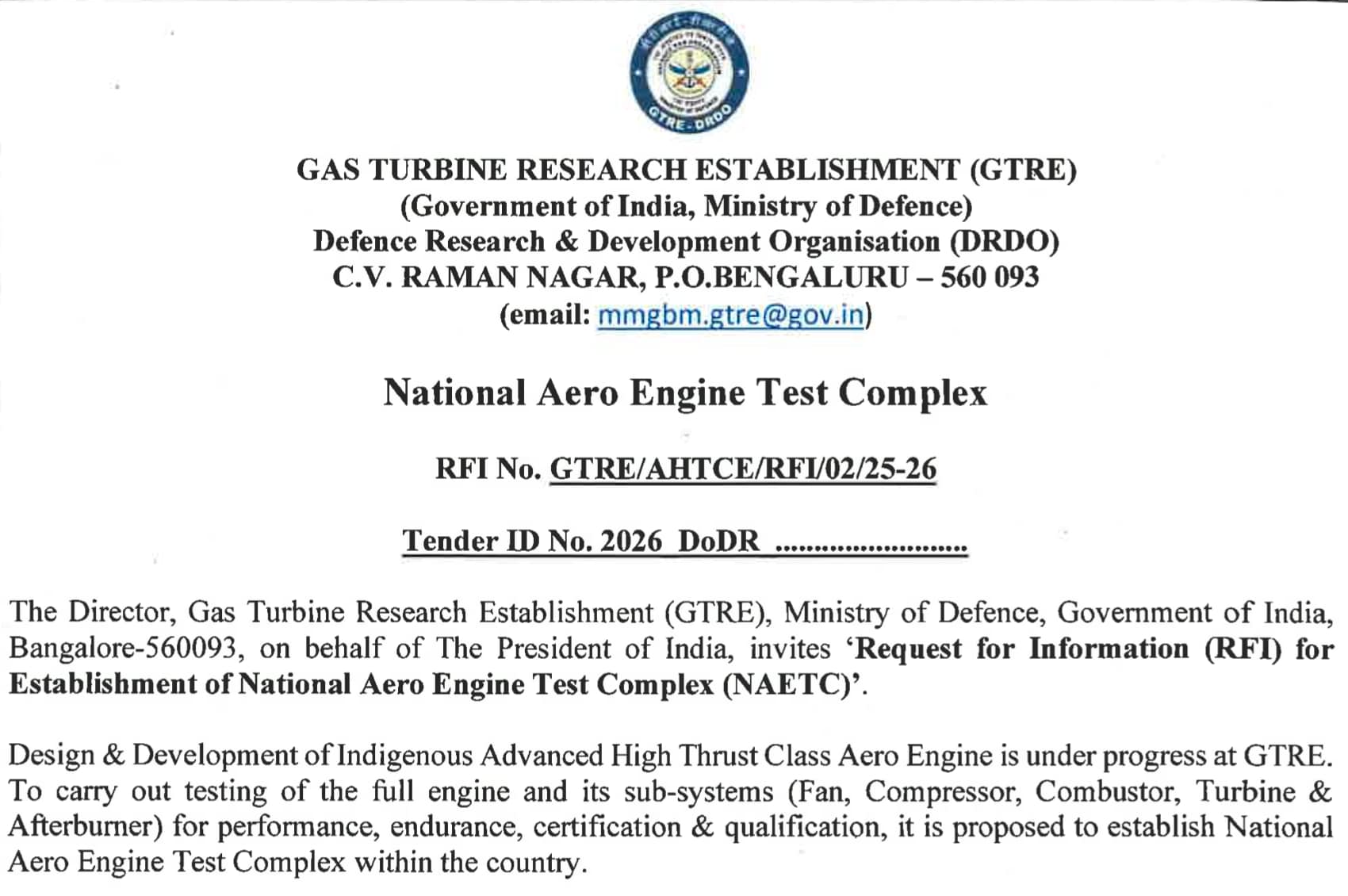
India is taking a quiet but significant step in one of the most difficult areas of defence technology—building its own jet engines. The Gas Turbine Research Establishment (GTRE), a key lab under DRDO, has put out a Request for Information to global and domestic firms to help set up a National Aero Engine Test Complex in the country. CNN-News18 has an exclusive copy of the document.
With this, India is trying to fix one of the biggest gaps that has held back its ambitions in military aviation for decades. The DRDO is already building an Indigenous Advanced High Thrust Class Aero Engine and will use the proposed testing facility to test the full engine and its sub-systems.
The proposed National Aero Engine Test Complex will be a comprehensive, integrated facility where entire engines, as well as their individual components—like fans, compressors, combustors, turbines and afterburners—can be tested in simulated real-world conditions. It would include systems that recreate high-altitude environments, along with sophisticated air heating and cooling setups. In simple terms, it would allow engineers to test an engine on the ground as if it were flying at 40,000 feet.
For years, India has struggled to develop a fully indigenous jet engine. The Kaveri engine programme, which began with high hopes, ran into multiple challenges—from not achieving the required thrust to issues with reliability. One of the less talked about reasons behind these setbacks has been the lack of advanced testing infrastructure within the country.
Jet engines are among the most complex technologies in the world. Only a handful of countries truly master them like the US, UK, France, Russia, China. This facility is a step toward joining that club.
Jet engines need to be tested repeatedly under extreme conditions: high altitude, intense heat, pressure variations, long-duration endurance runs. Without world-class testing facilities, even the best designs cannot be fully validated.
Most of India’s frontline fighter aircraft, including the Tejas, rely on engines sourced from foreign companies like General Electric. While these partnerships are important, they also come with limitations—from dependence on external suppliers to constraints on upgrades and technology access. In a worst-case scenario, geopolitical tensions or supply disruptions could directly impact military readiness.
DRDO’s latest move is not just about building a testing facility. It is about reducing that dependence, step by step. A project like this can accelerate indigenous engine development, shorten testing cycles, and improve reliability—all of which are essential if India wants to power its future fighter jets, including next-generation platforms, with homegrown engines, top officials pointed out to CNN-NEWS18.
There is also a broader economic and technological angle. By inviting global players, India is opening the door to collaboration, expertise sharing and possibly technology transfer. This could help build a stronger domestic aerospace ecosystem, create high-skill jobs and position India as a serious player in advanced propulsion systems.
In many ways, this is a foundational investment, officials say. “If India wants to be among the handful of nations that design, build and sustain their own jet engines, this is the kind of behind-the-scenes capability it needs to build," a top official told CNN-News18.
First Published:
March 23, 2026, 08:55 IST
News india India’s Big Jet Engine Push: DRDO Plans Mega Test Facility | Exclusive
Disclaimer: Comments reflect users’ views, not News18’s. Please keep discussions respectful and constructive. Abusive, defamatory, or illegal comments will be removed. News18 may disable any comment at its discretion. By posting, you agree to our Terms of Use and Privacy Policy.
Read More







 English (US) ·