

 1 week ago
8
1 week ago
8
ARTICLE AD BOX
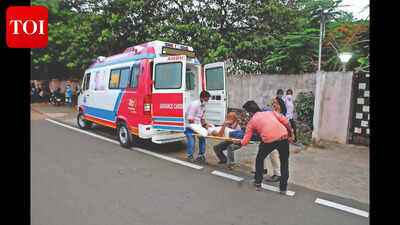
India grapples with a pervasive bystander effect, where fear of legal entanglements discourages helping those in distress. Despite a Good Samaritan law and advanced emergency systems, indifference prevails, turning life-saving acts into perceived self-harm. This learned helplessness, amplified by institutional failures, leaves citizens behind screens during public emergencies.
Srimathi VenkatachariIndia has never lacked crowds. It has perfected them. In Noida, a young tech professional drowned while people allegedly stood around filming his final moments.
The videos appeared online almost instantly.
Help did not. His father’s voice breaking, accusing now joins a growing chorus of grief asking a simple question: When did watching become easier than saving? A decade earlier, in Chennai, Swathi was hacked to death at Nungambakkam railway station. A public place. A busy hour. Commuters passed, vendors froze, cameras recorded. Authority arrived late. Society did not arrive at all.
She died not in isolation, but in full public view.From a Chennai railway platform to a Noida waterbody, the scenery changes. The response does not. Psychologists call this the bystander effect. In India, it has become a civic reflex. Responsibility evaporates in crowds, replaced by a paralysing fear of police stations, courtrooms, and that uniquely Indian threat: “You will get stuck in a case.”The Supreme Court has named this fear. In SaveLIFE Foundation vs Union of India, it bluntly acknowledged that the biggest reason Indians do not help accident victims is fear of harassment by police and legal machinery.
The Court responded with the ‘Good Samaritan law’: No liability, no compulsory disclosure, no forced hospital stay, no financial burden. The law exists. It lies unused, like an emergency exit nobody trusts.Tamil Nadu exposes the cruelty of this contradiction. The state runs one of India’s most advanced emergency response systems, 108 ambulances, free trauma care, insurance schemes and life-saving protocols. Yet bodies still lie on highways as crowds gather.
People drown at beaches while hundreds watch. Collapses during temple festivals produce panic, videos, prayers and delay.Article 21 promises the right to life. Courts have expanded it to include emergency medical care, timely rescue, and state responsibility. But no Constitution can protect life in a society that has normalised indifference. A right enforced only through autopsies, compensation cheques, and condolence tweets is not a right, it is paperwork.Other democracies are less sentimental about this. Several US states impose narrow duties to assist or at least report emergencies when it is safe, backed by widely known Good Samaritan protections. There, helping is not heroism. It is baseline citizenship.In India, helping still feels like self-harm. You rescue someone and inherit the burden, police questions, hospital corridors, court notices. The law may protect Good Samaritans on paper, but social practice punishes them relentlessly.The normative basis for Good Samaritanism in India finds resonance in classical Tamil moral philosophy. Thiruvalluvar’s Thirukkural emphasises compassion and the active prevention of harm as core ethical imperatives. Kural 571 advocates the avoidance of inflicting suffering, while Kural 572 extols the compassionate individual as possessing the highest form of human wealth. These precepts reflect a civilisational ethic in which the preservation of life is a moral obligation rather than an extraordinary act of heroism.
Contemporary acts of Good Samaritanism in Tamil Nadu demonstrate the continuity of these ethical principles within modern civic practice.Like in Tirunelveli, when a govt bus driver transformed his vehicle into an emergency transport following a road accident, administering first aid and ensuring rapid hospital transfer. Ranipet district collector S Valarmathi intervened to rescue schoolchildren after their van crashed into a ditch near Kaveripakkam, overseeing immediate medical care.
In Mannargudi, nurse M Vanaja administered life-saving CPR to an unconscious accident victim without hesitation.
These acts exemplify the operationalisation of ethical imperatives into civic conduct, bridging ancient moral norms with contemporary constitutional expectations.Yet the State’s protection of Good Samaritans remains inconsistent. On the East Coast Road in Tamil Nadu, three people were killed while assisting accident victims into an ambulance following an earlier crash.
Their deaths illustrate the structural vulnerabilities that persist despite judicial recognition of the moral and social value of rescue efforts.Even when legal intervention occurs, the outcomes are often circumscribed. In a decade-old Omni van accident in Chennai, the
Madras high court
reduced the driver’s sentence under Section 304A IPC from one year to four days, the period already served recognising that he had been transporting a stranger who had attempted suicide to hospital.
Justice D Bharatha Chakravarthy invoked res ipsa loquitur, noting that rescue-driven conduct cannot be judged by ordinary negligence standards. This jurisprudence underscores a tension in Indian law: while Good Samaritan actions may be morally valorised and judicially mitigated, they remain exposed to the vagaries of criminal liability and procedural uncertainty.This is not apathy. It is learned helplessness, cultivated by institutions and absorbed by society. We have created a system where the safest place during a public emergency is behind a screen.(The writer is an advocate in Madras high court)





 English (US) ·