

 1 hour ago
6
1 hour ago
6
ARTICLE AD BOX
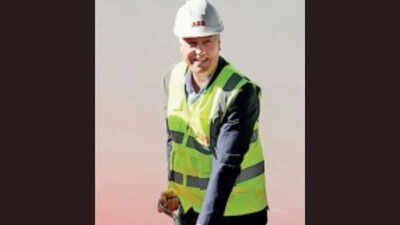
MORTEN WIEROD, CEO, ABB: Breaking ground for yet another plant in India. A facility that’s just been launched in Bengaluru will focus on producing UPS’s for data centres. Data centres is today ABB’s fastest growing business
We met Morten Wierod, CEO of the $33-billion electrification and automation group ABB, at a brand-new factory the company has set up in Bengaluru. The facility will focus on a new product category—UPS (uninterruptible power supply) systems for data centres.
“We see a very large pipeline now for data centres in India,” Wierod tells us.ABB’s next technology leap is being built around data centres and AI. A growing part of that work is also being shaped in India, where the group has built significant engineering, R&D, and manufacturing capabilities that support both local and global customers.AI is driving a massive expansion in computing infrastructure, pushing power demand to new levels.
The data centre business, which contributed less than 1% of ABB’s global revenue in 2019, now accounts for 9%. “It’s the fastest-growing segment for us, growing almost 35% every year,” Wierod says.While UPS systems sit next to server racks inside a data centre, ABB’s larger business comes from the electrical infrastructure outside—substations, medium-voltage switchgear, transformers, low-voltage systems, and power distribution equipment.
Large AI data centres now consume so much electricity that some are comparable to power plants, generating about 1 gigawatt of power.Another major shift is underway inside data centres. Nvidia is working towards a new 800-volt DC architecture—up from the current 48/54-volt systems—to improve power efficiency. This will significantly change how power is delivered to high-density computing racks. Today, racks may consume 100–150 kilowatts, but new AI racks could require up to 1 megawatt.
“We are working with Nvidia to design that next generation of data centres,” Wierod says, adding that such facilities are expected by 2028.AI is also transforming ABB’s own software and automation work. The company is focusing on applying AI across industries where it already has strong domain expertise. Much of this work is being led by ABB’s team in Bengaluru, which has around 4,000 employees. About half of them are engaged in R&D for new solutions—producing over 75 patents—while the rest work on project execution for global customers.One notable innovation is software that helps customers migrate from legacy control systems to upgraded ones. These systems are often large and complex, such as those used in offshore oil and gas platforms or refinery management. “Changing such a system is a massive exercise,” says Sanjeev Sharma, MD of ABB India. “We had a team in Paris that used to take about three months for this conversion. With the software built here, we can now do it in half a day.
”The India team has also developed Genix, an AI layer that sits on top of industrial control systems. These systems generate vast amounts of plant data, and Genix uses that data to provide deeper insights, helping customers make better decisions around production and maintenance.In addition, the centre has built domain-specific AI agents for industries such as cement, steel, and chemicals. These agents are trained on ABB’s internal reports, maintenance records, and process knowledge.“If you ask ChatGPT today how to run a cement plant, you may not get very good answers,” Wierod says. But ABB’s specialised AI agent for cement plants, built using its domain expertise, acts like a first-response service assistant—helping operators understand control-system issues, offering advice, and enabling engineers to identify the right spare parts before visiting a site.“Teams in India have been core to these advances,” he says.









 English (US) ·