

 4 days ago
13
4 days ago
13
ARTICLE AD BOX
Most explainers online fail to break down the fundamentals of LPG, LNG, PNG and CNG.
Most kitchens in India have one common item: the red LPG gas cylinder.
But now, the everyday Indian kitchen is at the centre of a major change. In areas where Piped Natural Gas(PNG) networks are available, the government has mandated a switch to PNG connections within three months.
The energy crisis at home has deepened as the war in the Middle East stretches beyond a month, causing some of the worst disruptions to the global fuel market in recent years.
By late March 2026, an estimated 2,500 commercial vessels carrying critical oil and gas supplies were still stranded in the Hormuz corridor. For India, the alarm runs deeper. The maritime route that once handled nearly 90 per cent of its imported LPG has slowed to a near standstill. The situation has been made worse by attacks on energy infrastructure across the Middle East, with key facilities damaged or forced out of operation.
So India is trying to move the kitchen off the ship and on to the pipe. But that shift is neither simple nor seamless. For more than 33 crore LPG users, it opens up a chain of immediate questions and a lot of confusion. If India is under pressure, why not just produce more LPG at home? What exactly makes LPG different from PNG? Why does one arrive in cylinders while the other flows through pipelines? And many more.
These questions lead us back to the basics of how these gases work. India Today’s OSINT team has built a clear, no-nonsense explainer, drawing on official data and public records, to break down the fundamentals of how India cooks.
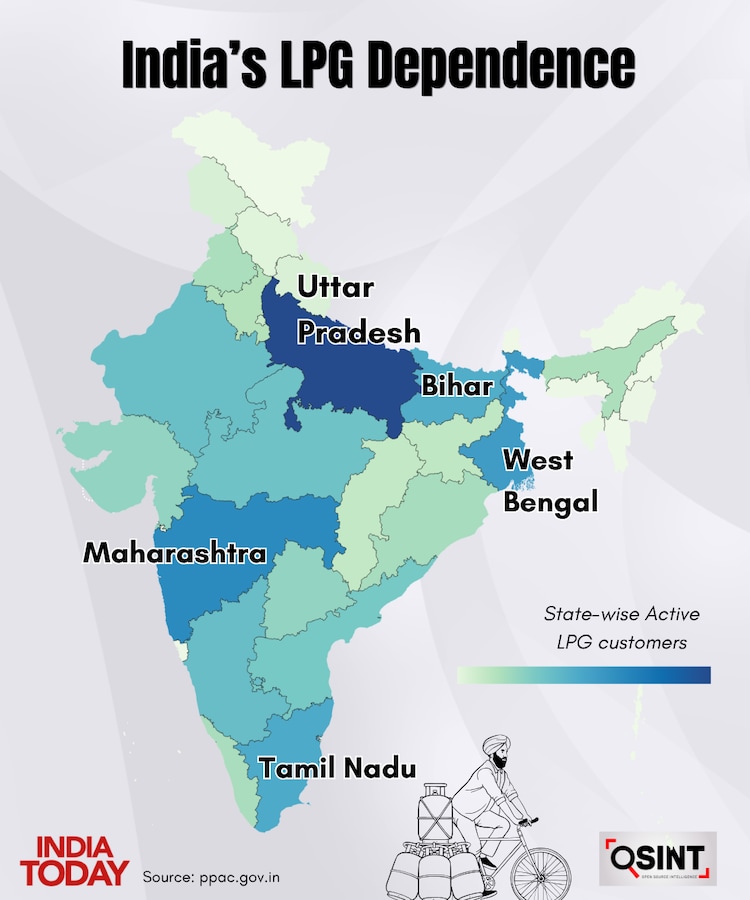
For most Indian households, cooking still means the LPG cylinder in the kitchen. The numbers show about 95.3 per cent of reported household gas connections are LPG, while PNG accounts for only 4.7 per cent. That means the shift to piped gas has begun, but it is still limited to pockets of the country.
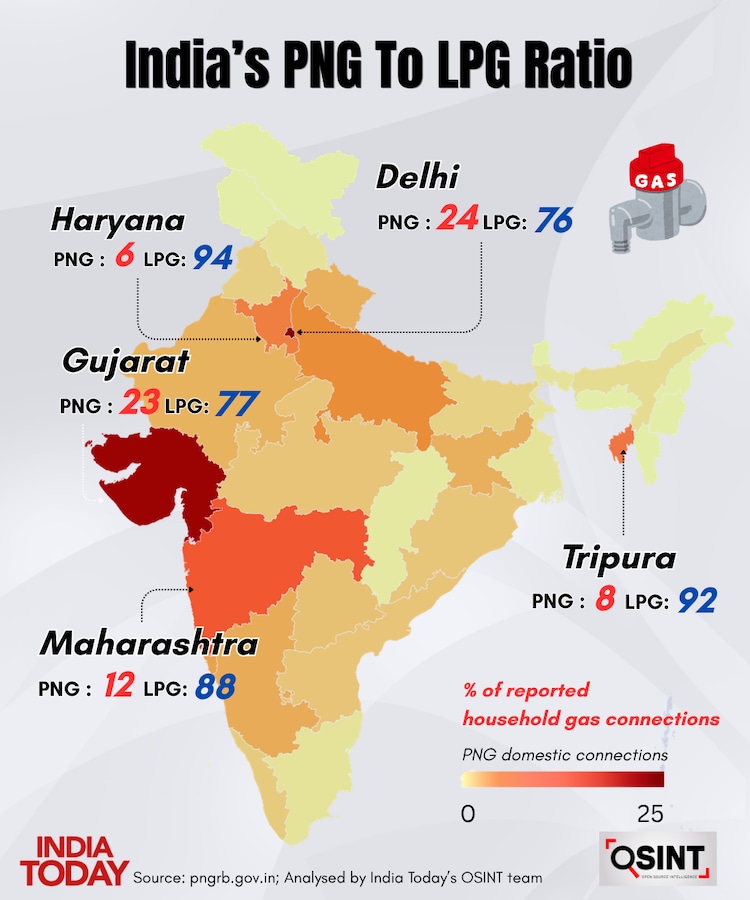
Data reviewed from the Petroleum and Natural Gas Regulatory Board and analysed by India Today shows that the transition is concentrated in a few urbanised and better-networked markets, with Delhi, Gujarat and Maharashtra showing the strongest PNG presence, while Tripura and Haryana also stand out relative to most other states.
PART 1: THE WHAT
Think of them as gases from the same family, all hydrocarbons, but in different outfits. LPG, the gas in India’s red cylinders, is mostly propane and butane. PNG, CNG and LNG, meanwhile, are all versions of natural gas, mostly methane, processed in different ways: piped, compressed or chilled into liquid form. 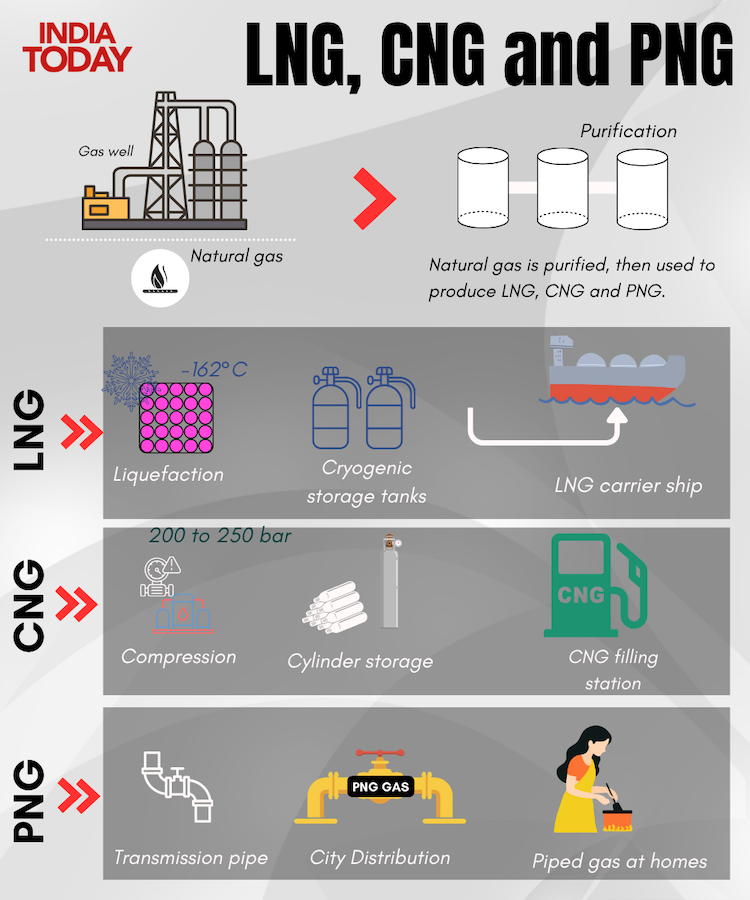
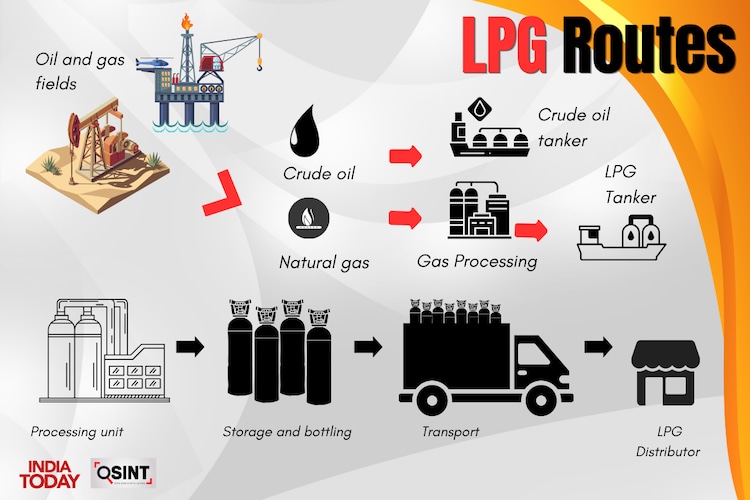
The difference lies in how these fuels are produced. LPG is not mined or extracted on its own — it is made. More accurately, it is a by-product of crude oil refining and, in some cases, of natural gas processing. When wet natural gas is extracted, it contains methane along with heavier gases like propane and butane. These are separated out — and that forms LPG. 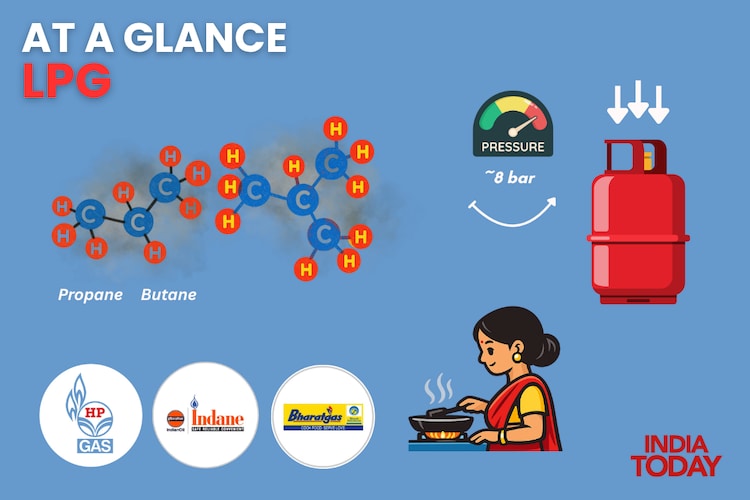
PART 2: THE WHERE AND HOW
In India, most LPG comes from refineries rather than gas fields. During crude oil refining, the oil is heated and separated into different components based on its boiling points in a process called fractional distillation. LPG is one of the lighter fractions that separates out during this process, alongside other fuels like petrol, kerosene and diesel. 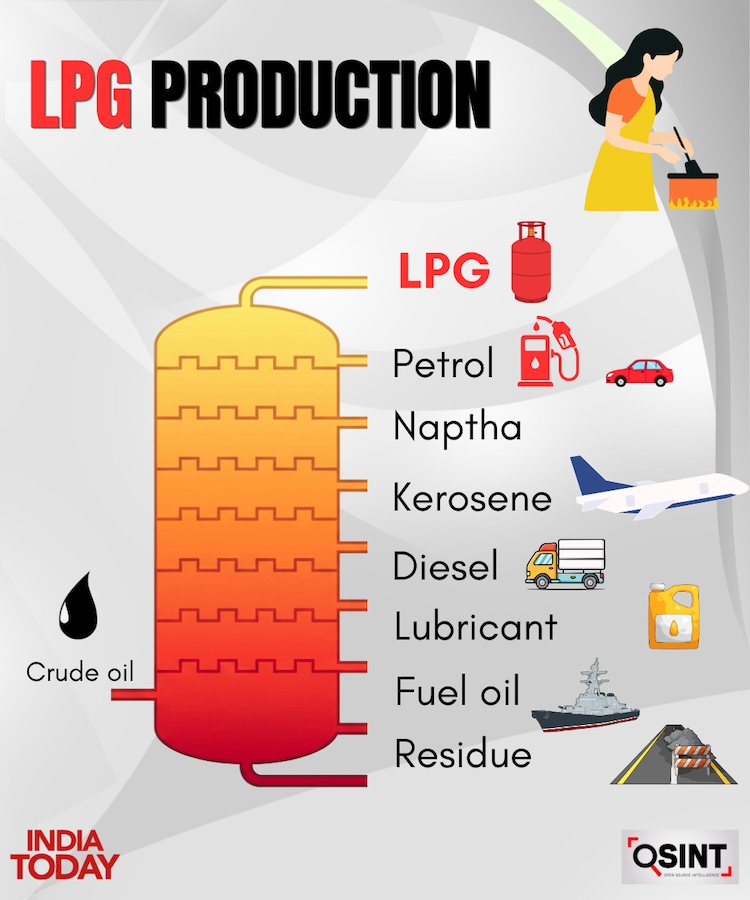
Natural gas is extracted from gas wells and oil-and-gas fields. The US Energy Information Administration (EIA) explains that gas from wells is often "wet" gas containing methane plus natural gas liquids and impurities and must be processed before sale. 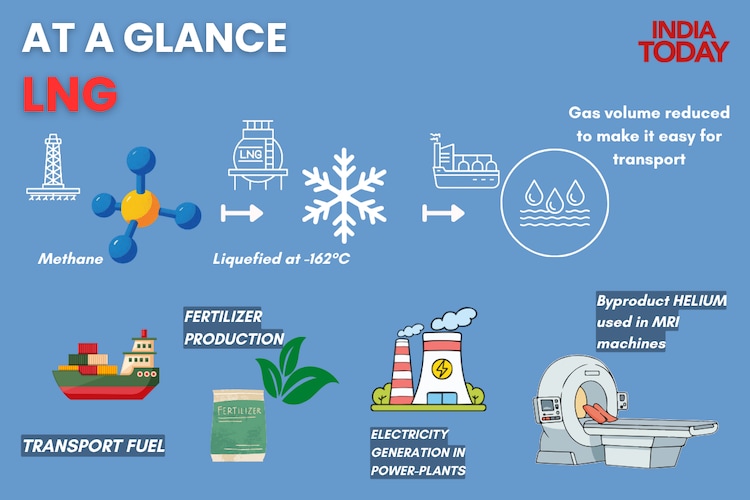
LNG is natural gas, mainly methane, that has been cooled to about -162°C so it turns into a liquid. In this form, it occupies far less space than gas, making it easier to transport over long distances by ship. In India, LNG is mostly imported through terminals, where it is turned back into gas through regasification and then supplied into pipelines for uses such as PNG, CNG, power and industry.
In India, both imported LNG and natural gas produced from domestic gas fields are supplied for end uses such as CNG and PNG. LNG is first regasified at import terminals, while domestic gas enters the network after processing. 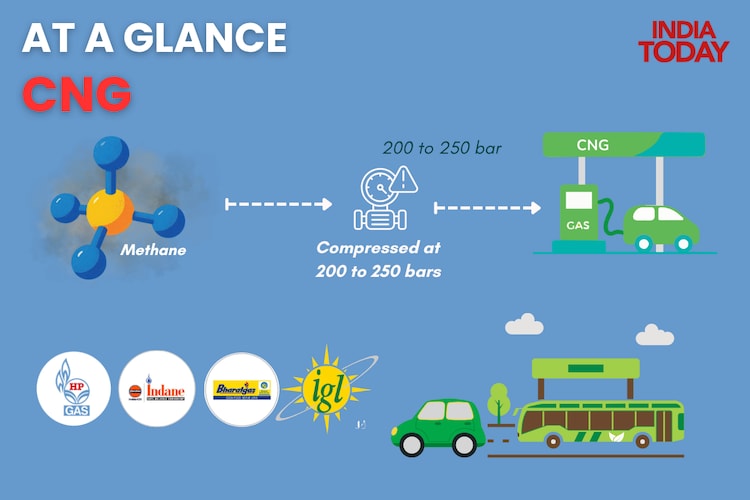
CNG is the natural gas that has been compressed to very high pressure for storage in cylinders and vehicle tanks. It is still natural gas, just pressurised rather than liquefied. 
PNG, or the pipeline-quality natural gas, is the processed natural gas that reaches homes, shops and factories through pipelines. It is not a separate hydrocarbon. It is simply the form after processing, transmission and local distribution.
PART 3: INDIA'S IMPORT DEPENDENCE
The Indian government said in March 2026 that about 60 per cent of the country’s LPG consumption is met through imports. Earlier, much of this came from Gulf suppliers such as Qatar, the UAE, Saudi Arabia and Kuwait. In recent years, however, sourcing has been diversified to include countries like the United States, Norway, Canada, Algeria and Russia. Imported gas is processed and filled in cylinders before distribution.
Natural gas tells a similar story. India does have domestic reserves, but production is not enough to meet demand, which is why LNG imports remain crucial. According to Petroleum Planning & Analysis Cell (PPAC) data for January 2026, domestic gas production stood at 2,941 MMSCM, while LNG imports were 2,865 MMSCM, taking total consumption to 5,806 MMSCM.
In effect, imported LNG accounted for roughly half of India’s gas consumption, with domestic production making up the rest forty-nine per cent.
India does not import PNG as a separate fuel. It is simply processed natural gas either produced domestically or obtained after regasification of imported LNG and then supplied through city gas pipelines.
Again, India does not import CNG as CNG. CNG sold in India is compressed domestically from the same gas pool that feeds city gas systems: domestic gas plus regasified LNG.
PART 4: INDIA'S DOMESTIC PRODUCTION
LNG, CNG and PNG are the processed and delivery forms of natural gas. Crude oil, natural gas, condensate, and sometimes natural-gas liquids are extracted from gas fields in India. While LPG can be recovered from natural gas streams, most of India’s LPG also comes only from refineries.
The reason: India has limited oil and gas reserves. It imports roughly half of its natural gas needs as LNG. But LNG does not solve the LPG problem.
That is because LPG and LNG come from different parts of the gas stream. Raw natural gas from a field contains mostly methane, along with heavier hydrocarbons such as propane and butane. Those heavier components are separated early in processing, and that is where LPG comes from. What remains is mostly methane. That methane is then transported as PNG, compressed as CNG, or cooled into LNG for shipping.
So by the time natural gas becomes LNG, the propane and butane have already been removed. Regasifying LNG simply turns it back into methane-rich natural gas. It does not recreate LPG. Turning methane into propane or butane would require a separate, complex chemical process.
According to the Directorate General of Hydrocarbons, India’s main conventionally producing hydrocarbon basins include the KG Basin, Mumbai Offshore, Assam Shelf, Rajasthan, Cauvery, Assam-Arakan Fold Belt and Cambay. DGH’s latest basin-wise gas production data for 2023–24 shows Mumbai Offshore leading with 40.71% of national output, followed by the KG Basin at 31.67%. The Assam Shelf entry appears in the production table as Assam-Arakan Shelf, contributing 9.69%, while Rajasthan accounted for 6.03%, Assam-Arakan Fold Belt 4.18%, Cambay 3.13% and Cauvery 2.80%.
PART 5: THE CURRENT STATE
Publicly available government data indicates that while the system came under stress in March 2026, supplies remained largely under control. LPG availability was closely monitored, with no reported dry-outs at distributorships. After an initial spike driven by panic buying, booking levels began to stabilise. According to the Petroleum Planning and Analysis Cell (PPAC), LPG bottling plants typically maintain a cover of about 4 to 7 days, depending on the region.
India’s retail base also remains extensive, with around 33.21 crore active domestic LPG connections as of January 1, 2026, including about 10.43 crore PMUY beneficiaries. To manage supply pressures, the government partially restored commercial LPG supplies to 20 per cent and, on March 18, 2026, proposed an additional 10 per cent allocation to States and Union Territories linked to PNG expansion efforts.
The natural gas system, however, was tight enough for the government to invoke a Natural Gas Control Order on March 9, 2026, under the Essential Commodities Act. The order prioritised uninterrupted supply to critical segments, including 100 per cent allocation for domestic PNG and CNG, to manage disruptions linked to West Asia.
India currently operates around eight onshore LNG terminals with a combined regasification capacity of about 47.7 Million Metric Tonnes Per Annum (MMTPA), or roughly 170 Million Metric Standard Cubic Meters per Day(MMSCMD).
To stabilise the system, additional LNG cargoes and regasified LNG (RLNG) have been sourced, while supply to operating urea plants has been maintained at around 70–75 per cent of their recent average consumption.
Within this framework, household and transport segments have been protected. India had around 1.62 crore domestic PNG connections as of late 2025, with the government maintaining full supply to households, estimated at about 3.73 MMSCMD.
Similarly, the CNG network, with 8,609 stations across the country, has continued to receive 100 per cent supply under the emergency allocation system. The current approach reflects a prioritisation strategy — shielding households and transport, while managing industrial demand to balance a constrained but functioning gas supply system.
- Ends
Published By:
bidisha saha
Published On:
Mar 31, 2026 18:52 IST
Tune In






 English (US) ·