

 1 hour ago
7
1 hour ago
7
ARTICLE AD BOX
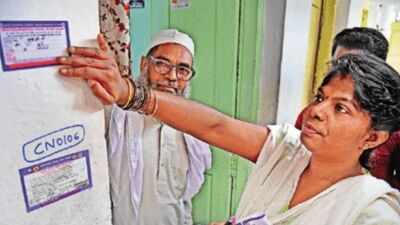
Shruthi KC, anganwadi teacher-turned-BLO, at a voter’s residence in Chickpet constituency
For 59,050 booth-level officers, the Special Intensive Revision (SIR) of electoral rolls promises to be a grueling month-long marathon. These grassroots workers have to go door-to-door to verify voter details, collect documents, and update records.
spent a day with Shruthi KC, anganwadi teacher-turned-BLO, in Chickpet (Bengaluru) assembly constituency to capture the ground realities 8AM | Managing morning anxietyFuelled only by a hurried early breakfast at home — mouthfuls gulped down while scanning her checklists — Shruthi seemed already under pressure. Long before hitting the streets near polling booth area 201, Shruthi’s phone had been ringing off the hook since 5am with citizens sending voter card photos. At the location, she faced an anxious crowd at a local mosque operating as a quasi-voter facilitation centre. Terrified of deletion, voters walked toward her and the stack of 500 enumeration forms she carried. As the sole custodian of these papers, Shruthi had to find a fine line between being assertive and accommodative. She checked voter IDs against her lists, assured citizens that she would visit each house individually, and prevented a chaotic bottleneck.
11AM | Tech hurdlesBy 11am, we set out on foot through a maze of narrow lanes, accompanied by BLA, a team of volunteers and her supervisor. The drive immediately hit a technological snag: The official ECI app malfunctioned on Shruthi’s smartphone. Improvising, she used an agent’s phone to verify the part number and serial number of the paper and scanned the family’s QR code on her ‘EF distribution tracker’. She handed over the forms and asked them to fill it before her next visit. The visit concluded with her pasting a purple-bordered sticker on the house, entering the assembly name, booth number, form serial number, and her contact details. 1PM | Locked doors & rickety stairsAdministrative gaps and physical hurdles tested her progress. The next house was locked. Surprisingly, Shruthi had not been supplied with the mandatory, red-bordered stickers. “They (officials) said we would have to put them after three visits and hence will be given later,” she said. This directly contradicts ECI guidelines, which mandate that locked houses receive a red sticker on the first visit to serve as an immediate audit trail. The physical layout presented its own ordeals. We climbed a rickety metal staircase supported by loose wires to reach a third-floor voter. Here, we encountered a common systemic bottleneck: A woman was registered under Shruthi’s booth, but her husband was mapped to another.
This meant another BLO would have to climb the same dangerous stairs, leaving the household with a confusing clutter of multiple stickers. Before pushing forward, a quick lunch was squeezed into a 20-minute pause — Rs 25 rice and sambar from a local eatery — while keeping her heavy ledgers always close to her. Even during her meal, voters had gathered around her and approached her to visit their house first, which went against a systematic combing of the area that she had planned.
The pressure intensified when a local politician and supporters arrived, attempting to join the drive. 3PM | Data quagmire & political pressureWord spread, and with every house she visited, different communities gathered outside it to invite her home next. A political representative threw in his two cents, “Why don’t you sort out the sheets by the street numbers and that way you cover houses street by street.” Shruthi and her BLA2 tried sorting for a bit, but realised they would run out of time, and went back to their original plan combing all streets, regardless of people there being in their booth or not. The process devolved into a time-consuming quagmire, averaging 30 minutes per household. Older voter IDs failed to show up via digital mobile searches, forcing Shruthi to look up nine separate data categories on the app. Concurrently, a political worker aggressively questioned why his mobile number displayed his family’s data but omitted his own name. A father anxiously inquired how to register his 20-year-old son without Form 6 — a document that Shruthi had not been provided with. 4.30PM | Confounding end-of-day queriesAs evening neared, Shruthi was bombarded with complex queries, even as the sky was getting overcast, prompting her to pause work for the day. A displaced homeowner rushed up to ask whether he should wait at his old house or if he would receive his form at his new address two streets away. Flooded with queries, Shruthi noted the issues and promised to return. Her calls to her seniors who had to deal with nine other BLOs went unanswered. As the sun dipped, the bottom sheets in her bag were already fraying. With more days of gruelling walks ahead, the integrity of Karnataka’s voter list rests on the endurance of these resilient frontliners.






 English (US) ·