

 1 hour ago
3
1 hour ago
3
ARTICLE AD BOX
The US torpedoed an Iranian warship, IRIS Dena, near Sri Lanka in the Indian Ocean, sparking an intense debate over India's role and responsibility in the strategic waters. Does the Indian Ocean mean India's ocean? What about India's maritime jurisdiction and its role as the guardian of the Indian Ocean?
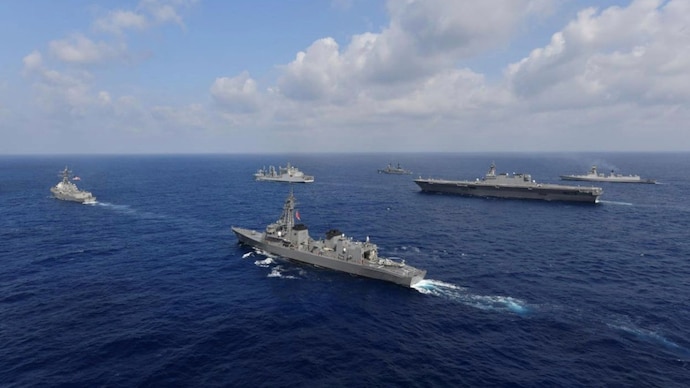
Vessels the US and Indian Navies, and Japan Maritime Self-Defense Force and the Philippine Navy sail in formation at sea, in the Indian Ocean. (Image: Reuters)
New Delhi,UPDATED: Mar 5, 2026 14:06 IST
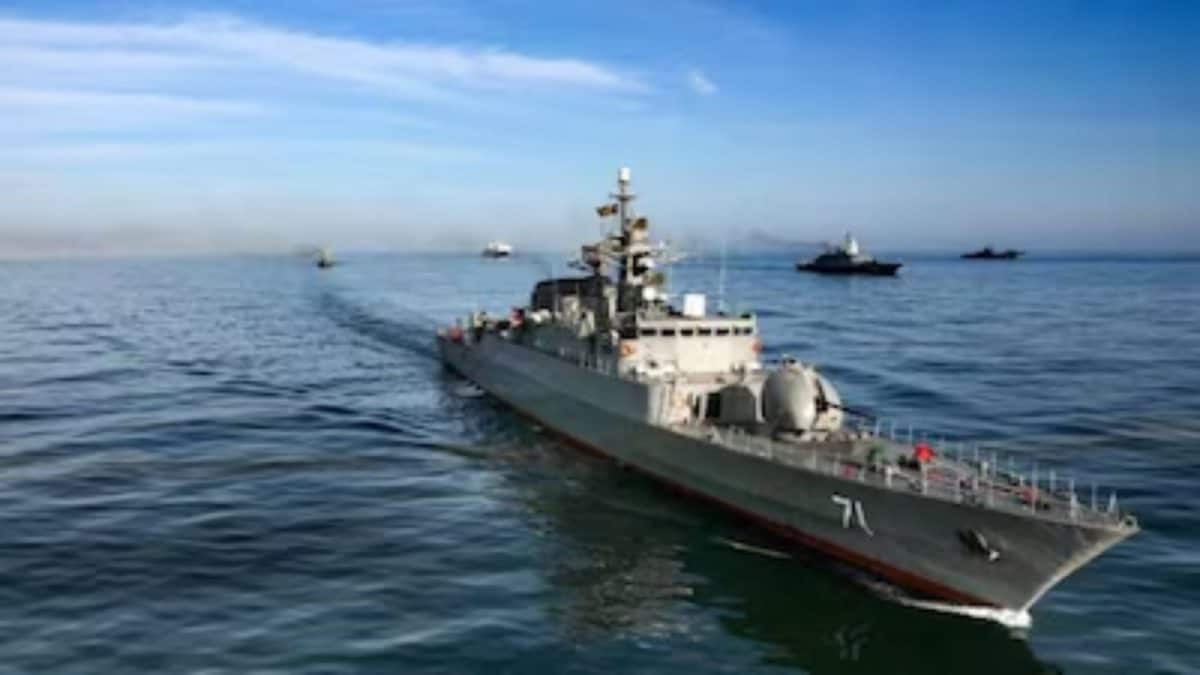
There are five oceans in the world and the Indian Ocean is the only one to be named after a country. But to what extent does India have its maritime jurisdiction in the Indian Ocean? This question comes in the wake of the escalation of the Iran war in India's strategic backyard, where a US Navy submarine torpedoed and sank the Iranian frigate IRIS Dena on Wednesday morning. There is intense debate on India's role and responsibility in waters that India considers itself a guardian of.
At the outset we need to get one thing clear. The IRIS Dena, which was returning after a naval drill in Visakhapatnam, Andhra Pradesh, was torpedoed in international waters, where India doesn't have any jurisdiction.
Defence analysts said the sinking of the Iranian warship has brought the Iran war to India's doorstep. The incident occurred about 40 nautical miles south of Galle, Sri Lanka, in what US officials described as international waters. Regardless, the attack occurred not far from India's shores.
The Indian Ocean is named after India due to the country's geographical centrality. The Indian peninsula juts into the ocean, which spans about 70 million square kilometres, connecting Asia, Africa, and Australia. Historically, the ocean was referred to in the Indian context.
But despite the name, it's not India's private domain. The ocean is shared space, governed by international law. Coastal nations assert only limited claims to the ocean.
Under the United Nations Convention on the Law of the Sea (UNCLOS), signed in 1982 and ratified by over 160 countries, the Indian Ocean is divided into zones with varying degrees of control.
These rules balance coastal states' interests, and grant freedom of navigation to other countries as well.
The IRIS Dena incident occurred within Sri Lanka's maritime zones, but was deemed permissible under wartime rules, as warships enjoy passage rights in most areas.
HOW FAR IS INDIA'S MARITIME JURISDICTION IN INDIAN OCEAN?
India's maritime reach in the Indian Ocean is substantial, but finite. With a coastline of over 7,500 kilometres, including the mainland, Andaman and Nicobar Islands, and Lakshadweep, India claims an Exclusive Economic Zone (EEZ) of approximately 2.3 million square kilometres — the 18th largest globally.
This zone extends 200 nautical miles (about 370 kilometres) from India's baselines, granting sovereign rights over natural resources like oil, gas, minerals, and fish.
Within its EEZ, India has exclusive authority to explore, exploit, and manage these resources.
For instance, it regulates offshore drilling in the Arabian Sea and Bay of Bengal, where major fields like Mumbai High contribute to energy needs.
The Andaman and Nicobar chain extends India's EEZ eastward, overlapping strategic chokepoints like the Malacca Strait.
However, other nations also retain freedoms of navigation, overflight, and laying submarine cables in the EEZ, as long as they don't interfere with India's economic activities.
WHERE DO THE HIGH SEAS START IN INDIAN OCEAN?
Beyond the EEZ lies the high seas, where no country has sovereignty.
India's territorial sea, where it exercises full control like on land, extends only 12 nautical miles from the coast. It is around 22 kilometres.
A contiguous zone up to 24 nautical miles allows enforcement of customs, immigration, and sanitation laws. India's jurisdiction doesn't cover the entire Indian Ocean; it's a patchwork, shared with neighbours like Sri Lanka, the Maldives, and Indonesia.
Strategically, India views the Indian Ocean as its "backyard", a sphere of influence important for both security and trade. Over 90% of India's trade by volume passes through these waters, and threats like piracy or rival navies could disrupt supply lines.
India has aircraft carriers, submarines, and bases in the Andamans to deter intrusions, especially from China, which has challenged this move by building ports in Sri Lanka and Pakistan.
The IRIS Dena sinking, outside India's EEZ, but in the broader ocean, shows that like China, even the US operates freely here.
INTERNATIONAL WATERS, HIGH SEAS AND FISHING RIGHTS
International waters, often synonymous with the high seas, begin beyond the 200-nautical-mile EEZ. Here, all nations enjoy freedoms: navigation, fishing, research, and resource extraction from the seabed, which has to be regulated by international bodies.
No state can claim ownership, ensuring open access for trade and military movements. The IRIS Dena was in such waters—technically within Sri Lanka's EEZ, but treated as international for navigation purposes, allowing the US strike under freedom of the seas principles.
Fishing rights vary by zone.
In territorial seas (0-12 nautical miles), the coastal state has absolute control; foreign fishing is banned without permission. In the EEZ (12-200 nautical miles), the coastal nation holds exclusive rights to fish stocks, conserving them and licensing others if surplus exists.
India exploits about 3.2 million tonnes annually from its EEZ, out of a potential 3.9 million, focussing on sustainable practices.
Trawling, a method of dragging nets along the seabed, is allowed in EEZs but regulated to prevent overfishing and habitat damage.
On the high seas, fishing is open to all but governed by regional agreements to avoid depletion.
The Indian Ocean bears its name, but its waters are a common jurisdiction ends at 200 miles. Defence strategy demands vigilance way beyond.
- Ends
Published By:
Anand Singh
Published On:
Mar 5, 2026 14:06 IST





 English (US) ·