

 1 hour ago
4
1 hour ago
4
ARTICLE AD BOX
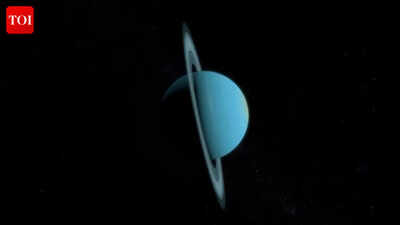
For years, everyone assumed our solar system’s eight planets (nine, when Pluto was within the fold) were the whole story. Planets, moons, asteroids, comets, and that’s all — case closed.
But there’s a growing suspicion that the solar system was once even busier, maybe with another giant planet or two that got tossed out into deep space long ago. Now, some astronomers think the clues aren’t hiding in other star systems, but are actually right here, wrapped up in the frozen, battered moons orbiting distant Uranus.These moons, usually overshadowed by the showier satellites of Jupiter and Saturn, could be holding onto the scars of ancient disasters — all the cosmic chaos when giant planets migrated, collided, or ejected their siblings.
Studying their strange shapes and survival stories might help scientists piece together what really happened in the solar system’s wild early days.
Does the solar system have more ‘missing’ planets?
Believe it or not, the idea that planets are “missing” isn’t so crazy. Scientists have long suspected that Jupiter, Saturn, Uranus, and Neptune didn’t start out where they are now. Early in their history, they orbited much closer, in a tightly packed dance with gravitational shoves and close calls.
During this messy phase, often called the giant planet instability, things got rough. So, the planets could have been thrown out entirely.
Some models even predict one or two extra ice giants, maybe the size of Uranus or Neptune, that got flung out and lost to interstellar space.So where does Uranus come in?Uranus has always been one of the odd ones — spinning on its side, with its poles basically where its equator should be.
That tilt likely came from a massive impact, but new research suggests it went through even more eventful occurrences.According to Wired, a recent Icarus study details that scientists ran more than a hundred, 122 to be exact, computer simulations to see how Uranus’ moons would fare during the solar system’s wild youth. In most cases, those moons didn’t make it through; their orbits got scrambled, or they were destroyed.
Yet, Uranus’ moons are still there.How so?The researchers came to the conclusion that its current configuration could only take place under the scenario of an episode of violent instability. And this type of instability and this chaos, which likely destroyed and rebuilt the moons, only appears in models where more giant planets existed than we see today.Now, all eyes turn to Miranda, the oddest of the bunch. Of Uranus’ five big moons, Miranda is the smallest and, honestly, looks like it’s been stitched together from leftovers.
Its surface is a patchwork of cliffs, ridges, and broken terrain, like it was smashed up and haphazardly glued back together. Astronomers have long guessed that Miranda was destroyed and rebuilt at some point. The latest research makes that seem even more likely.
If Miranda really is a rebuilt world, it could be one of the oldest, weirdest witnesses to whatever went down during our solar system’s rowdiest era.And Miranda isn’t the end of the story. Scientists suspect there are even more tiny, hidden moons buried in Uranus’ rings.
Odd ripples and waves in those rings hint at unseen “moonlets” shaping the patterns, while the outer rings hint at gravitational influences from still-undiscovered objects. Every new moon found could add another clue about what Uranus lived through, and what got lost along the way.
What’s next?
So, what’s the biggest issue here? We’ve barely visited Uranus.Only Voyager 2 flew past the planet in 1986, almost 40 years ago, so our knowledge is still incredibly limited.
But that may change, as NASA and the European Space Agency are reportedly talking about sending new missions there in the 2040s. Those could get a first close look at Miranda and the other moons, maybe revealing once and for all whether they’re ancient survivors of planetary mayhem.If the moons really do preserve evidence of planets that vanished, it wouldn’t just rewrite our solar system’s story. It would change what we think about how planets form everywhere. For now, the mystery is wide open. But in the deep cold shadows around Uranus, the battered moons keep spinning, silently holding on to the secrets of potential worlds that once were, and then were gone.







 English (US) ·