

 1 hour ago
7
1 hour ago
7
ARTICLE AD BOX
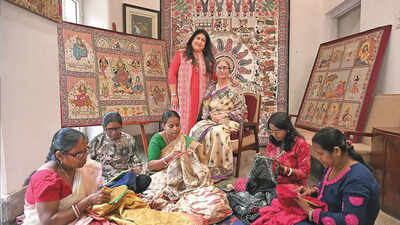
Kantha revivalist Shamlu Dudeja (centre) with her daughter Malika Dudeja Varma (in red) and artisans, who fondly call her Boro Maa
What began with a visit to a crafts mela and three silk saris has, over 37 years, reshaped the trajectory of a simple running stitch. Kantha revivalist Shamlu Dudeja is widely revered for taking Bengal’s homegrown needlecraft and putting it in the global spotlight.
SHE Kantha today empowers 1,000+ women, as 87 -year-old Dudeja, her daughter Mallika Dudeja Varma and granddaughters Mahima & Saumya, stay committed to the craft.What sparked your interest in the craft of Kantha?Shamlu: I didn’t even know the word Kantha when I first saw it. One day, while Malika was playing tennis, I visited a Santiniketan crafts mela and came across a simple embroidery, which reminded me of my school days, my Bengali craft teacher, and my mother.
Around that time, my husband had brought back three silk saris from South India, which I dyed in tea and gave to the women at the mela to embroider, paying them in advance. Malika and I later visited their homes, and while we were taken aback by the intricacy of the craft, we were deeply moved by their living and working conditions.
When the first three saris returned, beautifully embroidered, I bought more, dyed them again, and asked them to repeat the work.
I shared these pieces with friends and family across Kolkata, Mumbai, and London, and everyone was amazed. At the time, very few people outside Bengal knew what Kantha was, and that curiosity set everything in motion.Malika: She began without a larger plan, but over time, it became both a revival of Kantha and a means of financial empowerment for many.
I didn’t even know the word Kantha when I first saw it. It was just a simple running stitch that took me back to my childhood, yet left me in awe of its intricacy
Shamlu Dudeja
How would you place SHE Kantha’s journey over the last 37 years?Malika: This was never meant to be CSR or structured social work. It began without a clear plan, evolving into both a revival of Kantha and financial empowerment for women.
Documented by Harvard Business School, the initiative has grown from three women to over 1,200 artisans, many from remote villages, focusing on income, agency, dignity and skills. She travelled widely, often using her own savings, taking Kantha across India and to France, Japan, the US, and the UK, building a global audience.
The SHE Foundation has nearly 1,200 artisans under its umbrella, working in Kantha for over 35 years, while her Calcutta Foundation, has expanded to over 22 centres offering stitching, digital skills, and livelihood training to many, making her a pioneer whose work has inspired thousands.What’s future looking like?Malika: Maa also started SHE Art to promote Kantha wall art, and we are taking it forward with large, intricate works that often take years to complete. At the same time, we are innovating in fashion by combining Kantha with aari and beadwork for contemporary and occasion wear, while introducing stoles, shirts, and modern silhouettes. My daughters, Saumya and Mahima, are also bringing in fresh ideas, and we are collaborating with young designers while maintaining high-quality craftsmanship and fair wages.
Interest from younger audiences has been encouraging, especially for Kantha jackets, which are easy to wear, pushing us to expand into such formats.What design directions are you exploring?Shamlu: I draw inspiration from everything around me and interpret it in my own way through my work.Malika: We are exploring geometric patterns for non traditional markets in India and abroad while continuing to revive traditional Kantha. We are also working with batik, hand painted textiles and Kalamkari, alongside experimenting with chiffon, georgette and crepe, with innovation closely linked to training and growth.How is the work evolving?Malika: Our focus remains on supporting women while expanding and maintaining quality. The process is challenging as each piece is handcrafted and cannot be mass produced. Our work finds meaning through women now suporting their children’s education and making decisions. They receive payments directly, with flexibility to work at their own pace. Today, we operate across 30 locations in West Bengal and serve global clients.Numbers, nations and new beginningsShamlu began her career teaching in schools before joining Loreto Teachers’ Training College, where she trained young teachers in mathematics and authored several books, from which she continues to earn royalties. Born in Karachi, she recalls glimpsing historic moments, including the presence of Lord Mountbatten and Muhammad Ali Jinnah around the time of Independence. After moving to India, her family settled in Delhi, where she grew up and studied, before later moving to Mumbai, where she met her husband and built her life in Kolkata.
I’m happy Kantha has regained recognition through Maa’s efforts. Maintaining quality remains a challenge, as fewer artisans commit to time intensive work today
Malika Dudeja Varma






 English (US) ·