

 5 days ago
13
5 days ago
13
ARTICLE AD BOX
4 min readNew DelhiMar 31, 2026 05:03 AM IST
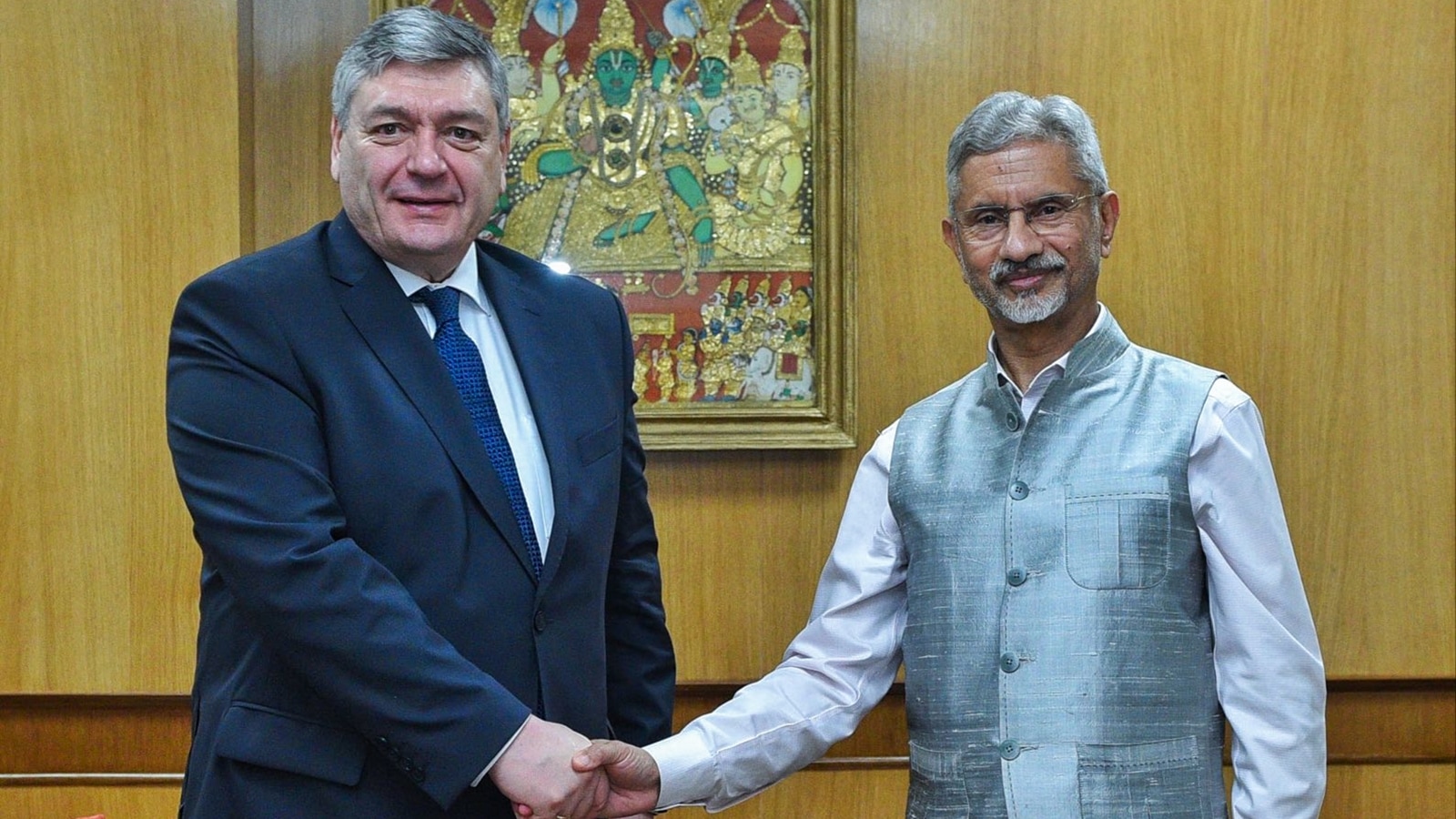 External Affairs Minister S Jaishankar with Russian Deputy Foreign Minister Andrey Rudenko in New Delhi on Monday. (PTI)
External Affairs minister S Jaishankar and Foreign Secretary Vikram Misri on Monday met Russian Deputy Foreign Minister Andrey Rudenko and discussed ways to further expand their strategic partnership against the backdrop of the West Asia crisis.
The meeting comes at a time when Delhi is facing a shortage of energy supply in the wake of the US-Israel-Iran war, which has completed 30 days now.
After the meeting, Jaishankar posted on X, “Good to meet Deputy Foreign Minister Andrey Rudenko of Russia. Spoke about further advancement of our wide-ranging cooperation. As well as regional and global developments.” While there was no reference to energy supplies in the post, it is learnt that this topic was “part of the discussions”.
Ministry of External Affairs official spokesperson Randhir Jaiswal said, “India-Russia Foreign Office Consultations, co-chaired by Foreign Secretary Vikram Misri and Russian Deputy Foreign Minister Andrey Rudenko, were held in New Delhi today (Monday). Both sides reviewed the full spectrum of Special and Privileged Strategic Partnership and shared perspectives on bilateral, regional and global issues of mutual interest.”
According to Russian official news agency TASS, on March 27, Moscow and Delhi expressed readiness to an increase in liquefied natural gas (LNG) supplies and an opportunity to deliver liquefied petroleum gas (LPG) to India was also discussed.
“Both sides expressed readiness to increase LNG supplies and also discussed deliveries of LPG that is widely used domestically in India,” a source in the oil and gas industry told TASS.
“Continuation of talks with involvement of the business is expected,” the source said, as per TASS.
Story continues below this ad
Reuters had reported last week the “verbal agreement” to negotiate an LNG deal was reached during a March 19 meeting between Russian Deputy Energy Minister Pavel Sorokin and Petroleum and Gas Minister Hardeep Singh Puri in New Delhi.
Amid the disruption of oil supplies from West Asia, India’s rapid ramp-up of Russian oil imports has significantly cushioned the supply hit. India’s Russian oil imports in March are nearing a historic peak and a similar trend is expected in April as well, according to tanker data and industry insiders and experts.
Due to the halt in vessel movements through the critical maritime choke point of the Strait of Hormuz since early March, imports from West Asia suppliers like Iraq, Saudi Arabia, the UAE and Kuwait have crashed this month.
India depends on imports to meet over 88% of its crude oil needs; 2.5–2.7 million bpd of India’s crude imports — around half of the overall oil imports — have transited the Strait of Hormuz in recent months, while the longer-term average is around 40%. This oil is mainly from Iraq, Saudi Arabia, the UAE and Kuwait. The Strait of Hormuz is a narrow waterway between Iran and Oman that connects the Persian Gulf with the Gulf of Oman. It is critical for energy exports from West Asia, with one-fifth of global oil and LNG flow usually transiting the chokepoint.
Story continues below this ad
Delhi was buying oil at a discounted price from Moscow after the Russia-Ukraine war started. Now, India is looking at Russia after US President Donald Trump granted a waiver to import from Moscow. Trump had imposed 25% tariffs — that took the total tariffs to 50% (25% as reciprocal tariffs) — on India for importing Russian oil, in August last year. The tariffs were taken off after a framework for a trade deal was announced early February.
But after the West Asia war began, creating a gap in demand and supply in the global energy supply chain, Trump waived off the sanctions on buying oil from Russia.
On March 23, Jaishankar said India and Russia need to address issues such as non-tariff barriers and regulatory impediments to increase the two-way annual trade to USD 100 billion by 2030. He also reaffirmed New Delhi’s steadfast commitment to strengthening the long-standing partnership with Moscow.
Russian Foreign Minister Sergey Lavrov lauded India’s “independent foreign policy” and said Russia looks forward to welcoming Prime Minister Narendra Modi for a visit this year.

Shubhajit Roy, Diplomatic Editor at The Indian Express, has been a journalist for more than 25 years now. Roy joined The Indian Express in October 2003 and has been reporting on foreign affairs for more than 17 years now. Based in Delhi, he has also led the National government and political bureau at The Indian Express in Delhi — a team of reporters who cover the national government and politics for the newspaper. He has got the Ramnath Goenka Journalism award for Excellence in Journalism ‘2016. He got this award for his coverage of the Holey Bakery attack in Dhaka and its aftermath. He also got the IIMCAA Award for the Journalist of the Year, 2022, (Jury’s special mention) for his coverage of the fall of Kabul in August 2021 — he was one of the few Indian journalists in Kabul and the only mainstream newspaper to have covered the Taliban’s capture of power in mid-August, 2021. ... Read More
Stay updated with the latest - Click here to follow us on Instagram
© The Indian Express Pvt Ltd



 English (US) ·