

 1 day ago
3
1 day ago
3
ARTICLE AD BOX
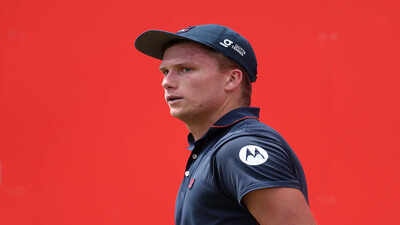
Jenson Brooksby of United States (Getty Images)
American Jenson Brooksby’s game is unorthodox, his court coverage razor-sharp and like his approach to life, it’s shaped by seeing the world differently.At 6 ft 4’ Jenson Brooksby’s frame is imposing, yet there’s a quiet agility in the way he carries himself, a reflection of the unorthodox style that defines both his tennis and his life.
His groundstrokes, struck off a short backswing, rely on timing and redirection, his service motion can appear halting, but his court coverage is unusually nimble for someone his size.Go Beyond The Boundary with our YouTube channel. SUBSCRIBE NOW!On the sidelines of the Dubai Duty Free Tennis Championships in February, the 25-year-old spoke openly about his approach, sparking the same energy while engaging in conversation as he does in rallies. That willingness to engage, he admits, hasn’t always come easy.
Brooksby, ranked 41, has had to navigate a world that didn’t always feel intuitive, learning to connect with others. On court, he steps into matches ready to make them physical, off it he tends to retreat into his own quiet space.On World Autism Awareness Day, stories often focus on challenges, overlooking autism as a neurodevelopmental difference that shapes communication. Brooksby’s journey has been one of learning to find ease with something that once lay firmly outside his comfort zone -- social connection.
“A lot of the years growing up, I felt myself being more secluded. It was hard for me to socialise, especially during my school years,” Brooksby said in an exclusive chat with TOI. “Now it’s pretty normal, I’ll talk with players when I’m at tournaments, and I have good relations with my team, but maybe there’s still a part of me that likes to be by myself more often than the average person does.”Brooksby, who announced himself at the US Open five years ago, began 2021 ranked outside the top 300, starting the year at an ITF Futures event in Villena, Spain.
In New York, he stunned Taylor Fritz, then world No. 42, and backed it up with a win over 25th seed Aslan Karatsev to reach the fourth round, where he fell to Novak Djokovic in four sets. The following year Brooksby surged to a career-high ranking of No. 33.He then missed most of 2023 and all of 2024 for a combination of reasons: a ban for missing three out-of-competition drug tests within a 12-month period, a violation that can be sanctioned without a positive result, and injury woes, including surgeries on both wrists.Late last year, deep into his comeback, he shared for the first time that he was diagnosed on the severe end of the autism spectrum as a child. Brooksby was nonverbal until the age of four and underwent intensive Applied Behaviour Analysis therapy, totalling 40 hours per week.“My parents did not hide my diagnosis from me,” said Brooksby, the only child of Glen, an anaesthesiologist, and Tania. “A majority of what I heard about the disorder growing up was through conversations, I would hear between my parents and experts, which would make me think about it more.”The first person Brooksby spoke to about his condition was his agent, Amrit Narasimhan, a former pro from Bengaluru.“That was a big step, I was sharing something I never really felt comfortable sharing,” he said of telling Narasimhan over dinner on his birthday in 2023. “I saw how he responded to it, he took it normally. I did wonder before telling him if he’d treat me differently, but no, that didn’t happen and that gave me so much confidence.
I was then able to share it with the rest of my team.”Narasimhan, who has known Brooksby from his teenage days, heard out the American.“I always knew there were challenges, but didn't know the why,” he said. “Once I found out I felt I needed to learn, adapt and do things differently in a way that worked for him.”Brooksby, among the first sportspersons to open up about this lifelong condition, describes it as one with both challenges and strengths.
He emphasizes his ability to focus deeply, noting that he thrives on repetition, discipline, and a structured, routine-driven approach.“Regardless of who I'm playing, I feel good about how I'm supposed to play. I'm able to focus on those few things and do it for a long period of time,” the 25-year-old said. “But if I’m playing someone who has more (variety), I struggle to switch things around quickly. I think everyone has some level of struggle with that, but it is a little bit higher for me.”On practice weeks, Brooksby keeps a steady schedule, waking up around eight, beginning with a lengthy gym session, then heading to the court for an hour or two. Tournament weeks are less predictable, shaped by match timings and recovery.He is easy about evenings, dinner at home with his own company or a night out, going solo or with pals. During tournaments, things are more low-key, meals with his team or alone. Once competition begins, the focus narrows and the routine quietens.That balance, between structure and flexibility, solitude and connection, mirrors Brooksby’s broader journey as he learns to move through the world on his own terms, finding comfort within it.








 English (US) ·