

 50 minutes ago
7
50 minutes ago
7
ARTICLE AD BOX
Defence procurement proposals worth Rs 52,000 crore, including anti-drone systems, missiles, jet-powered kamikaze drones and advanced air defence platforms received clearance to move forward.
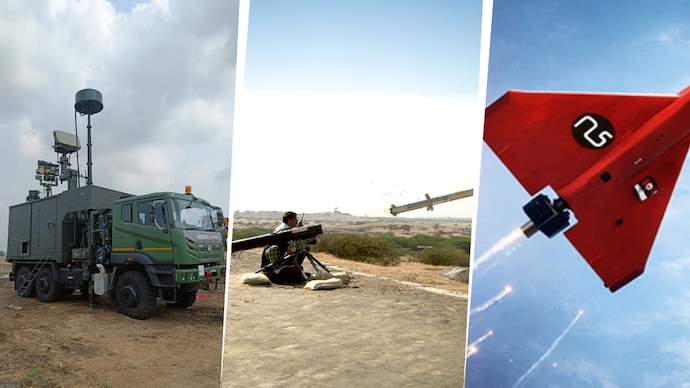
Defence forces are set to get anti-drone systems, missiles and kamikaze drones.

New Delhi,UPDATED: Jul 3, 2026 19:59 IST
In a major push to strengthen the operational preparedness and combat capabilities of the armed forces, the Defence Acquisition Council (DAC), chaired by Defence Minister Rajnath Singh, on Friday cleared a series of proposals for the acquisition of advanced weapons, ammunition and defence systems worth approximately Rs 52,000 crore.
The approvals cover a wide range of advanced weapon systems, air defence platforms, anti-drone technologies, unmanned systems and naval capabilities for the Indian Army, Navy and Air Force. The DAC's nod marks an in-principle administrative approval, making it the first step in the procurement process.
ANTI-DRONE SYSTEMS, MISSILES AND KAMIKAZE DRONES
Among the major acquisitions cleared for the Indian Army are the procurement of the Anti-Unmanned Aerial Vehicle (UAV) Electronic Warfare System 'Akash Tarang', Man-Portable Anti-Tank Guided Missile (MPATGM) systems, Medium-Range Surface-to-Air Missile (MRSAM) weapon systems, Very Short-Range Air Defence Systems (V-SHORADS), Active Protection Systems for tanks and jet-powered kamikaze drones.
The Defence Ministry said the Akash Tarang system will provide effective protection against hostile drones and other unmanned aerial threats, a capability that has gained increasing significance amid evolving battlefield requirements.
The indigenous MPATGM system is expected to strengthen the infantry's ability to neutralise enemy armoured and mechanised formations. The MRSAM weapon system will bolster India's layered air defence network by providing protection against a range of aerial threats, including stand-off weapons.
The V-SHORADS system, equipped with multi-spectral sensing capabilities, is expected to improve resilience against countermeasures while enhancing short-range air defence effectiveness.
The Active Protection System for tanks is designed to improve battlefield survivability by detecting and intercepting incoming anti-tank threats before impact. The DAC also approved the procurement of jet-powered kamikaze drones, which can carry out precision strikes while offering improved electronic warfare capabilities, greater survivability and cost-effectiveness.
BOOST FOR MARITIME SURVEILLANCE, MINE WARFARE CAPABILITIES
For the Navy, the DAC approved the acquisition of Multi-Influence Ground Mines (MIGM), Naval Shipborne Unmanned Aerial Systems (NSUAS) and the establishment of a Land-Based Testing Facility (LBTF) for electric propulsion systems.
The MIGM will strengthen the Navy's mine warfare capabilities by restricting the movement and manoeuvrability of adversary vessels in strategic maritime zones.
The NSUAS platforms, equipped with advanced sensors, will significantly improve maritime domain awareness and surveillance capabilities, enabling naval commanders to maintain a more comprehensive operational picture in critical sea lanes.
The proposed Land-Based Testing Facility will support the testing and validation of motors and associated propulsion systems intended for naval platforms, contributing to the development and induction of next-generation electric propulsion technologies.
HIGH-ALTITUDE SURVEILLANCE PLATFORM FOR AIR FORCE
The DAC also approved the procurement of Fixed-Wing High-Altitude Pseudo Satellites (FW-HAPS) and other systems for the Indian Air Force.
The FW-HAPS platform is designed to operate at high altitudes for extended durations and will provide persistent intelligence, surveillance and reconnaissance (ISR) capabilities. In addition to surveillance, the platform can support telecommunications and remote-sensing missions, enhancing the Air Force's ability to continuously monitor vast areas.
FOCUS ON MODERNISATION, SELF-RELIANCE
The latest approvals come as India continues to accelerate military modernisation amid evolving regional security challenges and the growing importance of emerging technologies such as drones, autonomous systems, electronic warfare and advanced air defence networks.
Defence officials said the acquisitions are aimed at enhancing the operational readiness, lethality and survivability of the armed forces while supporting the country's long-term objective of strengthening indigenous defence manufacturing and reducing dependence on imports.
With the DAC's approval in place, the proposals will now move to subsequent stages of the procurement process before contracts are finalised.
- Ends
Published On:
Jul 3, 2026 19:59 IST









 English (US) ·