

 2 days ago
6
2 days ago
6
ARTICLE AD BOX
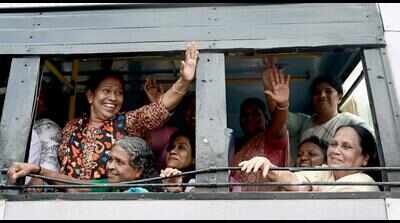
During hearing, the petitioner argued that the scheme was introduced without any prior study, policy formulation or examination of its feasibility by a ministerial committee, and without prescribing any eligibility criteria
Kochi: High court on Thursday, while considering a PIL challenging the free travel scheme for women and transgender persons in KSRTC buses, orally observed that the beneficiaries of the scheme are basically from the working class and that merely because around 10% of them may have better incomes, it cannot be said that the policy deserves to be struck down.A bench of Chief Justice Soumen Sen and Justice V M Syam Kumar made the remarks while reserving orders on the PIL filed by Muhammed Firdouz of Ernakulam, who claims to be a frequent KSRTC bus traveller. The petitioner contended that the scheme is arbitrary, discriminatory and violative of Articles 14 and 15 of the Constitution.During hearing, the petitioner argued that the scheme was introduced without any prior study, policy formulation or examination of its feasibility by a ministerial committee, and without prescribing any eligibility criteria.
He further contended that the scheme was not the result of a considered policy decision but was merely a pre-written electoral promise that was mechanically converted into a govt order, with the machinery of the state being pressed into service even before the govt was properly constituted.Meanwhile, opposing the PIL, advocate general K Jaju Babu, appearing for the state govt, argued that the free travel scheme for women and transgender persons was introduced in furtherance of the welfare state’s obligation to adopt affirmative action measures and formulate specific policies for the empowerment of women.
He submitted that it is a uniform policy adopted by at least eight states across the country, including Karnataka, Delhi, Tamil Nadu, Punjab, Telangana and West Bengal.The advocate general also relied on a 1952 Bombay high court judgment in the Dattatreya case, which upheld the constitutional validity of reserving seats for women in municipal elections by holding that, although discrimination solely on the ground of sex is generally prohibited, protective discrimination in favour of women is constitutionally permissible to ensure equal representation and address systemic disparities.
He further referred to a 2020 decision of the Delhi high court in the STA Operators Ekta Manch case, in which a plea by private bus operators challenging the Delhi govt’s scheme permitting free travel for women in public buses was dismissed.








 English (US) ·