

 4 days ago
9
4 days ago
9
ARTICLE AD BOX
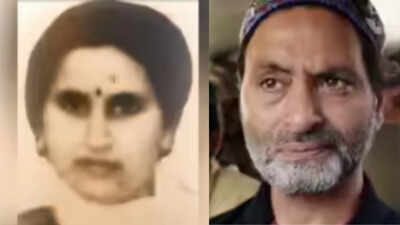
(Image credits: Social media)
SRINAGAR: Thirty-six years after a young Kashmiri Pandit nurse was kidnapped and brutally killed in the violence-scarred Kashmir of 1990, the State Investigation Agency has finally named those responsible, with banned JKLF chief Yasin Malik at the top of the list.Sarla Bhat, a resident of Qazibagh, Anantnag, was working as a nurse in the neonatology ward at the Sher-e-Kashmir Institute of Medical Sciences (SKIMS) in Soura when she was kidnapped from the hospital on April 16, 1990.In April 1990, as thousands of Pandits fled for their lives, Sarla Bhat was kidnapped, killed and dumped, her identity, in that moment, reason enough to make her a target.Investigators believe her killing was part of a larger attempt to drive out the Kashmiri Pandit community from the Valley.Her bullet-riddled body was recovered the next day from Lal Bazar, several kilometres from SKIMS. A murder case was registered at Nigeen police station. For decades, the case was forgotten.Following her murder and a series of other targeted attacks, nearly the entire Kashmiri Pandit community fled the Valley, abandoning homes and properties, many of which were later looted, set ablaze, or seized through distress sales and encroachments.
The SIA's 737-page chargesheet names Malik, then serving as the self-styled commander-in-chief of the JKLF, as the key accused in planning and executing her abduction and killing.His four accomplices are also named: Khursheed Ahmad Chalkoo, Abdul Hamid Sheikh, Ghulam Mohammad Taploo and Mohammad Yousuf Sofi.Police sources said it is believed she was shot dead by three JKLF militants.Of these, Chalkoo, identified as the man who pulled the trigger, is believed to have fled to Pakistan.The remaining three are deceased. Malik is currently in judicial custody in a separate case.The case was handed over to the SIA in March 2024. Over the next two years, the agency conducted raids at multiple locations, including the residences of individuals formerly associated with the banned JKLF, among them former JKLF leader Peer Noorul Haq Shah, also known as "Air Marshal", piecing together oral, documentary, forensic, ballistic, medical and electronic evidence accumulated over decades.The result was a chargesheet the SIA calls "a historic milestone" in holding perpetrators of legacy terror crimes accountable.In a statement, the SIA said time can never become a shield for terrorism and those responsible for atrocities will continue to remain answerable before the law."The filing of the chargesheet after nearly 35 years marks a historic milestone in the pursuit of justice for victims of terrorism and stands as one of the most significant breakthroughs in the investigation of legacy terror crimes in Jammu and Kashmir.
More importantly, the chargesheet sends a powerful and unequivocal message that time can never become a shield for terrorism. No matter how many years have elapsed, those responsible for terrorist atrocities will continue to remain answerable before the law," SIA spokesperson said in a six-page handout.The accused have been charged under various sections of the Terrorist and Disruptive Activities (Prevention) Act (TADA), 1987, and Indian Arms Act, 1959."The chargesheet establishes offences punishable under Sections 364, 341, 302 read with 34, 201 and 120-B RPC, Sections 3(2), 3(3), 4 and 6 of the Terrorist and Disruptive Activities (Prevention) Act, 1987 (TADA), and Sections 7 and 27 of the Indian Arms Act, 1959," he added.(With PTI inputs)







 English (US) ·