

 1 hour ago
9
1 hour ago
9
ARTICLE AD BOX
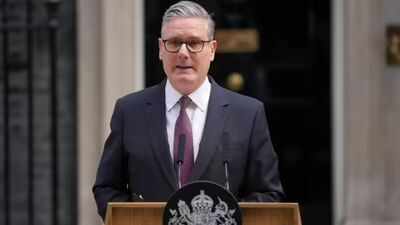
London: Four years ago Andy Burnham complained he was repeatedly denied a main-stage speaking slot at the Labour Party conference under PM Keir Starmer’s leadership, saying it was a sign of disrespect for his then position as Greater Manchester mayor.There was some sympathy for one of Labour’s most popular politicians, but now, as he seeks to become Britain’s seventh PM in a decade, Burnham must prove he can occupy that centre stage, win over restless voters and overcome the economic constraints that hamstrung his predecessors. Burnham’s pitch is that only he has the political charisma and the vision in Labour to connect with voters to defeat the populist anti-immigration Reform UK party, led by Nigel Farage, which has led in every poll since early last year.His decisive victory in a contest for a seat in parliament last week, where Reform had recently performed strongly in local elections, has won over many Labour lawmakers.Burnham “has proven his credentials in putting forward a Labour vision voters can rally around”, said Alex Sobel, a Labour member of parliament. His supporters see Burnham — who won the nickname “King of the North” for his defence of the area during the Covid-19 pandemic — as a leader who made his mark at the helm of one of Britain’s few regional success stories in recent years.
But his critics portray Burnham as someone who has continually changed his policy positions and has sought to portray himself as a “normal man of the people” rather than the highly educated career politician he is.It is now likely that Burnham will replace Starmer as PM after the former health minister, Wes Streeting, said he would not oppose him in a leadership contest. Burnham later posed with more than 100 Labour lawmakers in parliament on Monday, but did not speak to waiting journalists.
So far, Burnham has only given hints of what his agenda could be if he becomes the next PM. It is his record as Greater Manchester mayor, a job he took in 2017 to escape what he called London-centric politics, that offers the best insight into his possible plans.
His battle against then-PM Boris Johnson over the toughest Covid pandemic restrictions in 2020 raised his profile again beyond Manchester. He strongly supports further decentralisation along with a more interventionist state and describes his political beliefs today as “more place first rather than party first”.
He has long argued that, by shifting power away from London, which dominates Britain’s economy, communities can take direct control over the things that shape their own lives, such as utilities and transport.Burnham was born in Liverpool, where his father worked as a telephone engineer and his mother a receptionist. He won a place to study English at the University of Cambridge and after graduating, took a familiar path to political prominence, first as a researcher and then adviser in parliament.He first served as a junior minister under former PM Tony Blair, and later culture secretary and health secretary under Gordon Brown. In 2010 and 2015, he ran to become leader of the Labour Party and failed both times.REUTERS






 English (US) ·