

 2 hours ago
7
2 hours ago
7
ARTICLE AD BOX
3 min readNew DelhiApr 16, 2026 01:29 AM IST
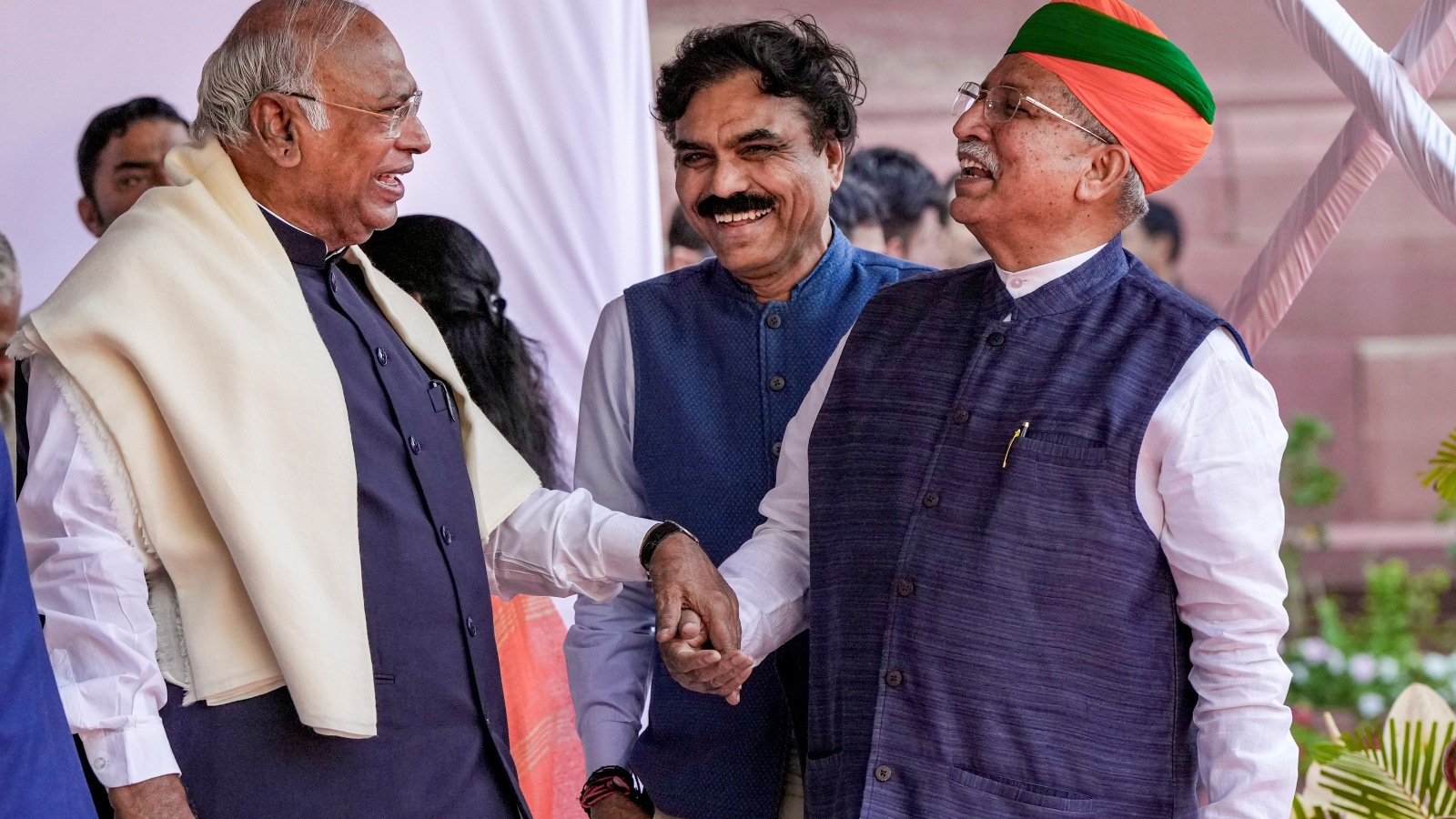 MoS Arjun Ram Meghwal in conversation with Congress President and Rajya Sabha LoP Mallikarjun Kharge during the tribute paying ceremony to Dr BR Ambedkar on his birth anniversary, observed as ‘Ambedkar Jayanti’, at Prerna Sthal, Samvidhan Sadan, in New Delhi, Tuesday, April 14, 2026. (PTI Photo)
The three new Bills scheduled to be tabled in the Lok Sabha on Thursday contain amendments to seven key Articles of the Constitution, The Indian Express has learnt. The amendments are related to Articles 55, 81, 82, 170, 330, 332 and 334A.
According to sources, these broadly fall under sections pertaining to the Executive – most specifically to the election of the President and Vice President of India – to the composition of legislatures, including the Parliament and State Assemblies, and to ‘Special Provisions’ relating to certain classes which provide for reservation for Scheduled Classes and Tribes.
Union Law Minister Arjun Ram Meghwal will introduce The Constitution (One Hundred and Thirty First Amendment) Bill 2026, as per the List of Business published on the Lok Sabha website on Wednesday.
According to the agenda of proceedings for the day, this will be followed by Home Minister Amit Shah tabling The Union Territories Laws (Amendment) Bill 2026.
Megwhal is also scheduled to move The Delimitation Bill 2026, which seeks to provide for the readjustment of the allocation of Lok Sabha seats to the States and UTs, the total number of seats in the Legislative Assembly of each State and UTs.
Article 55, which pertains to the ‘Manner of election of President’ pertains to “uniformity in the scale of representation of the different States at the election of the President” as far as “practicable” as well as uniformity and parity between states and the Centre.
It also lays down the procedure for the election of the President by the members of an electoral college consisting of the elected members of Parliament and Legislative Assemblies and the number of votes these electors are entitled to cast.
Story continues below this ad
Article 81, pertaining to ‘Composition of the House of the People’, provides for the Lok Sabha consisting of “…not more than 530 members chosen by direct election from territorial constituencies in the States, and … not more than 20 members to represent the UTs, chosen in such manner as Parliament may by law provide”.
Article 82, which provides for ‘Readjustment after each census’, states that upon the completion of each census, the allocation of Lok Sabha seats to the States and the division of each State into territorial constituencies “shall be readjusted by such authority and in such manner as Parliament may by law determine”.
Article 170 deals with the ‘Composition of the Legislative Assemblies’, while Article 330 pertains to reservations in the Lok Sabha for the SCs and the STs (except the STs in the autonomous districts of Assam). Article 332 relates to reservation of seats for SCs and STs in the Legislative Assemblies.
Article 334 pertains to ‘Reservation of seats and special representation to cease after a certain period’ both in case of those reserved for SCs and STs as well as the representation of the Anglo-Indian community in the Lok Sabha and in the Legislative Assemblies of the States by nomination. The Article provides for the ceasing of these reservations in 80 and 70 years, respectively, “from the commencement of this Constitution”.

Jatin Anand is an Assistant Editor with the national political bureau of The Indian Express. With over 16 years of experience in mainstream journalism, he is a seasoned expert in national governance, electoral politics, and bureaucratic affairs. Having covered high-stakes beats including the Election Commission of India (ECI), intelligence, and urban development, Jatin provides authoritative analysis of the forces shaping Indian democracy. He is an alumnus of Zakir Husain Delhi College (DU) and the prestigious Asian College of Journalism (ACJ), Chennai, where he specialized in Print Journalism. Expertise High-Stakes Beat Coverage: Throughout his decade-and-a-half career, Jatin has covered some of the most sensitive and influential beats in the country, including: The Election Commission of India (ECI): Monitoring electoral policy, reforms, and the conduct of national and state polls. National Security & Intelligence: Reporting on the internal mechanisms and developments within India's security apparatus. Urban Development: Analyzing the policies and bureaucratic processes driving the transformation of India’s cities. National Political Bureau: In his current role, he tracks the intersection of policy and politics, offering deep-dive reporting on the Union government and national political movements. Academic Credentials: Zakir Husain Delhi College (DU): Alumnus of one of Delhi's premier institutions. Asian College of Journalism (ACJ), Chennai: Specialized in Print Journalism at India's most prestigious journalism school. ... Read More
Stay updated with the latest - Click here to follow us on Instagram
© The Indian Express Pvt Ltd



 English (US) ·