

 1 hour ago
3
1 hour ago
3
ARTICLE AD BOX
The Supreme Court has reaffirmed that daughters are equal heirs to their father's share under Hindu law. The ruling highlights how legal equality continues to face resistance within families and social practice.
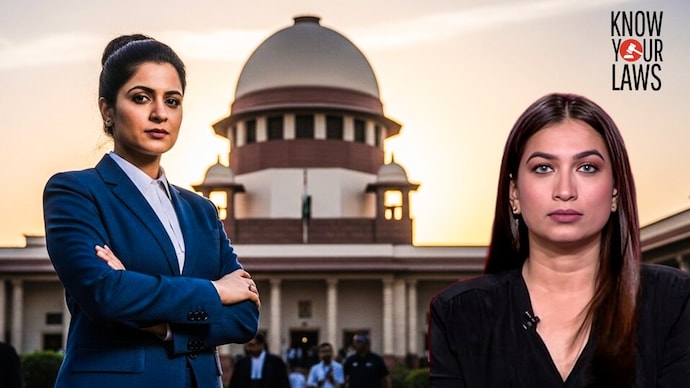
The Supreme Court has reaffirmed that daughters are equal heirs to their father's share under Hindu law.
New Delhi,UPDATED: May 24, 2026 23:41 IST
Across India, courts are increasingly being called upon to settle disputes over daughters’ inheritance rights, exposing the continuing gap between legal equality and social reality. From royal families to ordinary households, women are still being denied their lawful share in family property despite clear constitutional and statutory protections.
One of the most prominent examples is the ongoing dispute involving the royal family of Mewar, where the daughters of the late king have challenged his will in the Delhi High Court after his separate properties were left entirely to his son, the current king. Similarly, in February, the Supreme Court directed compulsory mediation in a long-running partition dispute among siblings in Hyderabad, observing that mediation could provide a faster and less damaging resolution than prolonged litigation.
The issue once again came into focus on May 15, 2026, when a Supreme Court bench comprising Justices Sanjay Karol and Augustine G Masih reaffirmed that daughters possess equal inheritance rights under Hindu law. The Court clarified that even before the 2005 amendment to the Hindu Succession Act, daughters had the right to inherit an equal share in their father’s portion of ancestral property through the principle of “notional partition.”
This ruling reflects a broader legal position that daughters are equal heirs in all forms of parental property, whether ancestral or self-acquired. Yet, patriarchal social norms often continue to override the law in practice. In many families, daughters are given gifts at the time of marriage and are thereafter expected to forgo any claim to family property, while sons inherit the entire estate.
Advocate Varun Chopra notes that the denial of women’s inheritance rights is often less about law and more about social conditioning. According to him, many sisters avoid legal disputes to preserve “family tranquility,” while others remain unaware of their legal entitlements altogether. He explains that the Hindu Succession Act clearly grants daughters inheritance rights, but social attitudes frequently discourage women from asserting them.
A key turning point came in 2005, when Parliament amended Section 6 of the Hindu Succession Act to grant daughters equal coparcenary rights. Coparcenary refers to the right acquired by birth in a Hindu Undivided Family (HUF), allowing a person to inherit ancestral property and demand partition.
Before 2005, daughters could inherit only their father’s share after his death but could not seek partition of ancestral property. The amendment recognised daughters as equal coparceners alongside sons.
The Supreme Court further strengthened this principle in the landmark 2020 Vineeta Sharma judgment. The Court ruled that a daughter is a coparcener by birth, equal to a son, and that marriage does not extinguish her rights. Importantly, the judgment clarified that the father did not need to be alive on September 9, 2005 — the date the amendment came into force — for daughters to claim their share. The ruling also affirmed daughters’ equal rights to partition and inheritance within Hindu Undivided Families.
The Court has continued expanding gender equality in succession law. In the 2025 Ram Charan verdict, the Supreme Court extended equal inheritance rights to tribal women, observing that customary laws denying succession to women could not survive constitutional scrutiny. The Court emphasised that customs cannot remain “stuck in time” and cannot be used to perpetuate discrimination. Invoking
Article 14 of the Constitution, which guarantees equality before law, the bench held that denying female heirs succession rights only deepens gender inequality.
Despite these progressive judgments, discrimination persists in several state-specific laws, especially concerning agricultural land. For example, the Uttar Pradesh Zamindari Abolition and Land Reforms Act, 1950 prioritises widows, sons, and unmarried daughters in inheritance of agricultural land. Married daughters inherit only in the absence of these relatives and even parents of the deceased are given preference over married daughters.
The law also provides that a widow loses inheritance rights upon remarriage. Such provisions reveal how outdated legal frameworks continue to undermine women’s equality.
Inheritance rules also vary across religions in India. Under Muslim personal law, there is no concept of coparcenary or inheritance by birth.
Property devolves only after the death of a parent. However, sons generally receive twice the share of daughters. In contrast, Christians governed by the Indian Succession Act receive equal inheritance rights regardless of gender.
The recent May 15, 2026 judgment in the BS Lalitha case further clarified the concept of “notional partition.” The Supreme Court explained that under the earlier Section 6 of the Hindu Succession Act 1956, which was built on the basis of the Hindu Mitakshara law, a deceased coparcener’s (father) share would be separated through a deemed partition before death, enabling daughters to inherit that share equally.
The Court also observed that a later partition deed cannot extinguish daughters’ rights if those rights had already vested by operation of law. Meaning that daughters have always been recognised as equal heirs of the father's share of the property.
The earlier law, before the 2005 amendment, merely denied the right to demand a formal partition. However, the right to claim their share from the notional division on the death of the Father has been read into the 1956 Act also.
In fact, the Apex court in the BS Lalitha case clearly held that the actual partition and share would be a matter of trial, but the law recognises the right of the daughter to claim the father's share.
India’s inheritance jurisprudence has evolved significantly over the past two decades. Yet, the continued reluctance of families to recognize daughters as equal stakeholders shows that legal reform alone is insufficient.
True equality will emerge only when social attitudes begin to reflect what the law has already made clear: daughters are equal heirs, not secondary claimants.
- Ends
Published By:
Akshat Trivedi
Published On:
May 24, 2026 23:41 IST






 English (US) ·