

 2 days ago
6
2 days ago
6
ARTICLE AD BOX
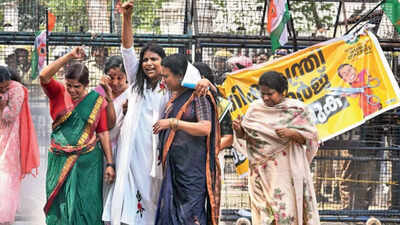
The 2026 assembly election is shaping up as more than a routine test for Kerala’s political class; it is emerging as a structural test of political endurance for the CPM-led Left Democratic Front (LDF), an existential battle for the Congress-led United Democratic Front (UDF), and a strategic expansion project for the BJP-led NDA.LDF: 10-Year Test?Under CM Pinarayi Vijayan, LDF enters the election seeking a rare, third consecutive term — something unprecedented in Kerala’s modern political history. The front had already disrupted the state’s four-decade-old pattern of alternating govts by forming govt in 2021. A victory in 2026 would cement that shift from cyclical anti-incumbency to performance-based continuity.LDF’s campaign is expected to foreground infrastructure expansion, welfare delivery and state-led development.
Road connectivity upgrades, digital governance initiatives and sustained social security pension schemes form the backbone of its narrative. The govt is likely to argue that stability has enabled long-term planning and implementation, striking a contrast with what it calls the opposition’s fragmented leadership.Yet, a decade in office inevitably produces fatigue. Concerns over fiscal stress, unemployment, rising living costs and allegations of administrative centralisation have created pockets of discontent.
Anti-incumbency in Kerala does not always erupt as a wave, but accumulates silently across demographic segments.For the CPM, the anchor of the LDF, the strength lies in its disciplined cadre network and booth-level organisational machinery. However, the party’s challenge in 2026 is not merely organisational — it is sociological. The possibility of minority consolidation against the Left has become a serious electoral variable.The govt’s decision to extend a Rs 1,600 monthly pension to Catholic nuns and other women in religious institutions without independent income reflects a calibrated outreach to Christian communities. Such measures indicate that identity balancing, once peripheral to Left politics, is now central to its electoral calculus.
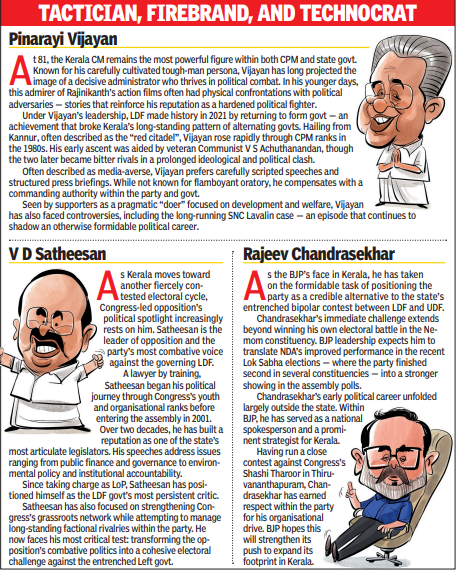
UDF: Moment of Reckoning?For the Congress-led UDF, the 2026 election is being widely viewed as a defining moment.
After two con secutive defeats, the alliance cannot consider the prospect of another term in opposition as that will cer tainly pose a risk of structural ero sion. Under Opposition Leader V D Satheesan, Congress has adopted a sharper and more confrontational tone against the govt.Corruption allegations, governance failures and economic distress form the core of its campaign strategy. UDF is betting on accumulated anti-incumbency, hoping that, channelled effectively, it can offset LDF’s welfare-driven appeal.
UDF’s emphatic performance in local body elections would have come as a shot of vigour for its leadership and rank and file.UDF’s alliance arithmetic hinges significantly on minority consolidation — particularly among Christian and Muslim voters — alongside the recovery of urban middle-class support. Allies such as the Indian Union Muslim League and Kerala Congress factions remain critical to this coalition matrix.
Smooth seat-sharing arrangements and credible candidate selection will determine whether dissatisfaction with the ruling dispensation translates into votes for the main opposition.
However, Congress continues to wrestle with factional undercurrents. UDF’s ability to present a cohesive leadership alternative will be as important as its ability to amplify discontent with the governing front.BJP: Margins To Mainstream?Though the Kerala polity remains largely bipolar — split between LDF and UDF — BJP sees 2026 as an opportunity to entrench itself as a credible, and durable, third pole.
The party has steadily increased its vote share in recent elections, particularly in urban constituencies and pockets with potential of strong Hindu consolidation. BJP’s strategy combines identity mobilisation with aspirational politics, leveraging the appeal of its national leadership — led by PM Narendra Modi — and doubling down on youth outreach.
While it may not yet be in a position to form govt, even incremental seat gains could alter constituency-level margins and complicate the bipolar arithmetic.
In closely fought contests, a strengthened BJP presence could fragment traditional vote banks, especially in areas where the margin of victory between LDF and UDF has historically been thin. Thus, the party’s impact may be disproportionate to its seat tally.Beyond AlternationThe upcoming assembly elections are, therefore, not simply about who forms the next govt in the state. It represents a deeper transition in Kerala’s political arena.
For LDF, it is about redefining politics of Kerala — from a state of predictable alternation to one of sustained incumbency. For UDF, it is about proving that anti-incumbency remains a decisive force, while BJP will be looking to convert ideological presence into legislative relevance.
Governance, welfare sustainability, economic stress and identity politics are likely to intersect in complex ways. The electorate’s verdict will indicate whether Kerala prefers continuity, correction, or structural reconfiguration of its political landscape. In many ways, 2026 may determine not just the next govt, but the future shape of Kerala’s party system itself.







 English (US) ·