

 1 hour ago
6
1 hour ago
6
ARTICLE AD BOX
Recent fires in Lucknow, Delhi and Indore have raised questions about whether smart locks and sealed exits trapped residents inside. The cases have sharpened concern that security systems without fail-safe evacuation measures can become hazards in emergencies.
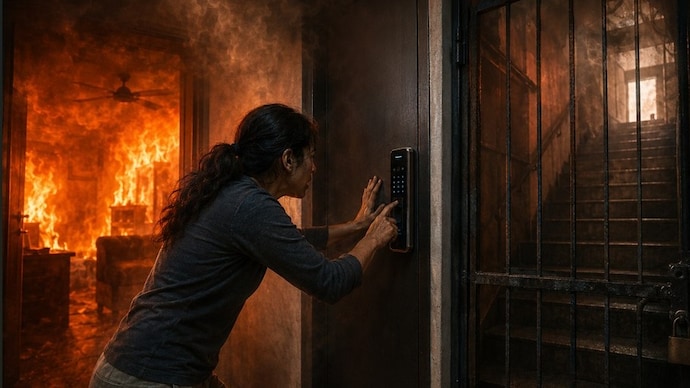
As temperatures rise, the intense heat can damage internal circuits, sensors and control panels of electronic locks, causing them to freeze or stop responding. (AI photo for representation)
Every major fire leaves behind a familiar trail of grief, investigations, and half-answered questions.
What caused the blaze? Could it have been prevented? Why couldn't the victims escape?
But a disturbing pattern emerging from several recent fires has added another question to that list: Did the very systems meant to keep people safe end up trapping them inside?
From residential complexes and office towers to luxury apartments and independent homes, electronic locks, biometric access systems, and automated security gates have become part of modern urban life. They promise convenience, security and control. Yet recent incidents in Lucknow, Delhi and Indore have exposed a troubling reality: when fire strikes, the line between security and entrapment can become dangerously thin.
The debate is no longer about technology alone. It is about whether modern buildings are being designed with evacuation in mind.
THE PARADOX OF MODERN SECURITY
For decades, urban India worried about unauthorised entry.
Builders responded with stronger gates, access-controlled staircases, biometric doors, smart locks, terrace restrictions and security grills.
The result is visible everywhere. Buildings today are harder to enter than ever before.
But fire safety experts argue that another question often receives far less attention: How easy is it to get out?
In many buildings, security planning has evolved faster than evacuation planning.
Doors that automatically lock, staircases accessible only through controlled entry points, terraces kept shut to prevent misuse and balconies covered with permanent grills or nets may all appear sensible on ordinary days.
During a fire, however, these features can transform into obstacles.
What protects a building during normal times can become a barrier during an emergency.
WHEN SECONDS MATTER
Fire does not provide the luxury of time.
According to fire officials, a small flame can grow into a major blaze in less than half a minute. Within minutes, smoke can spread through corridors, staircases and ventilation shafts.
The danger is often misunderstood.
People tend to imagine fire as a wall of flames advancing through a building. In reality, smoke and heat frequently reach occupants first.
A Delhi Fire Service officer notes that temperatures inside a burning room can rise from around 100 degrees Celsius near the floor to as high as 600 degrees Celsius at eye level. Long before flames arrive, toxic smoke can make breathing difficult, impair judgment and leave occupants unconscious.
In such conditions, every second matters.
An exit that opens immediately can save lives. An exit that delays evacuation by even a few moments can have devastating consequences.
LESSONS FROM LUCKNOW, DELHI, AND INDORE
Recent fire incidents have brought these concerns into sharp focus.
In Lucknow, where 15 people lost their lives, investigators are examining whether auto-locking access systems and the absence of accessible emergency exits contributed to the tragedy. Rescue teams reportedly had to breach walls to reach those trapped inside.
Big revelation in Lucknow fire probe:
-Auto-locking gate trapped youngsters inside
-Biometric entry door under probe scanner
-No emergency exit left victims with no escape
-Many forced to jump from windows to escape
-Smoke inhalation left several unable to flee#UttarPradesh pic.twitter.com/wvOccAqAXU— IndiaToday (@IndiaToday) June 23, 2026
In Delhi's Vivek Vihar fire, smart locks, a single staircase, locked terrace access and enclosed balconies emerged as key concerns during the investigation. Residents reportedly found themselves cut off from multiple escape routes as smoke rapidly spread through the building.
In Indore, questions were raised about whether electronic locking systems failed during a residential fire. While investigators continue to examine the exact cause, the incident reignited concerns about how electronic systems behave under extreme heat and power disruptions.
Each case is different. Yet together they point to a broader concern: buildings are increasingly dependent on systems that may not function as expected during emergencies.
WHY DIGITAL DOORS CAN FAIL IN EMERGENCIES
Electronic and biometric locks are not designed to fail during a fire, but extreme conditions can render them ineffective. As temperatures rise, the intense heat can damage internal circuits, sensors and control panels, causing the lock to freeze or stop responding. Fire can also trigger short circuits, melt electronic components or disrupt communication between the scanner and locking mechanism. In some buildings, access-control systems, magnetic locks and security gates are linked to a central power supply or network, which may malfunction during a blaze.
Even when locks have battery backups, prolonged exposure to heat, smoke or water from firefighting operations can cause system failure. In panic situations, occupants may also struggle to remember override codes or locate emergency keys. The result is that a door designed for convenience and security can become an obstacle at the very moment when rapid evacuation is critical, turning precious seconds into a matter of life and death.
TECHNOLOGY IS NOT THE VILLAIN, BUT COMPLACENCY CAN BE FATAL
It would be simplistic to blame electronic locks alone.
Most modern smart locks are equipped with battery backups, emergency power options and manual overrides. Many premium models also include panic-release mechanisms and automatic unlocking features triggered by rising temperatures.
The real issue lies elsewhere.
Problems arise when buildings rely entirely on electronic systems without adequate fail-safe mechanisms. Risks increase when residents are unaware of emergency overrides, when backup exits remain locked, or when security measures are implemented without considering evacuation needs.
Technology can enhance safety. But technology without redundancy can create vulnerability.
A CULTURE OF FIRE SAFETY REMAINS MISSING
Perhaps the larger problem is that fire safety remains an afterthought in many homes and offices.
People spend significant amounts on surveillance cameras, access-control systems and advanced locking mechanisms. Yet few families practice evacuation drills. Few residents know alternative escape routes. Fewer still verify whether emergency exits remain accessible.
The focus often remains on preventing intrusion rather than enabling escape.
Fire safety experts say every building should be evaluated through a simple question: If the power fails, smoke fills the corridor and panic sets in, can occupants still find a clear and reliable way out?
The answer should never depend on a fingerprint scanner, a mobile application or a functioning internet connection.
SECURITY MUST NEVER COMPROMISE SURVIVAL
The rise of smart buildings reflects a broader shift toward technology-driven living. There is little doubt that electronic security systems will continue to become more common.
Yet recent tragedies serve as a reminder that safety and security are not always the same thing.
A building may be highly secure and still be unsafe during a fire.
The challenge for architects, builders, residents and regulators is to ensure that one objective does not undermine the other.
Because in a fire, the most sophisticated security system in the world is worthless if it prevents people from reaching safety.
An exit is not merely a door.
It is a lifeline.
And a lifeline must work when everything else fails.
- Ends
Published By:
Zafar Zaidi
Published On:
Jun 23, 2026 13:29 IST








 English (US) ·