

 57 minutes ago
5
57 minutes ago
5
ARTICLE AD BOX
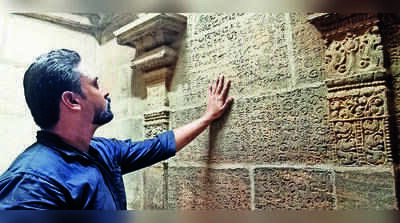
S Manikandan and team are creating a digital archive of Pandya history; (below) A statue of Sadaiyavarman Sundarpandiyathevar I found in Chidambaram Nataraja Temple
For more than a decade, S Manikandan has been following the Pandyas across state borders. From inscriptions and hero stones in Andhra Pradesh to royal lineages in Kerala and temple records in Karnataka, the Madurai paddy farmer has been piecing together one of south India’s oldest and longest imperial histories.What began in 2014 as one man’s search has grown into a 69-member grassroots research movement, the Pandiyargal Thedi Payanam Historical Research Group (PTP), with epigraphists, Siddha doctors (who can read palm-leaf manuscripts or oalaichuvadi) and full-time scholars documenting inscriptions, coins, copper plates and palm-leaf manuscripts. Full-timers are paid salaries, funded by 25 core committee members.
PTP, he says, is also ready to provide full funding for those who do a PhD or thesis on Pandya-related topics.“We also want to create a digital archive and a world-class Pandya museum,” says Manikandan, who developed an interest in Pandya history while studying in Class XII.As to why he got started, Manikandan says it is because the Pandyas have a fascinating story, which gets overshadowed by the more flamboyant Chola dynasty.
While the Cholas left behind magnificent temples such as Brihadeeswara in Thanjavur and other Unesco-recognised sites, thousands of detailed stone inscriptions, and a powerful presence in popular imagination through Kalki’s novel ‘Ponniyin Selvan’ and its blockbuster adaptation by director Mani Ratnam, the Pandyas, despite a history spanning two millennia, are harder to trace.C Santhalingam, a retired archaeologist with the Tamil Nadu govt, says there is a continuous, clear historical record regarding the Cholas, supported by thousands of temple inscriptions.
In contrast, the Pandya region has fewer temples and inscriptions. “Forty-two kings shared only six names — Sundara Pandian, Kulasekara Pandian, Parakrama Pandian, Veera Pandian, Vikrama Pandian, and Srivallabha Pandian.
Although each king ruled a specific area, we lack information about the kinship ties between them; consequently, the history of the Pandyas remains ambiguous.”Pandya rule, he says, was marked by several interruptions.
“After the Sangam era came a hiatus of 200 years, before they re-emerged and ruled from around 550 CE to 950 CE. The Cholas then controlled the Pandya region from about 980 CE to 1150 CE, after which the Pandyas returned to power until 1300 CE. Following another break, Pandya rule later shifted to Tenkasi, which saw the era of the Pancha Pandyas, or Five Pandyas.
So, it would be good to trace the dynasty’s history.”PTP, says Manikandan, is working towards establishing the diverse Pandya link.
“Historical evidence suggests that the Pandya dynasty once stretched from Kanyakumari to parts of present-day Andhra Pradesh. We undertook field research in Andhra Pradesh for more than two years, uncovering Pandya-related inscriptions, hero stones, and memorial markers as far north as West Godavari.” He adds that studies are going on in Karnataka and Kerala as well, examining ancient trade routes, royal lineages, temple grants, and copper plate charters of the Pandya dynasty.“Inscriptions say that around 1170 AD, due to Chola dominance in Madurai, some members of the Pandya lineage migrated to Poonjar and established their rule. There is evidence that five branches of the Pandya lineage settled in Kerala as early as the 12th century,” says Manikandan. According to him, the Pandalam and Poonjar dynasties in Kerala may be direct descendants of the Pandyas.“The Poonjar dynasty brought the idols of Meenakshi and Sundareswarar from Madurai, built a temple for deities near the Poonjar Palace, and worship there to this day.
They also named the river near the palace after Meenakshi. An annual ritual is conducted on their behalf during the month of Purattasi, coinciding with the Karthigai Nakshatra,” says Manikandan.M Udhayasankar, an epigrapher with PTP, says the group has started exploring hidden places based on inscriptions. “These places once flourished, but today, not many know about them.”In 2022, PTP established the Pandya Nadu Trust to integrate historical research with culture, medicine and social service.Similar to the ‘Sadhaya Vizha’ (an annual festival honouring Raja Raja Chola), PTP commemorates the birth anniversaries of prominent Pandya rulers, including Maravarman Sundara Pandyan I, Jatavarman Sundara Pandyan I, Maravarman Vikrama Pandyan, Maravarman Kulasekara Pandyan and Jatavarman Parakrama Pandyan,” says Udhayasankar.“We recreate royal insignia such as the Pandya sceptre, fish emblem, royal seals, and banners.
Reviving an ancient tradition, special sandhi pujas are conducted at temples on the kings’ birth anniversaries.”Manikandan adds that in Feb, 50 commemorative coins were released for public display during the Sundara Pandyan sandhi puja at the Alagar Kovil in Madurai.Inspired by the Agathiyar lineage associated with the Pandya gurukula tradition, PTP helped establish the Pandya Nadu Siddha Research Centre with contributions from 13 Siddha physicians.
Documentation of Siddha medicine, varma therapy, and herbal practices is underway through the Pandya Nadu Siddha Varma Hospital.“We are also creating a Pandya digital history portal, which will showcase inscriptions, coins, copper plates, palm-leaf manuscripts, research papers and field reports. Work is on for searchable inscription databases, digitising govt and private epigraphical publications. More than 10,500 inscriptions have been documented,” he says.But documentation must be done carefully, says Santhalingam. “Controversies can arise when interpretations of history become linked to present-day caste identities. In the 2012 ‘Meendu Ezhum Pandiyar Varalaru’, for example, author Senthil Mallar writes that the Pandyas belonged to the Pallar community. The book was later banned during the tenure of chief minister J Jayalalithaa. One can certainly explore the history of the Pandyas, but any conclusion drawn from the available evidence must be unbiased.
”(With inputs by Matthew Selvadoray)





 English (US) ·