

 1 hour ago
6
1 hour ago
6
ARTICLE AD BOX
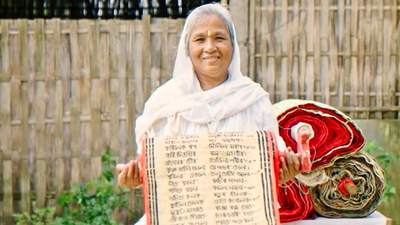
Padma Shri Hemoprova Chutia. (Image Courtesy: History TV18)
Copying a page of text isn't hard if you can read it. You know what each letter means, so your hand just follows your eyes. But imagine recreating every single letter of a language you cannot even read and doing it entirely by hand, on a cloth nearly the length of a football field.That's what Hemoprova Chutia did. And for it, Assam's master weaver was awarded the Padma Shri, one of India's highest civilian honours. But here's the part that still doesn't quite make sense: she can’t read Sanskrit. Her English isn't fluent either. And yet she embroidered the complete Bhagwad Gita, in both languages, onto handwoven fabric stretching close to 280 feet.
6 May 2026 | 16:56
What are the three things that make you instantly happy?
Her work is not just extraordinary craftsmanship. It is a story of lifelong commitment to preserving Assam's rich weaving tradition.
A life rooted in Assam's rich weaving traditions
As per various media sources, Hemoprova is from Moran, in Assam's Dibrugarh, and her connection to weaving runs far deep. She's also created pieces using Muga silk, the golden-hued fabric Assam is famous for worldwide. While traditional Assamese weaving usually leans on floral or geometric patterns, she brought something different to the table: intricate beadwork stitched into cotton and silk ‘gamochas’, giving a textile that's practically a cultural symbol a whole new visual identity.
Her work is proof that a loom can do more than make fabric. It can tell a story. It can hold devotion. It can preserve history.
When you can't read letters, you learn to see them
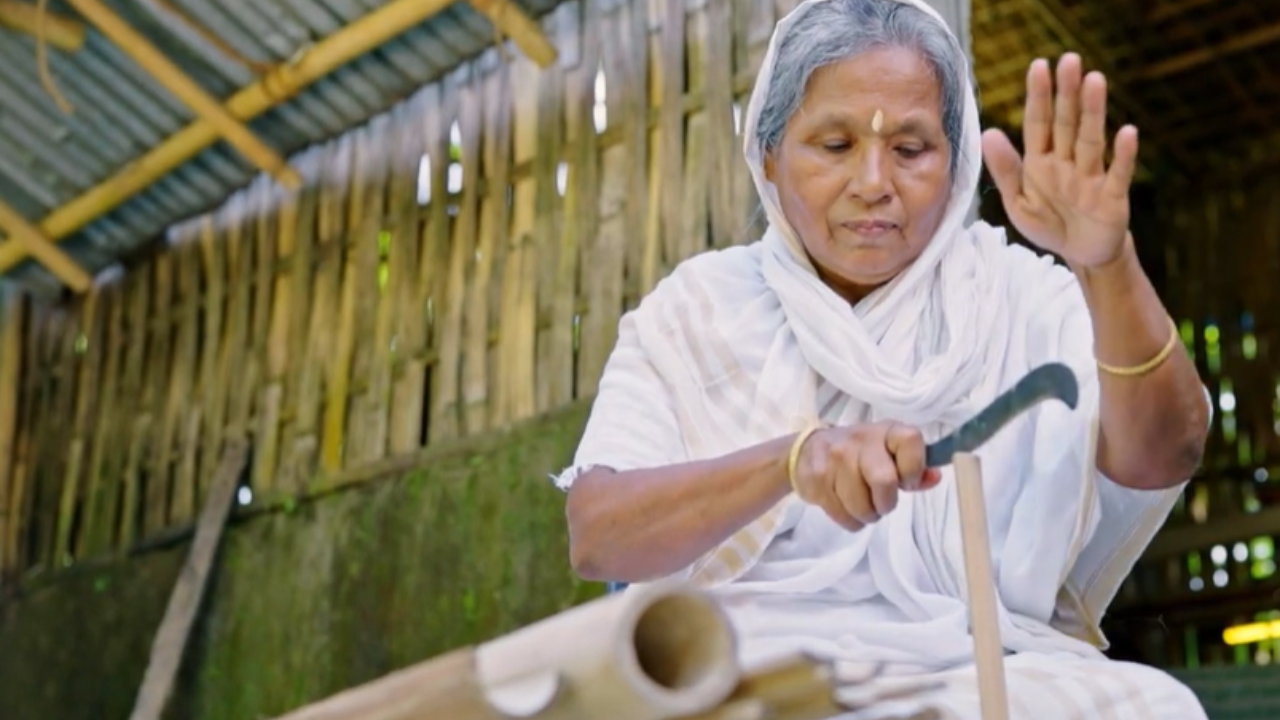
Padma Shri Hemoprova Chutia. (Image Courtesy: History TV18)
Most of us take words for granted because we understand them the moment we look at them. Hemoprova didn't have that shortcut. Every Sanskrit character was just a shape to her, a pattern with no built-in meaning. So that's how she treated it. She studied each letter the way an artist studies a form, memorized its exact curves and strokes, and then recreated it stitch by stitch.
One wrong loop of thread and an entire word could change into something else entirely and she'd have no way of knowing, since she couldn't read it back to check.
It only gets harder from there
Embroidery already asks a lot of patience. But weaving text onto a loom adds a twist nobody warns you about: everything has to be done backwards! Words get woven in a mirror image so they read correctly once the cloth is flipped to the front. That means constantly thinking in reverse: while still keeping every letter spaced evenly and perfectly aligned with the last. Now multiply that by hundreds of thousands of characters, in a script she can't read, with no machine, no printer, no shortcut of any kind. Just her hands and thread, one letter at a time.
Two years, one piece of cloth
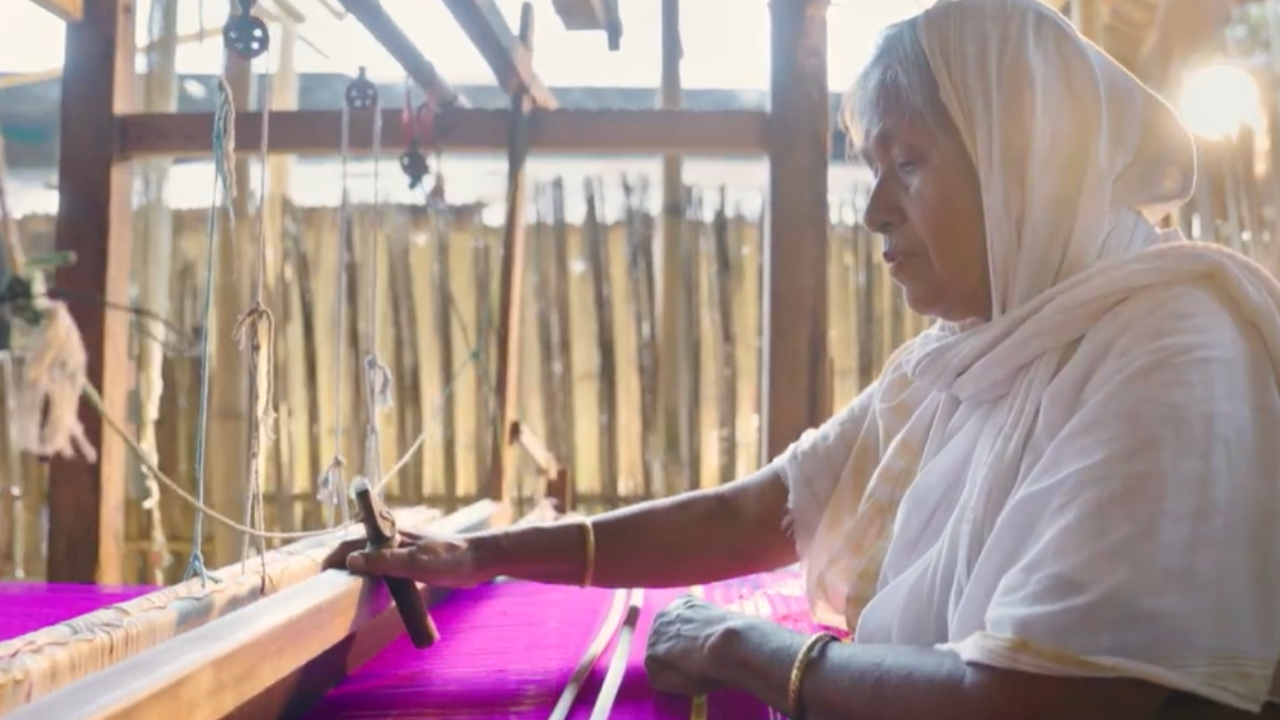
Padma Shri Hemoprova Chutia. (Image Courtesy: History TV18)
Her most staggering piece might be the English rendering of the Bhagwad Gita: about 280 feet long and roughly two feet wide. For scale, that's close to the height of a 25-storey building, laid flat instead of standing up. It took her more than two years to finish.Two years of sitting with thread and cloth, letter after letter, with no sense of when the "story" she was weaving actually made sense: only that the shapes were right.
The Gita was just one chapter
As remarkable as that piece is, it's only a fraction of what Hemoprova has made over her lifetime. She has also woven the ‘Naam Ghosa,’ a devotional text from the 16th century, and the Gunamala, written by the Assamese saint-reformer Srimanta Sankardev, and she didn't stop at the original Assamese.
She recreated both in Hindi and English too.Cotton, silk, wool, even finely cut bamboo: she's worked with all of it, always finding new material without ever straying from the traditional techniques she grew up with.
When she got the long-due recognition
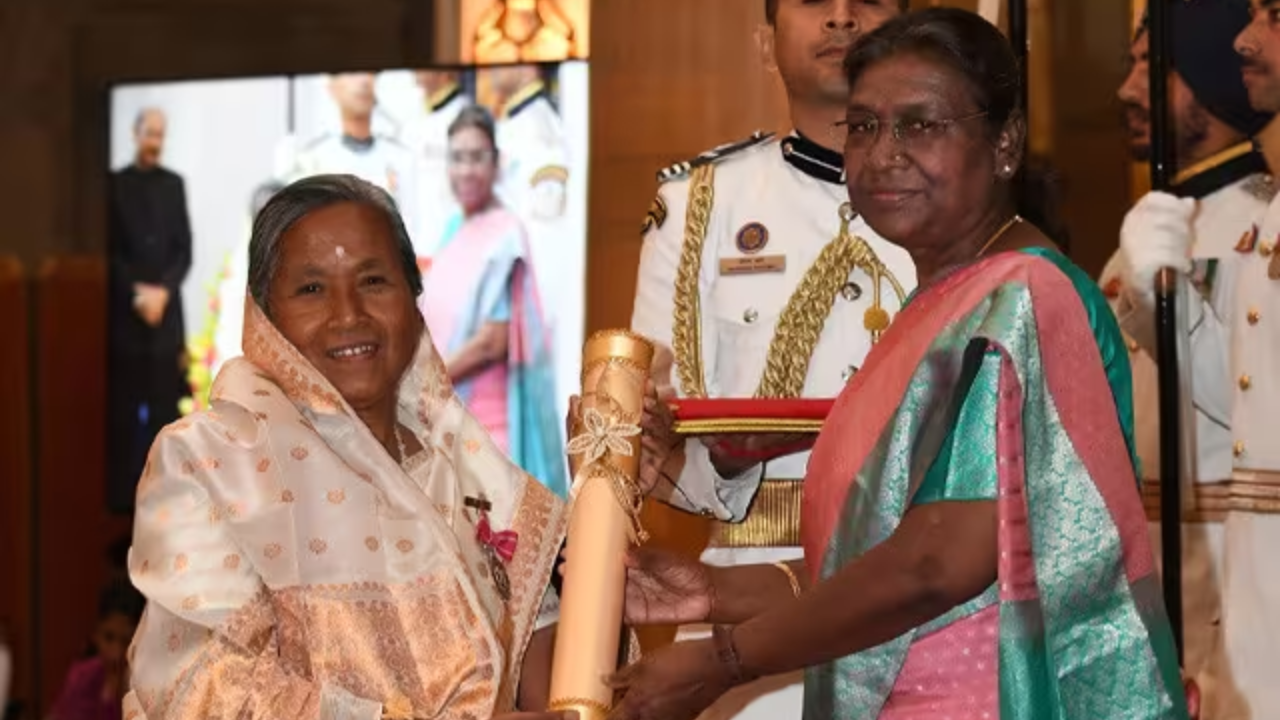
Hemoprova Chutia receiving the Padma Shri from President of India Droupadi Murmu in 2023.
The Padma Shri wasn't her first honour, and it likely won't define her legacy on its own. Long before that, she'd already received the Assam Gaurav Award, the Bakul Bon Award, the Aai Kanaklata Award, and the state's Handloom and Textile Award.
Each one marks years most people never see: the quiet, repetitive, often invisible labour behind a craft that rarely gets applause in the moment.We live in a time when a machine can embroider something intricate in minutes. Hemoprova Chutia's work is a reminder of what gets lost in that speed and what's gained by refusing it. She didn't understand the words she was stitching. She understood the shapes, the discipline, the years it would take, and she did it anyway.That's not just skill. That's devotion, quite literally woven into cloth, one thread at a time.








 English (US) ·