

 2 days ago
3
2 days ago
3
ARTICLE AD BOX
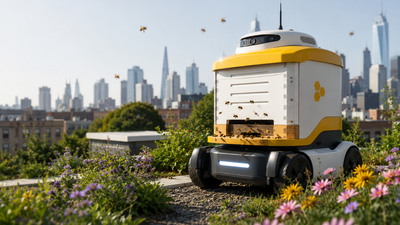
Urban beekeeping is entering a new era. A student designer, Christoffer Weinreich, from Umeå Institute of Design, has developed an innovative self-driving beehive concept that reimagines how bees could be managed within modern cities.
Rather than remaining fixed in one location, the mobile hive is designed to move autonomously through urban environments, helping colonies access diverse flowering areas while reducing some of the logistical challenges beekeepers face.
The project reflects a growing intersection between sustainable design, autonomous mobility and biodiversity conservation. At a time when pollinator populations continue to face pressure from habitat loss, climate change, and disease, concepts like this highlight how young designers are exploring new ways to support essential species.
While still a design proposal, the idea has sparked interest because it combines technology and ecology in a way rarely seen in traditional beekeeping.
How a student's autonomous beehive reimagines urban beekeeping
The concept, known as MOBEE, was created by industrial design student Christoffer Weinreich. It combines a compact autonomous vehicle with modular beehive units, allowing bee colonies to be transported efficiently across urban areas. According to the project description, the vehicle is capable of navigating autonomously and can operate with or without a beekeeper on board.
Its modular system enables hives to be moved where pollination opportunities are greatest while simplifying hive management in densely populated cities.MOBEE is a network of autonomous compact and multi-functional vehicles that helps broaden the number of beehives in urban areas by providing the infrastructure and logistics to urban beekeeping services while also increasing local production in urban environments.The idea addresses a growing challenge in urban beekeeping: finding suitable forage throughout the year. By relocating colonies when floral resources shift seasonally, the system aims to support healthier bee populations while improving pollination services within cities. The project envisions a network of connected urban hives rather than isolated colonies.
Why cities need smarter beehives to protect pollinators
Pollinators play a critical role in ecosystems and food production. Researchers involved in the European HIVEOPOLIS initiative describe bees as providers of vital ecosystem services through pollination, making their survival increasingly important for both natural environments and human societies.
The project explores how modern technology and intelligent hive design can help support bee health and improve accessibility to beekeeping.Similar research and student-led initiatives around the world have focused on integrating sensors, automation and environmental monitoring into beehives. Smart hive systems can track temperature, humidity and colony conditions in real time, helping beekeepers identify potential problems before they become critical.
These developments demonstrate a broader trend towards technology-assisted conservation rather than traditional hive management alone.As the HIVEOPOLIS project notes, the goal is to create a "smart city for honeybees" by combining sustainable materials, modern mechatronics and innovative hive structures that support colony survival and ecosystem health.
Could self-driving beehives become the future of sustainable cities
Although MOBEE remains a conceptual design, it reflects a wider movement towards integrating biodiversity into urban planning.
Cities worldwide are increasingly investing in pollinator corridors, rooftop gardens and green infrastructure to support declining insect populations. A mobile hive system could complement these efforts by dynamically connecting bee colonies with available floral resources.The project also demonstrates how design students are contributing fresh perspectives to environmental challenges. By combining autonomous mobility with ecological stewardship, the concept moves beyond conventional thinking about both transportation and conservation.
Whether self-driving beehives eventually become reality or remain an experimental idea, they underline an important principle: future cities may need to be designed not only for people, but also for the species that help sustain urban ecosystems.As environmental innovator Janine Benyus has often argued through the principles of biomimicry, via her work such as ‘Biomimicry: Innovation Inspired by Nature’, nature can serve as a model, measure and mentor for human innovation. Projects such as MOBEE embody that philosophy by using technology not to replace nature, but to work alongside it.









 English (US) ·