

 59 minutes ago
5
59 minutes ago
5
ARTICLE AD BOX
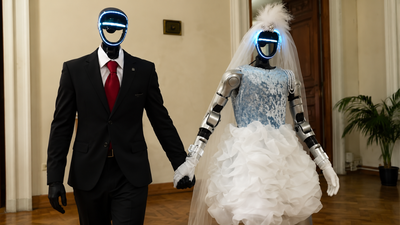
Robots are increasingly finding roles in homes, workplaces and public spaces, but in Moscow this week, they stepped into a far more symbolic role. Two humanoid robots, Robert and Matilda, became the centre of attention during what organisers described as Russia's first robotic wedding ceremony, an event designed to showcase advances in humanoid technology rather than blur the line between humans and machines.Held at Moscow's Pushkin Library to mark the country's Day of Family, Love and Fidelity, the ceremony featured many of the traditions associated with a conventional wedding. The robots exchanged vows and symbolic wedding bracelets, which were delivered by a robotic dog named Dogmatik, before a host declared them "robot spouses" following a mock compatibility and synchronisation announcement. According to the developers behind the project, the event was intended to highlight the growing capabilities of humanoid robotics and encourage public discussion about how intelligent machines could assist people in everyday life, rather than suggest that robots are capable of genuine emotions or legal marriage.
A symbolic ceremony featuring two household robots
The wedding was held in Moscow during celebrations for the Day of Family, Love and Fidelity, Russia's annual holiday dedicated to marriage, loyalty and family values. According to Russia House, every year on July 8, Russia celebrates a significant holiday: the Day ofFamily, Love and Fidelity. This holiday is a reflection of the importance of family values and close relationships in Russian culture. It is symbolic that its first celebration took place in 2008, which was officially declared the Year of the Family in Russia.
As reported by First Nyus Media, dressed for the occasion, the two humanoid domestic robots exchanged rings, performed coordinated movements and delivered pre-programmed wedding vows in front of spectators. The ceremony recreated many familiar elements of a traditional wedding, from the formal exchange of promises to the symbolic presentation of the rings.A video shared by @Твоя Лента-55 on YouTube captures highlights of the ceremony, showing Robert and Matilda exchanging symbolic vows before receiving wedding bracelets delivered by the robotic dog, Dogmatik.
Crowds gathered to watch the unusual spectacle, which quickly drew attention across Russian media and social media platforms. While the event had all the visual hallmarks of a wedding, organisers stressed that it was a technological showcase rather than an attempt to blur the line between humans and machines.
A celebration rooted in Russian tradition
The timing was no coincidence. The Day of Family, Love and Fidelity has been observed across Russia since 2008 and honours Saints Peter and Fevronia of Murom, figures revered in the Russian Orthodox tradition as enduring symbols of faithful marriage and lifelong devotion.The holiday is marked by weddings, family celebrations and public events that promote stable family life. By placing a pair of humanoid robots at the heart of those festivities, organisers created an unusual contrast between one of Russia's oldest cultural traditions and one of its fastest-evolving technologies.
Domestic robots are becoming increasingly capable
The ceremony also reflected the rapid development of domestic robotics. Modern household robots are no longer limited to simple, repetitive tasks.
Many can recognise voices, navigate indoor spaces, identify objects and interact with people using increasingly sophisticated artificial intelligence.Humanoid designs are becoming especially prominent because they can operate in environments built for humans without requiring major adaptations. Although the wedding itself was carefully choreographed, it demonstrated the growing ability of robots to perform complex sequences of movements and social interactions with remarkable precision.Events like this often serve another purpose as well: they encourage the public to engage with emerging technologies in a setting that feels entertaining rather than intimidating.
Where technology meets culture
The Moscow ceremony did not hold any legal standing and was nothing more than a ritualistic display of sorts. Its significance resided in what it signified, namely, a convergence of the past with the present.While for some it may have merely been an interesting spectacle, for others, it served as a hint to the future where robots would be integrated in human society not only through their functions as helpers but also through their status as recognizable individuals. Whatever one's view of it, whether as an ingenious publicity stunt or as a snapshot of robotics technology reaching a certain point in development, this ceremony demonstrated that the development of technology goes hand-in-hand with discourse.





 English (US) ·