

 1 week ago
10
1 week ago
10
ARTICLE AD BOX
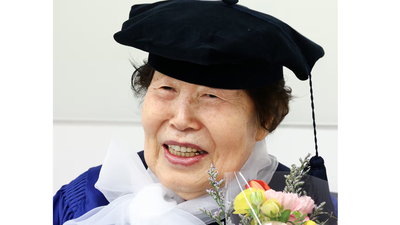
At an age when most people have long stepped away from classrooms, Kim Jung-ja was walking into one. At 78, she began learning how to read and write for the first time, taking tentative steps into formal education decades after it usually ends.
What followed was not a symbolic gesture or a short course, but a determined, years-long journey through middle school, high school and eventually university, driven by curiosity rather than credentials.That journey reached a remarkable milestone when Kim graduated at 85 with a degree in social welfare from Sookmyung Women’s University, becoming South Korea’s oldest university graduate. For Kim, however, the ceremony did not mark an ending.
Instead, it was a pause before her next chapter, as she now prepares to return to university once again, convinced that learning has no expiry date.
From learning to read at 78 to becoming a university student
Kim’s educational journey began at 78, when she decided to learn basic literacy. Growing up in post-war Korea, formal schooling had not been accessible to her, and reading and writing remained out of reach for most of her life. Mastering the alphabet as an elderly learner required patience and repetition, but it also opened a door to further study that she had never imagined possible.
After achieving literacy, Kim went on to complete middle school and high school equivalency courses. She later sat South Korea’s competitive college entrance examination, becoming the oldest candidate of her year. Her admission to Sookmyung Women’s University marked an extraordinary transition from adult education centres to lecture halls filled with students more than six decades younger.
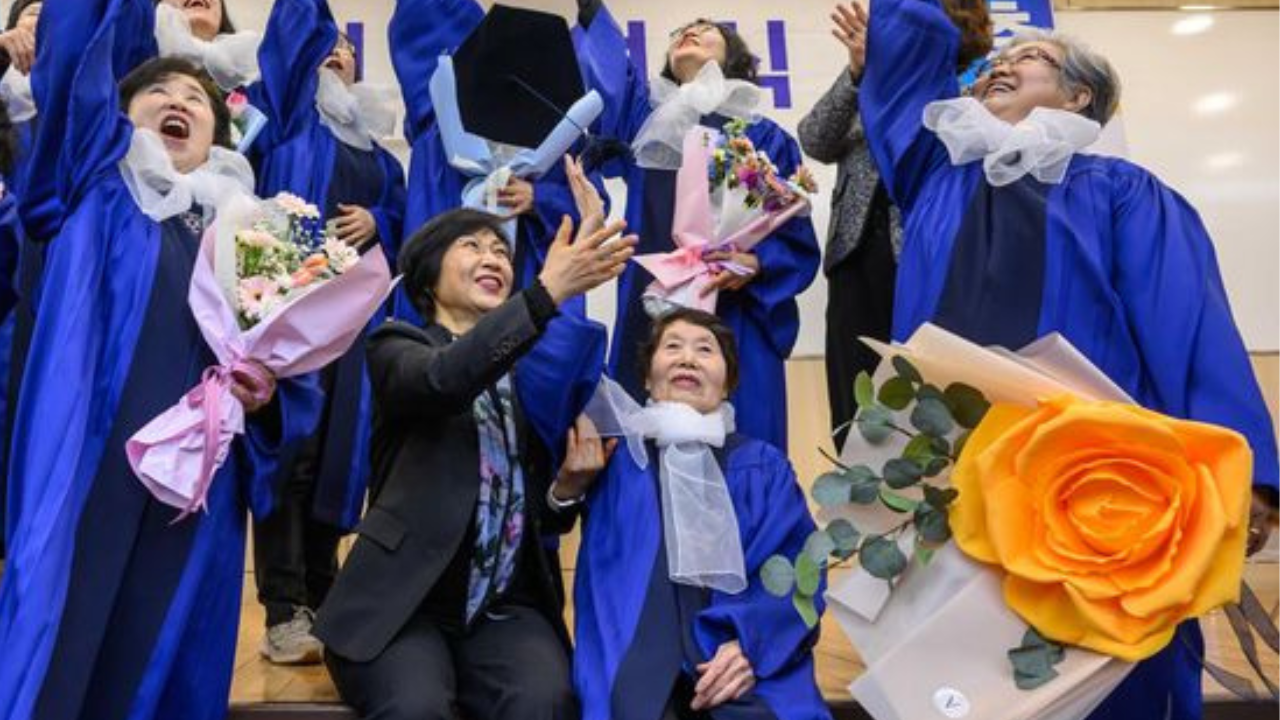
University life came with daily challenges. Kim reportedly spent up to three and a half hours commuting each day and struggled with digital coursework, submitting handwritten assignments instead of typed ones.
Heavy textbooks were difficult to carry, so she bought duplicate copies to keep at home and on campus. Classmates frequently stepped in to help, carrying her bags and arranging transport, turning her university experience into a collective effort rather than a solitary one.
Recognition and national attention
Kim’s perseverance earned widespread attention in South Korea. She received the Minister of Education Award, with officials citing her determination and her role in highlighting the importance of lifelong learning in an ageing society.
Her story has since been shared internationally as an example of education extending well beyond conventional timelines.

Retirement from learning is not part of Kim’s plan. She has announced her intention to enrol in a four-year programme in children’s studies and hopes to learn English, partly to communicate better with her grandchildren living overseas. As she has repeatedly said, she plans to keep studying for as long as she can, believing that education, once begun, should never truly end.





 English (US) ·