

 1 hour ago
6
1 hour ago
6
ARTICLE AD BOX
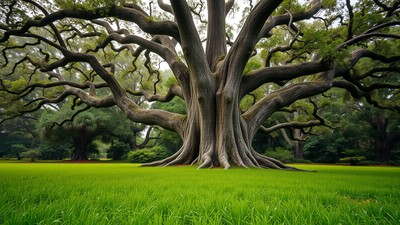
Standing quietly on Johns Island near Charleston, South Carolina, is a tree that was already old when America was born. The Angel Oak, a southern live oak known scientifically as Quercus virginiana, is estimated to be between 400 and 500 years old, making it one of the oldest living things east of the Mississippi River.
It was alive before the American Revolution, before Charleston itself was founded, and before most of the world's great nations took their current shape.
Today, roughly 400,000 people visit it every year, and almost everyone who stands beneath its massive, twisting branches walks away feeling something they did not expect: a quiet sense of awe that is hard to put into words.
How big is the Angel Oak, and what makes it so extraordinary
The numbers alone are enough to stop you in your tracks. The Angel Oak stands 66.5 feet tall, which is already unusually high for a southern live oak, a species that typically grows outward rather than upward.
Its trunk measures 28 feet in circumference. Its canopy, the total area of shade it creates, covers an astonishing 17,200 square feet, roughly equivalent to three basketball courts laid side by side. Its longest single branch stretches 187 feet from end to end.Live oaks are known for their massive, low-sweeping limbs, but the Angel Oak takes this to an extreme that feels almost unreal. Some of its heaviest branches have grown so long and heavy that they dip all the way down to the ground before curving back upward, a behaviour typically seen only in the very oldest live oaks.
Ferns and other small plants grow along the surface of its ancient limbs, giving the whole tree a fairytale quality that photographs can capture but never fully replicate.
In 2026, it was listed on the National Register of Historic Places, an official recognition that was a long time coming.
The history behind the name: from the Waight family to the Angel Estate
The land on which the Angel Oak stands has a long and layered history. According to historical records, it was originally part of the territory of the Cussoe people, the Indigenous inhabitants of this part of the South Carolina coast.
In 1675, the land changed hands when it was acquired by English colonists. By 1717, it had been granted to Abraham Waight as part of a 96-acre land grant, and the Waight family turned it into a working plantation, with enslaved people farming cotton and corn across the property for the next century and a half.The tree got its name in 1810, when Martha Waight, a descendant of Abraham Waight, married a man named Justus Angel.
As part of the marriage settlement, the couple inherited the land surrounding the great oak, and they established a plantation they called Angel Oak Plantation. Over time, the locals simply began calling the tree itself the Angel Oak. The family retained ownership of the land for generations, with the Angel family continuing to farm cotton there until as late as 1904.
The City of Charleston eventually purchased the tree and its surrounding park in 1991, and it has been open to the public free of charge ever since.
The legends, folklore, and Civil Rights history surrounding the tree
The Angel Oak carries more than just biological history. Because it stood on plantation land for so many decades, it has become deeply connected to the stories of the enslaved people who lived and worked nearby. Local legend holds that the spirits of former slaves appear as angels around the tree one popular theory for how the name "Angel" took on a second, deeper meaning beyond its connection to the Angel family. Some believe African American individuals are buried in the ground near the tree's roots, though this has not been formally confirmed.During the era of racial segregation in the American South, the Angel Oak became a rare kind of refuge. As civil rights activist Septima Clark recalled in a 1980 oral history, the tree was one of the few places in the region where Black families could freely gather, picnic, and let their children play. It was not segregated the way so much else in the South was. That history gives the tree a dignity that goes far beyond its age and size it was a place of shelter and equality long before either became guaranteed by law.
How a 500-year-old tree survived both nature and human development
Living for half a millennium means surviving a great deal. The Angel Oak has been through earthquakes, floods, and numerous hurricanes, including Hurricane Hugo in 1989, which caused serious damage to the tree. It recovered. And in more recent decades, it has faced a different kind of threat: urban development.In 2008 and again in 2012, plans were proposed to build large apartment and retail complexes very close to the tree, which would have altered the groundwater flow and cleared much of the maritime forest whose root systems are connected to the Angel Oak's own.
Community groups, conservation organisations, and ordinary citizens fought back hard. By 2013, the Lowcountry Land Trust had purchased 17 acres of adjacent land specifically to protect the tree from future encroachment, and the area has since been secured for preservation.
The Angel Oak is now the centrepiece of Angel Oak Park at 3688 Angel Oak Road on Johns Island, open Monday through Saturday from 9 AM to 5 PM, and Sunday from 1 PM to 5 PM. Admission is free, with donations accepted to support the tree's ongoing care and conservation.








 English (US) ·