

 1 hour ago
3
1 hour ago
3
ARTICLE AD BOX
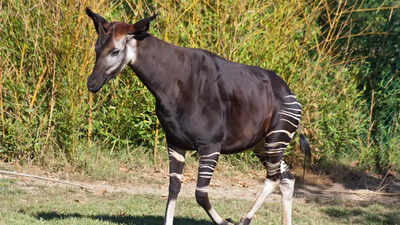
The okapi is one of the rainforest’s most mysterious mammals. At first glance, it looks like someone stitched together a zebra and a giraffe. Its hind legs have striking white stripes, its face is long like a giraffe’s, and its body is antelope-like.
It’s a distinct species, found only in the Democratic Republic of the Congo. It lives in dense forests that are hard to access. Scientists discovered through anatomy and DNA studies that the okapi is the closest living relative of the giraffe. This link was not obvious at first, given the stark differences in appearance.
Okapis: Long-necked relatives of giraffes thriving in dense forests
Okapis fall under the Giraffidae family. They possess similar characteristics to giraffes. For instance, their necks are long but shorter than those of giraffes.
Additionally, their tongues are incredibly flexible and can extend up to 30 centimeters. Experts have asserted that okapis use their tongues to strip leaves from trees, pick buds, and even pick their ears. Okapis also have big ears that rotate independently to help them hear even the slightest sounds in the forest.
This assists them in detecting leopards, which are their main predators.Okapis also have a slow and careful pace. They stroll calmly through the forest, consuming hundreds of plant species, including leaves, fruits, buds, and fungi.
This mode of foraging is perfectly suited for the forest, where making little noise is a matter of life and death.
Okapis: Stripes and camouflage
The okapi’s zebra-like stripes are not just for show. They serve as camouflage. Sunlight filters through the rainforest canopy, creating patches of light. The stripes break up the okapi’s silhouette, helping it remain invisible to predators. It seems almost like nature painted them for safety. Researchers note that this camouflage is vital in a habitat where dense foliage limits visibility.
Okapis: Behaviour and social life
Okapis are also solitary animals. They prefer to live alone. However, it is worth mentioning that okapi mothers and calves communicate with each other through low sounds. Experts state that okapi calves and their mothers communicate with each other through low sounds, which cannot be heard by okapi predators. This way, the okapi calves and their mothers stay in touch with each other without revealing their whereabouts.On the other hand, the local population of Congo had been familiar with okapi presence for a long time. Okapi presence was scientifically identified in 1901 by a British explorer named Harry Johnston.
Okapis’s conservation
Okapis are classified as endangered. Habitat loss from logging, mining, and agriculture is the main threat. Poaching exists but is less significant than habitat destruction. Protected areas, like the Okapi Wildlife Reserve, provide some safety.
Scientists continue to monitor populations to prevent decline. The species remains highly sensitive to environmental changes.
Okapis’ unique traits
Apart from their stripes and tongues, there are other unusual features about the okapi. The neck muscles enable precise movement, thus assisting the okapi in feeding. The okapi's body is able to move easily in the dense forests. It has been noted that the okapi has made the forests its home, and it is very specialised for the rainforest environment. The okapi may look like a mixture of different animals, but it is one of the rarest and most interesting creatures in the world. The fact that the okapi is related to the giraffe and its secretive nature indicates the richness of the forests in Central Africa. It is a rare and amazing experience to catch a glimpse of the okapi.









 English (US) ·