

 43 minutes ago
4
43 minutes ago
4
ARTICLE AD BOX
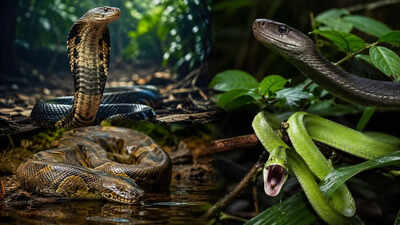
Snakes have always unsettled people a little. Maybe it is the silent movement, sudden strikes, or perhaps it is the way some species behave in ways that seem oddly calculated. Scientists usually avoid describing snakes as “smart” in the human sense because most reptile behaviour comes from instinct rather than conscious thought.
Even so, a few species display hunting and defence tactics so unusual that they almost look planned out.Some snakes lure prey using body parts that imitate other animals. One tricks fish into swimming directly into its mouth. Another collapses dramatically and pretends to die when danger appears nearby. The king cobra, often described as the world’s most intelligent snake, reportedly changes its hunting behaviour depending on the prey it faces.According to Discover Wildlife, none of these reptiles is a mastermind yet; evolution has shaped certain snakes into predators that seem surprisingly cunning when watched closely in the wild.
World’s smartest snakes and clever hunting tricks
King cobra
The King Cobra is famous for its size and venom, but researchers say its behaviour is what really sets it apart from many other snakes. It is the longest venomous snake on Earth and can grow over five metres long in some cases. What makes the king cobra stand out is its apparent adaptability.
Most snakes follow fairly repetitive hunting patterns throughout their lives. Ambush prey, strike quickly, and swallow the victim whole.
The king cobra seems more flexible than that. Herpetologists have observed the snake approaching different prey in different ways, particularly when hunting other snakes, which form a large part of its diet.The species also shows unusual parental behaviour. Female king cobras are the only snakes known to build nests for their eggs.
The female gathers leaves and debris into a mound, lays her eggs inside, and stays nearby to guard them. That level of protection is rare among reptiles and has helped create the impression that the snake is unusually aware of its surroundings.
Tentacled snake
The Tentacled Snake does not look especially dangerous at first glance. It is relatively small, thin-bodied, and spends much of its life hidden in muddy water across Southeast Asia.Then there are the strange tentacles near its nose. These tiny projections appear to help the snake sense movement underwater, though its hunting technique is what truly fascinates researchers. The snake remains almost perfectly still while waiting for fish to swim close. Once the prey enters range, the reptile performs a deceptive manoeuvre that seems surprisingly advanced for such a small predator.Fish naturally react to danger using a rapid escape reflex.
Their bodies bend sharply before darting away from the threat. The tentacled snake appears to exploit that instinct with remarkable precision. Instead of striking directly toward the fish, it makes a slight movement with another part of its body. The startled fish reacts instantly and swims away in a predictable direction. Unfortunately for the fish, that direction often leads straight into the snake’s mouth.
Researchers studying the behaviour discovered the entire sequence happens in under 30 milliseconds.
Eastern hognose snake
The Eastern Hognose Snake is not particularly deadly, though its behaviour has made it one of the more memorable snakes in North America. The species is mildly venomous, but its venom mainly affects amphibians and poses very little danger to humans.When threatened, the eastern hognose begins with intimidation displays. It hisses loudly, flattens its neck and performs rapid bluff strikes with its mouth closed. The snake wants predators to believe it is dangerous, even when it often has no intention of biting.If the act fails, the performance becomes even stranger. The snake rolls onto its back, opens its mouth, and lets its tongue hang limply to one side. For instance, one observed snake stayed motionless for around 45 minutes before quietly flipping over and slithering away after the threat disappeared.
Spider-tailed horned viper
The Spider-tailed Horned Viper looks almost unreal. Even reptile researchers were reportedly sceptical when the species was first described because its tail seemed too bizarre to be genuine.As the snake matures, the tail develops a bulb-like structure that looks similar to a spider’s abdomen, while surrounding scales spread outward in ways that resemble legs. When the snake twitches its tail slowly, the illusion becomes remarkably believable to birds and small reptiles searching for food.The viper hides among rocky desert terrain and wiggles the fake spider to attract curious prey. Once an animal approaches for what appears to be an easy meal, the snake strikes with extraordinary speed.
Black Mamba
The Mamba is already feared because of its speed and highly toxic venom. Black mambas, especially, have developed a reputation as some of Africa’s deadliest snakes. Their venom attacks the nervous system and can eventually stop breathing if treatment is not provided quickly.Recent studies suggest certain mamba species may possess a more complicated venom system than scientists once realised. Some toxins block communication between nerves and muscles, causing paralysis.
Others appear to overstimulate nerves at the same time.This creates an unsettling combination. Victims initially experience paralysis, but after the antivenom begins reversing the paralysis, severe muscle spasms may suddenly appear because the second group of toxins becomes more noticeable. Researchers are still studying how these venom effects evolved together and why they developed this way.









 English (US) ·