

 1 hour ago
5
1 hour ago
5
ARTICLE AD BOX
Bail denied to IAS officer in PMLA case
Ahmedabad: Observing that money laundering “scars the economic condition of the nation as a whole”, Gujarat high court denied regular bail to suspended IAS officer Rajendra Patel, who is facing corruption charges linked to alleged irregularities in processing change of land use applications during his tenure as Surendranagar collector.Patel, a 2015-batch IAS officer, was arrested in Jan by the Enforcement Directorate (ED) after the state anti-corruption bureau (ACB) registered an FIR against him and some of his subordinate officers on bribery allegations.He sought bail raising contentions regarding stringent provisions of the Prevention of Money Laundering Act (PMLA), under which he was booked.Denying bail, Justice H D Suthar stated, “The main object of PMLA is to prevent money laundering.
The economic health of the nation needs to be protected and money laundering scars the economic condition of the nation as a whole. It is needless to say that sovereignty of the nation always prevail over personal liberty.”Opposing Patel's bail plea, ED relied on investigation outcome and submitted that a ‘hisaab sheet’ recovered from the accused persons revealed that the collector allegedly received over Rs 3.12 crore towards his 50% share of the bribe.
On Patel’s claim of innocence, HC stated, “Applicant herein failed to satisfy the twin conditions under Section 45 of the PMLA as there exists no reasonable grounds to believe that he is not guilty or unlikely to commit the offence again.”It further added, “It is apparent from the record that applicant played a key role in a deep-rooted conspiracy involving diversion and laundering of public funds, with material evidence prevailing during investigation, his active involvement in acquiring ‘proceeds of crime’ routed through sham entities and transaction.”HC turned down Patel’s argument that ED was targeting him, as many co-accused in this case have not been arrested. It stated in its order, “The applicant is arrest based on circumstantial evidence indicating his active role in the offence of money laundering and the ongoing investigation justifies differential treatment based on individual culpability… Since his role is found to be serious one and applicant has received largest single share of bribe amount and the role of the present applicant is different or higher than other accused who have not been arrested or yet to be arrested.
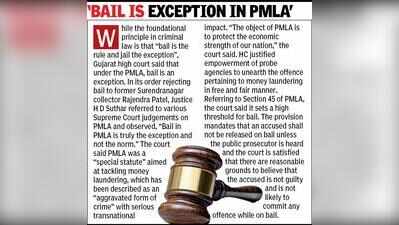
Hence, merely because co-accused are not arrested is not a ground for the applicant to claim absolute parity.”BOX 1: Bail is exception in PMLA: HCWhile the foundational principle in criminal law is that “bail is the rule and jail the exception”, Gujarat high court said that under the PMLA, bail is an exception.In its order rejecting bail to former Surendranagar collector Rajendra Patel, Justice H D Suthar referred to various Supreme Court judgments on PMLA and observed, “Bail in PMLA is truly the exception and not the norm.”The court said PMLA was a “special statute” aimed at tackling money laundering, which has been described as an “aggravated form of crime” with serious transnational impact. “The object of PMLA is to protect the economic strength of our nation,” the court said. HC justified empowerment of probe agencies to unearth the offence pertaining to money laundering in free and fair manner.Referring to Section 45 of PMLA, the court said it sets a high threshold for bail.
The provision mandates that an accused shall not be released on bail unless the public prosecutor is heard and the court is satisfied that there are reasonable grounds to believe that the accused is not guilty and is not likely to commit any offence while on bail.Box: 2 - What is the caseSuspended IAS officer Rajendra Patel and some of his subordinates in the Surendranagar district collector’s office are accused of running a systematic racket of accepting bribes to expedite applications for permission for change of land use (CLU).Probe agencies have alleged that officials manipulated the govt’s iORA portal — Integrated Online Revenue Applications — by adding a column where bribe rates were fixed between Rs 5 and Rs 10 per square metre, depending on the nature of the application.ED claimed that it traced around 800 applications, the processing of which allegedly generated proceeds of crime worth Rs 10 crore.According to ED, a “hisaab sheet” recovered from accused persons allegedly showed how the bribe amount was distributed among officials. ED arrested and recorded the statement of deputy mamlatdar and executive magistrate Chandrasinh Mori, who reportedly stated that 50% of the bribe collected went to collector Rajendra Patel, 10% to himself, and the remaining amount was distributed among other officers of the collectorate.ED has claimed that residential additional collector R K Oza received 25%, mamlatdar Mayur Dave 10%, and clerk Maryusinh Gohil 5%. The agency relied on these details to seek Patel’s custodial interrogation.






 English (US) ·