

 1 day ago
6
1 day ago
6
ARTICLE AD BOX
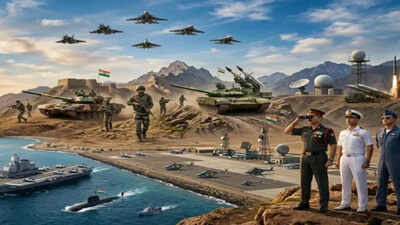
India's ambition to emerge as a global defence manufacturing hub rest not only on large public sector undertakings or major private conglomerates, but on a vast network of micro, small and medium enterprises (MSMEs).
These firms constitute the technological and manufacturing backbone of modern defence ecosystems worldwide.In India too, the contours of such a system are beginning to emerge. Over the past decade, a series of policy reforms, ranging from procurement changes to innovation programmes—have attempted to widen the defence industrial base and bring MSMEs into the fold. Today, nearly 16,000 MSMEs are linked to defence production and supply chains, contributing to areas such as electronics, precision engineering, drones, materials and software systems.India’s defence manufacturing output has crossed Rs 1.5 lakh crore, while exports have surged to over Rs 23,000 crore, reaching more than100 countries. These numbers signal momentum. Yet they also conceal an uncomfortable truth: India’s defence industrial architecture still remains dominated by large public sector entities, while MSMEs largely operate at the margins of the supply chain.For India to become a globally competitive defence manufacturing power, MSMEs must move from peripheral suppliers to core drivers of innovation, production and exports.
Why MSMEs matter in defence manufacturingGlobally, defence industries are built on layered supply chains. The prime contractor may design and integrate a system, but thousands of smaller firms manufacture components, electronics, subsystems and software.In the United States, for example, the aerospace and defence supply chain involves over 12,000 specialised suppliers. Germany’s defence industrial strength rests on the famed Mittelstand—medium-sized engineering firms known for precision manufacturing.India must replicate this model if it seeks technological depth and manufacturing resilience.
MSMEs bring three strategic advantages.
First, they expand manufacturing depth. Defence platforms, from fighter aircraft to missiles—contain thousands of components. Domestic MSMEs can manufacture these parts, reducing import dependence.Second, they foster innovation. Smaller firms are often faster and more flexible in adopting emerging technologies such as drones, artificial intelligence and robotics.Third, they improve cost competitiveness. Global defence markets are intensely price sensitive, and MSMEs can deliver components at lower costs compared with large industrial entities.In essence, MSMEs are not just suppliers; they are the industrial ecosystem that sustains defence production.
Policy reforms: Opening the sector
Recognising this reality, India has undertaken significant policy reforms over the past decade to integrate MSMEs into the defence sector.Procurement reforms: The Defence Acquisition Procedure (DAP) 2020 prioritises indigenous procurement through categories such as Buy (Indian–IDDM) and Buy (Indian). These frameworks mandate high levels of domestic content, creating opportunities for local supply chains.Furthermore, 75% of the defence capital procurement budget is now earmarked for domestic industry, a major shift aimed at reducing import dependence.Indigenisation push: The government has released multiple positive indigenisation lists banning the import of hundreds of defence items, from sensors and electronic warfare systems to ammunition components. For MSMEs, these lists effectively create guaranteed domestic markets. The SRIJAN portal complements this effort by identifying specific items currently imported and inviting domestic companies to develop them.Innovation platforms: One of the most transformative initiatives has been Innovation for Defence Excellence (iDEX). This programme connects the armed forces with startups and MSMEs to develop innovative technologies. Hundreds of defence challenges have been issued under iDEX, ranging from drone swarms to electronic warfare systems. For many small companies, this represents the first real opportunity to engage directly with the defence establishment.Defence industrial corridors: Industrial clusters are being developed in Uttar Pradesh and Tamil Nadu, designed to bring together manufacturers, suppliers, testing facilities and research institutions. Cluster-based development has historically been the most effective way to build high-technology industrial ecosystems.
The implementation gap
Despite progressive policy frameworks, MSMEs still face significant challenges in translating opportunity into sustained participation.Procurement complexity: Defence procurement remains complex and documentation heavy. Small companies often struggle with compliance requirements designed for large contractors.Payment delays: Delayed payments from prime contractors or government agencies can severely disrupt MSME cash flows.Limited access to testing facilities: Defence products require rigorous testing—ballistics, environmental stress testing, EMI/EMC certification and more.
Access to such facilities is limited and expensive.Technology barriers: Many defence technologies require advanced materials, specialised machinery and deep R&D investment—resources that MSMEs often lack. The result is a structural paradox: policy invites MSMEs into the sector, but operational barriers still restrict their growth.
Budget allocations: Are MSMEs benefiting?
India’s defence budget has risen to approximately Rs 6.8 lakh crore, with a substantial share earmarked for modernisation and domestic procurement.
However, the distribution of these funds reveals an imbalance. Defence public sector undertakings still account for around 70% of production, while the private sector—including MSMEs—contributes roughly a quarter. In most cases, MSMEs participate only as subcontractors to larger system integrators.This model is not inherently flawed—global defence industries also rely on layered supply chains. However, India must ensure that MSMEs move up the value chain, participating not only in component manufacturing but also in subsystem design and innovation.The export opportunity: India has set ambitious targets for defence exports, aiming to significantly expand its global market share. MSMEs will be central to achieving this goal. Global defence supply chains are increasingly fragmented. Prime contractors source components from specialised suppliers across multiple countries. If Indian MSMEs meet global quality standards, they can integrate into these international supply chains.Sectors with strong export potential include: Unmanned aerial systems, loitering munitions, electronic warfare systems, cyber security solutions and advanced materials and composites These are areas where small technology-driven firms can compete effectively.
Quality: The decisive factor
To succeed globally, MSMEs must focus relentlessly on quality. Defence manufacturing demands extremely high standards of reliability and precision.
Components must meet certifications such as: AS9100 aerospace standards, ISO quality management systems and international defence compliance requirements. Achieving these standards requires investments in advanced machinery, quality control systems and skilled manpower.Equally critical is the adoption of Industry 4.0 technologies—digital manufacturing, additive manufacturing, automation and AI-based quality monitoring.
Without these capabilities, MSMEs will struggle to compete in global markets.
Financing the defence MSME ecosystem
Access to finance remains a major constraint. Defence projects often involve long gestation periods, with significant upfront investment required before production begins. Traditional banking systems are often reluctant to finance such ventures. Targeted financing mechanisms are therefore essential, including: defence innovation funds, venture capital for deep-tech manufacturing, government-backed credit guarantees and long-term procurement commitments.
Such instruments can significantly reduce the risk for MSMEs entering the defence sector.
From Shahed to Shakti: What Iran’s drone playbook means for India’s defence strategy
India’s defence modernisation is at an inflection point. While capital-intensive platforms—fighter aircraft, submarines, and long-range missiles—continue to dominate procurement priorities, recent conflicts have exposed a decisive shift in warfare: the rise of low-cost, mass-produced drones and loitering munitions as strategic weapons.Iran has emerged as the most instructive case study. Despite decades of sanctions and technological isolation, it has built a formidable arsenal of drones and missiles that have challenged some of the world’s most advanced militaries. The lesson is not about sophistication—it is about scale, cost asymmetry, and doctrinal clarity.For India, facing a two-front threat and evolving grey-zone challenges, the implications are immediate and operationally relevant.Iran’s model: Strategy Over Technology. Iran’s success rests on a simple but effective framework: build affordable systems in large numbers and deploy them in integrated, saturating attacks. Instead of pursuing high-end precision platforms, Iran focused on: Low-cost loitering munitions (e.g., Shahed series), mass production capability and integration with missile forces and electronic warfare and decentralised and survivable manufacturing.Why this matters for India India’s current defence posture remains skewed toward high-value, low-volume platforms. While these are indispensable, they are increasingly vulnerable to saturation tactics. The emerging threat matrix—particularly from Pakistan’s adoption of low-cost drones and China’s industrial-scale unmanned capabilities—demands a recalibration. India cannot afford to fight a high-cost war against low-cost systems.
The core gaps in India’s approach
Prototype success, production weakness: India has demonstrated capability in drones and loitering munitions through startups and MSMEs. However: Production remains limited, procurement cycles are slow and scale manufacturing is absent. In contrast, Iran treats drones as consumables, not assets.Over-engineering vs cost optimisation: Indian systems often aim for high-end specifications, increasing cost and complexity. Iran’s approach is the opposite: “Good enough” accuracy, commercial off-the-shelf components and minimalist design philosophy.
This enables rapid scaling.Limited war reserve stocks: India largely follows a just-in-time procurement model. Iran builds large inventories in advance, allowing sustained operations.
MSMEs still peripheral
Despite policy reforms, MSMEs remain largely: Tier-2 or Tier-3 suppliers and dependent on large integrators They are rarely treated as prime system developers, except in niche cases like drones.Component dependency: Critical subsystems—sensors, chips, propulsion—are still imported.
This creates vulnerabilities in a conflict scenario.
Policy imperatives: A five-point action plan
Shift from platform-centric to volume-centric thinking. India must complement high-end platforms with mass-produced, low-cost systems, define target inventories (thousands, not hundreds) and treat drones as ammunition-class assets.Create a dedicated drone & loitering munition production mission. A national-level mission—akin to space or semiconductor programmes—should focus on: Scaling manufacturing, standardising designs and ensuring rapid induction.Empower MSMEs as prime integrators. The drone sector has shown that MSMEs can deliver complete systems. Policy must now: Enable direct procurement from MSMEs, provide assured orders and support scaling through financing and infrastructure.Build Component Sovereignty. India must prioritise domestic production of: Electro-optical sensors, Navigation systems, Microelectronics and Propulsion units. Without this, indigenisation remains superficial.Integrate drones into doctrine and war planning. Drones must move from tactical tools to central elements of war doctrine. This includes: Swarm warfare integration, Joint operations with artillery and air power and dedicated drone warfare units.Industrial survivability: The Missing Layer. Iran’s model includes dispersed and hardened manufacturing, ensuring continuity under attack. India’s defence industry remains geographically concentrated and vulnerable.
Future planning must incorporate: Distributed production networks, Redundant supply chains and Hardened infrastructure for critical facilities.
The Bottom Line
Iran’s rise as a drone and missile power is not an anomaly—it is a preview of the future of warfare. The decisive factors are no longer just technology or firepower, but: Production scale, Cost efficiency and Industrial resilience. India has the ingredients: a large MSME base, a growing innovation ecosystem, and supportive policy frameworks.
What it lacks is urgency and scale. If India continues to prioritise exquisite platforms without building mass, it risks entering future conflicts at a structural disadvantage.
But if it internalises the lessons from Iran’s playbook—adapted to its own strategic context—it can not only secure its borders but also emerge as a global hub for next-generation defence manufacturing. The choice is not between quality and quantity.
It is about achieving both—at scale, and in time.
Some success stories
Case 1: Solar industries & Z motion — Nagastra and the rise of indigenous loitering munitionsNagpur-based Solar Industries, working with Bengaluru startup Motion, has developed Nagastra-1, India’s first indigenous loitering munition. Precision strike capability with ~2 metre accuracy, Man-portable system designed for tactical deployment, successfully inducted by the Indian Army and Emergency procurement orders placed, including hundreds of units delivered.
More importantly, the system has already seen operational validation.
During recent deployments, upgraded variants like Nagastra-1R demonstrated night capability and high indigenous content—over 80% localisation.Why this matters: This is not just a product success—it is proof that MSME-led ecosystems can deliver combat-ready systems, not just components.Case 2: New space research — swarm drones and deep strike capabilityBengaluru-based NewSpace Research & Technologies represents the new generation of deep-tech MSMEs.
Its “Sheshnaag-150” swarm loitering munition: Capable of deep strikes beyond 1,000 km, designed as a cost-effective alternative to cruise missiles and focused on swarm warfare and autonomous targeting. NewSpace is working on multiple unmanned systems for defence forces, positioning itself as a high-end R&D-driven MSME rather than a traditional supplier.
Strategic takeaway: India’s MSMEs are not just assembling systems—they are beginning to define next-generation warfare doctrines such as swarm operations.Case 3: Johnnette technologies — rapid procurement to deploymentNoida-based Johnnette Technologies exemplifies how MSMEs can integrate into operational supply chains. Developed JM-1 loitering munition, delivered multiple batches to the Indian Army under emergency procurement and demonstrated rapid manufacturing and deployment capabilityWhy it matters: Speed is critical in modern warfare. MSMEs like Johnnette show that small firms can meet compressed timelines better than traditional procurement systems.
What these success stories reveal
These cases collectively highlight three structural shifts.MSMEs Are moving up the value chain. From supplying components, MSMEs are now designing complete weapon systems—drones, loitering munitions and swarm platforms.Speed and agility are competitive advantages. Emergency procurement routes have shown that MSMEs can deliver faster than traditional defence supply chains.Innovation is decentralising. Cutting-edge capabilities—AI targeting, autonomous navigation, swarm logic—are now being developed outside large institutions.This is a fundamental shift in India’s defence industrial structure.
Policy success — but partial
Government reforms have clearly enabled this ecosystem: iDEX has funded drone startups, Indigenisation lists created assured demand and 75% domestic procurement mandate ensured market access. Yet, these success stories are still exceptions—not the norm. Most MSMEs remain: Tier-2/3 suppliers, dependent on DPSUs or large integrators and constrained by finance, certification and procurement bottlenecks
The structural gaps
Even in the high-growth drone sector, critical constraints remain.Technology dependencies. Sensors, chips and advanced materials are still largely imported—limiting true indigenisation.Scale limitations. While prototypes are successful, scaling production to thousands of units remains a challenge.Certification and testing. Access to military-grade testing infrastructure is still limited.Procurement rigidities. Emergency procurement has helped—but standard procurement cycles remain slow and complex.
The strategic opportunity: Drones as India’s entry point
Drones and loitering munitions offer India a unique strategic window. Unlike fighter jets or submarines, these systems: Require lower capital investment, have shorter development cycles, are export-friendly and align with modern warfare trends (Ukraine, West Asia conflicts) India can realistically become a global supplier of tactical drone systems, with MSMEs at the centre.
What needs to be done next
To scale these successes into a systemic transformation, five priorities stand out.Create a dedicated MSME procurement track. Fast-track procurement pipelines specifically for MSME-developed systems.Expand testing infrastructure. Shared, subsidised access to defence testing facilities.Enable scale manufacturing. Production-linked incentives (PLI) for defence MSMEs—especially in drones.Build component sovereignty. Focus on indigenous sensors, chips and propulsion systems.Integrate MSMEs into global supply chains. Target exports through partnerships with global OEMs.
What reforms are still needed
If India is serious about building a globally competitive defence manufacturing ecosystem, several policy adjustments are necessary.First, procurement processes must be simplified for MSMEs. Dedicated procurement channels and faster contract cycles could encourage greater participation.Second, testing infrastructure must be expanded and made accessible to smaller companies.Third, stronger technology partnerships with global defence firms should be encouraged to accelerate capability development.Fourth, payment timelines must be strictly enforced to protect MSME liquidity.Finally, MSMEs should be integrated more directly into export promotion initiatives, enabling them to access international markets.
The strategic imperative
India’s defence industrial ambitions are entering a decisive phase.
Domestic production is expanding, exports are rising, and policy frameworks are increasingly supportive of indigenous manufacturing.Yet the real transformation will occur only when India builds a deep, technologically capable network of MSMEs—firms that can innovate, manufacture and compete globally. These enterprises represent the industrial muscle that will determine whether India remains primarily a defence importer or evolves into a major exporter of military technology.In the final analysis, the future of India’s defence manufacturing ecosystem will not be shaped solely by large corporations or public sector undertakings. It will be shaped in thousands of workshops, laboratories and factories run by small companies across the country.If empowered with the right policies, capital and technology, India’s MSMEs could become the decisive force multiplier in the country’s quest for strategic and industrial self-reliance.
Conclusion: From participants to prime movers
India’s defence manufacturing story is entering a decisive phase. The rise of indigenous drones and loitering munitions shows that MSMEs can deliver not just parts, but platforms—and not just platforms, but operational capability. But the ecosystem remains uneven. A handful of success stories cannot substitute for a broad-based industrial transformation.If India can scale these examples—turning dozens into hundreds and hundreds into thousands—it will not just build a defence industry. It will build a globally competitive, innovation-driven manufacturing ecosystem. In modern warfare, the decisive edge increasingly lies in agility, autonomy and affordability. India’s MSMEs, as the drone revolution shows, are uniquely positioned to deliver all three.







 English (US) ·