

 1 week ago
15
1 week ago
15
ARTICLE AD BOX
4 min readNew DelhiUpdated: Feb 25, 2026 03:46 PM IST
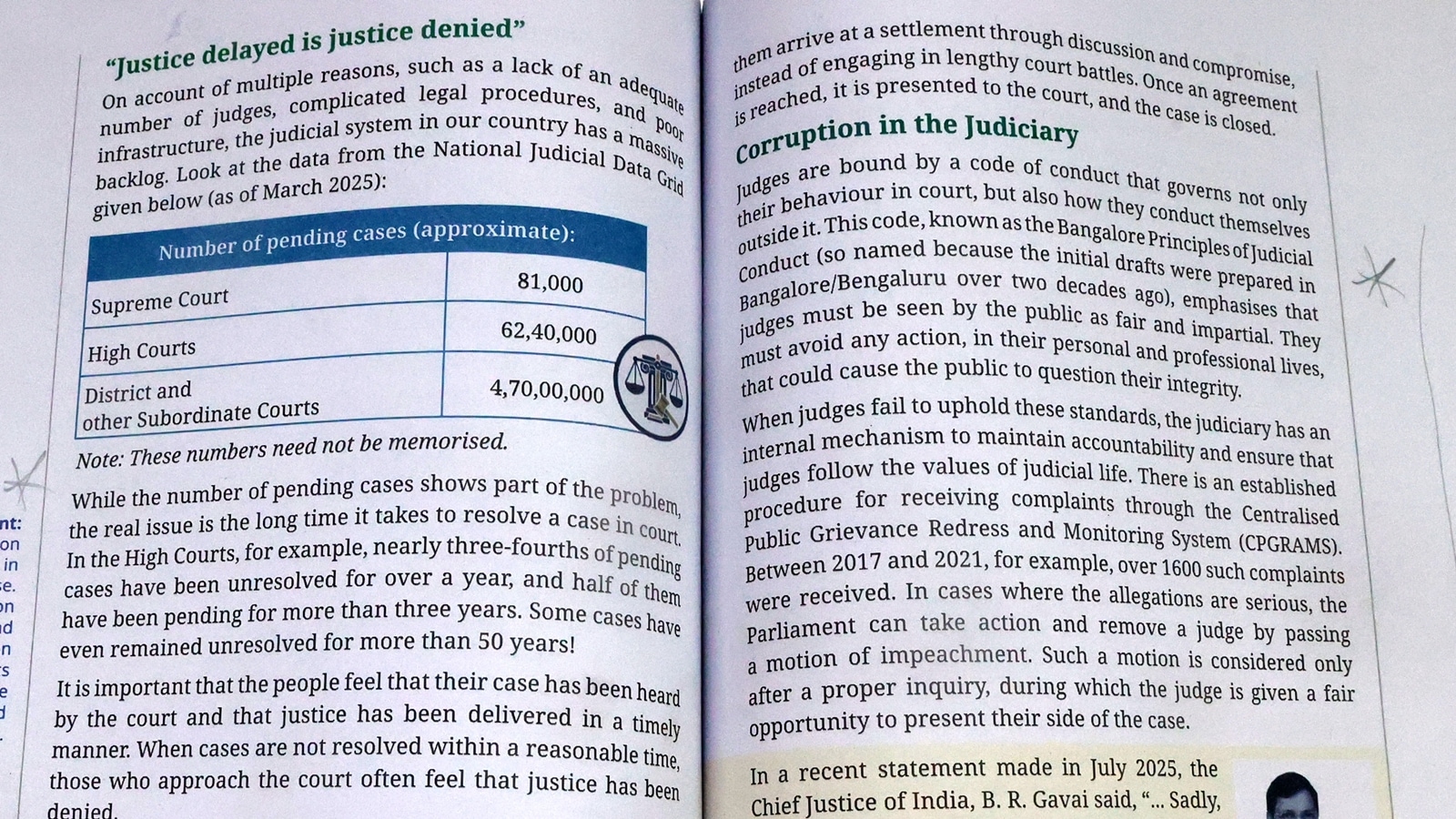 The section in NCERT’s Social Science textbook for Class 8.
The National Council of Educational Research and Training’s (NCERT) new Class 8 Social Science textbook, which had a section on “corruption in the judiciary”, has been pulled out of sale, sources in the Education Ministry confirmed on Wednesday.
Sources said that it was pulled out of sale on Tuesday. On Wednesday, staff at the publication division book counter in the NCERT campus in Delhi said that the book, which was available for sale at the counter on Monday, was no longer available.
The Indian Express had reported on Tuesday that the new book had a chapter on ‘The Role of the Judiciary in Our Society’, which featured a section on challenges faced by the judicial system—corruption, and “massive backlog…on account of multiple reasons, such as a lack of an adequate number of judges, complicated legal procedures, and poor infrastructure”.
Chief Justice of India (CJI) Surya Kant on Wednesday took serious exception to the section on ‘corruption in the judiciary’ and said he “will not allow anyone to defame the institution”.
“I will not allow anyone to defame the institution. I know how to deal with it,” the CJI said, after senior advocates A M Singhvi and Kapil Sibal raised the issue during mentioning hours.
While Singhvi said it was a case of selective portrayal, Sibal said, “We are deeply disturbed, Class 8 students being taught that judiciary is corrupt.”
The CJI said he had received many messages about it. “I have taken cognisance of it. It seems to be a deliberate and calculated measure to…I don’t want to say anything more…,” he said.
Story continues below this ad
The book–‘Exploring Society: India and Beyond’ Part 2–was released on Monday. The section on corruption in the judiciary stated that judges are bound by a code of conduct that governs not only their behaviour in court, but also how they conduct themselves outside it. It referred to the judiciary’s internal mechanism to maintain accountability, and an “established procedure for receiving complaints through the Centralised Public Grievance Redress and Monitoring System (CPGRAMS)”, with over 1,600 such complaints that were received between 2017 and 2021.
“In cases where the allegations are serious, the Parliament can take action and remove a judge by passing a motion of impeachment. Such a motion is considered only after a proper inquiry, during which the judge is given a fair opportunity to present their side of the case,” it stated.
It added: “Nevertheless, people do experience corruption at various levels of the judiciary. For the poor and the disadvantaged, this can worsen the issue of access to justice. Hence, efforts are constantly being made at the state and Union levels to build faith and increase transparency in the judicial system, including through the use of technology, and to take swift and decisive action against instances of corruption wherever they may arise.”
The chapter on the judiciary in the old Political Science book for Class 8 described the role of the judiciary, what an independent judiciary is, the structure of the courts, and access to them and did not mention corruption.





 English (US) ·