

 49 minutes ago
3
49 minutes ago
3
ARTICLE AD BOX
The Supreme Court has observed that cartoons have no place in NCERT textbooks and has appointed a committee led by former judge Justice Indu Malhotra to review such content.
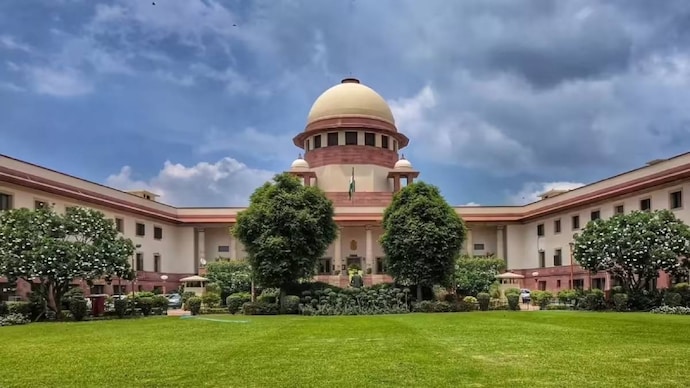
The matter was heard today as a continuation of proceedings arising from an earlier controversy over content in a Class 8 Social Science textbook relating to the judiciary.
New Delhi,UPDATED: May 22, 2026 22:12 IST
The Supreme Court on Friday observed that National Council for Educational Research and Training (NCERT) textbooks are not an appropriate space for cartoons and directed a committee headed by a former judge to review such content.
The observation came during a suo motu hearing before a three-judge bench headed by Chief Justice of India Surya Kant, where Solicitor General Tushar Mehta flagged the presence of cartoons in some NCERT textbooks.
Arguing before the court, the Solicitor General said that while there was no objection to cartoons in general, their inclusion in school textbooks raised concerns as they would be viewed by children of an “impressionable age”.
“It may not be proper to have these cartoons. A textbook is not a place where you use cartoons,” he argues, while raising a broader question of whether satire or lampooning should be part of school learning material.
Accepting the submission, the bench agreed that the issue of propriety of cartoons in NCERT textbooks should be examined by a government-appointed committee headed by former Supreme Court judge Justice Indu Malhotra.
In the past, the court had observed that the “art of satire” should not be judged by a “touchy and hyper-sensitive individual”, but by a reasonable person capable of appreciating its lighter side.
In its 2020 ruling in Indibily Creative (P) Ltd. v. State of West Bengal, the court had highlighted that satire has a “unique ability” to convey ideas quickly and clearly, often in ways other forms of expression cannot.
It had also cautioned that restricting freedom of expression could stifle public debate and undermine the stability of society.
The matter was heard today as a continuation of proceedings arising from an earlier controversy over content in a Class 8 Social Science textbook relating to the judiciary.
Shortly before making the above observation, the court also recalled its earlier remarks concerning three academicians, Professor Michel Danino, Suparna Diwakar and Alok Prasanna Kumar, who had been previously censured in connection with a Class 8 NCERT chapter on corruption in the judiciary that they had drafted.
A bench modified its March 11 order, deleting the direction that barred the Central government, states, universities and other educational institutions from associating with the three experts or engaging them in any capacity.
“In view of the explanation furnished by the applicants, namely the authors, we deem it appropriate to modify paragraph 8 of the order and recall the direction issued to the Government of India, the State Governments, Union Territories, universities, and educational institutions to disassociate themselves from the applicants in academic activities," SC ordered today.
The controversy first emerged in February after reports surfaced about the textbook Exploring Society: India and Beyond (Class 8, Vol. 2), particularly a section discussing “corruption in the judiciary” under a chapter on the role of courts in society.
The Supreme Court had taken suo motu cognisance of the matter, stating that the content undermined the dignity of the judiciary.
Following judicial scrutiny, NCERT issued a press note terming the inclusion of the material an “inadvertent error of judgment” and announced its withdrawal and revision. The court had also ordered a blanket ban on production and distribution of the book.
Subsequently, NCERT withdrew the textbook and apologised for the contentious chapter. The education body also informed the court that experts involved in drafting the material would not be associated further with curriculum or textbook preparation, in compliance with earlier judicial directions.
- Ends
Published By:
Shipra Parashar
Published On:
May 22, 2026 22:11 IST



 English (US) ·