

 1 week ago
6
1 week ago
6
ARTICLE AD BOX
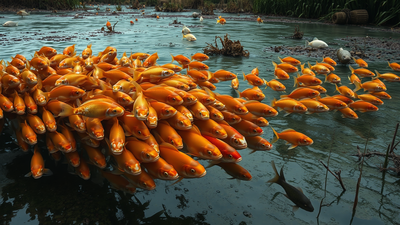
Releasing an unwanted pet goldfish into a local pond or lake might feel like a kind, harmless gesture, but a new experimental study suggests it can trigger lasting damage to the entire ecosystem.
Researchers from the University of Toledo and the University of Missouri built large outdoor mesocosms, controlled artificial ponds designed to mimic lake conditions, and introduced goldfish into two different water types to see what would happen. The results, published in 2026, showed that goldfish consistently pushed both nutrient-poor and nutrient-rich systems toward what ecologists call a regime shift, a sudden, irreversible reorganisation of an ecosystem into a degraded state.
According to the study's authors, the findings carry a warning for pet owners, wildlife managers, and policymakers worldwide.
What the new goldfish study reveals about freshwater ecosystem collapse
The research, titled Invasive goldfish trigger a regime shift in experimental lake ecosystems of varying trophic state and published in the Journal of Animal Ecology, set out to test something that had long been assumed but rarely measured directly: whether goldfish released into the wild can meaningfully alter how a lake functions. Lead author William Hintz, an associate professor in the University of Toledo's Department of Environmental Sciences and Lake Erie Center, worked alongside Rick Relyea of the University of Missouri's Johnny Morris Institute of Fisheries, Wetlands and Aquatic Systems.
According to the the University of Toledo's official statement, the team wanted to provide some of the first rigorous experimental evidence connecting goldfish releases to broader ecosystem damage, rather than relying only on observational data from already-invaded lakes.
How researchers tested goldfish across two different types of lakes
To isolate the effect of goldfish specifically, the team built outdoor mesocosms representing two common lake conditions: oligotrophic systems, which are nutrient-poor with clear water, and eutrophic systems, which are nutrient-rich and prone to algae growth.
They combined additive designs, where goldfish were added on top of existing fish communities, with substitutive designs, where goldfish replaced an equivalent biomass of other fish, allowing them to separate the specific influence of goldfish from the simple effect of adding more fish overall.
This dual approach let the researchers confirm that the most damaging outcomes traced back to goldfish themselves rather than just an increase in total fish density.
Why no lake type is immune to goldfish-driven regime shifts
The clearest warning from the study is that no lake type tested came through unaffected. In nutrient-rich, eutrophic systems, goldfish triggered a rapid breakdown in water clarity and a sharp rise in suspended solids, hallmarks of the kind of regime shift ecologists associate with degraded lake health. Nutrient-poor, oligotrophic systems were not spared either, though the specific pathway of damage differed.
Researchers found that native species declined across multiple trophic levels in both conditions, indicating that goldfish disrupt freshwater food webs broadly rather than affecting only one type of environment, a finding the study's authors say should end any assumption that certain lakes are naturally resistant to goldfish invasion.
How goldfish physically reshape lakes once they escape captivity
Goldfish that survive and grow in the wild bear little resemblance to the small fish sold in pet stores, and that size difference drives much of the damage. According to the University of Missouri, released goldfish can grow into large, bottom-feeding fish that stir up lake sediments as they forage, clouding the water and releasing nutrients that fuel algae growth.
At the same time, these larger goldfish consume substantial numbers of native invertebrates and compete directly with native fish species for food and space. Combined, this sediment disturbance and predation pressure pushed both lake types studied toward the same degraded outcome, even though they started from very different baseline conditions.
Why scientists want goldfish treated as a priority invasive species
Goldfish (Carassius auratus) are among the most widely distributed ornamental fish in the world, sold cheaply and kept casually, which makes accidental or deliberate releases common. The study's authors argue that this combination of popularity and ecological risk means goldfish deserve far more attention from environmental regulators than they currently receive. Once a regime shift occurs in a lake, the researchers note, reversing it is typically difficult and expensive, making prevention far more effective than remediation after the fact.
The team is now urging natural resource managers worldwide to formally classify goldfish as a high-priority invasive species and to invest in prevention, early detection, and control measures before populations become established.









 English (US) ·